Prep & Assembly
Har Gow Crescent Folding
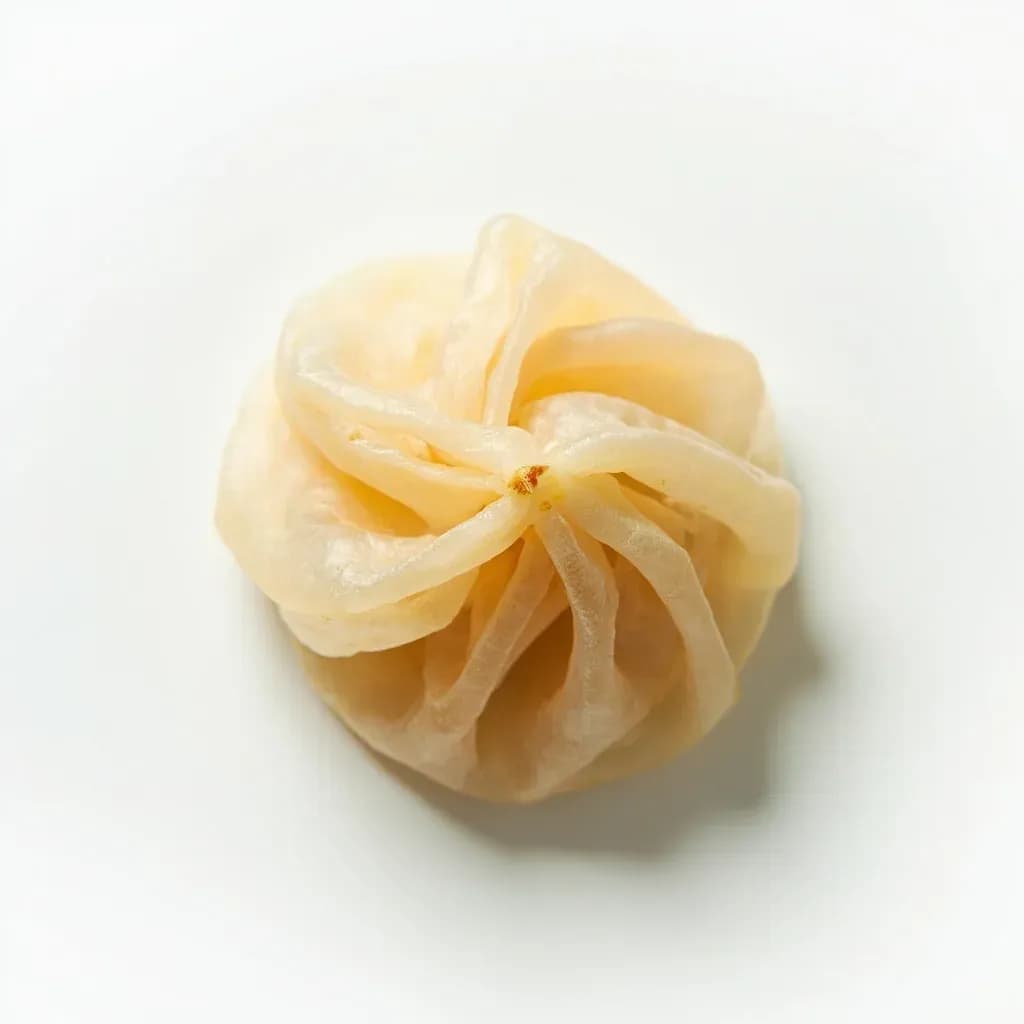
Pleating translucent dumpling wrappers into the classic shrimp har gow crescent.
Har gow folding pleats a thin, translucent wheat-starch wrapper around a shrimp filling into a crescent with many fine folds along one edge. The pleats are pressed only on the top edge so the dumpling sits flat and steams evenly. Achieving 7 to 10 clean pleats in delicate, sticky dough is a benchmark of dim sum skill.
Har gow folding is the Cantonese dim sum craft of pleating a translucent wheat-starch wrapper around a shrimp filling into a half-moon, or crescent, sealed along one curved edge with a row of tight, even ridges. The dumpling is small enough to eat in two bites yet the work is exacting: the wrapper is thin enough to read the pink of the shrimp through it, and the pleated seam must hold against the steam that cooks it. Mastery is judged partly on pleat count and uniformity, which is why a properly folded har gow is treated as a kind of calling card in a dim sum kitchen.
The technique matters because the wrapper is unforgiving. Wheat-starch dough gelatinizes only with hot water, dries in minutes, and tears at the seam if the pleats are loose or the filling is wet. Done well, the dumpling comes out of the steamer glossy, slightly chewy (the Q texture prized in Cantonese cookery), and shaped like a swollen crescent with a clearly ridged belly. Done poorly, the wrapper goes gummy, the filling weeps, or the dumpling springs open in the steamer. Practising har gow folding also teaches the broader discipline of crystal-skin dumplings, because every skill — thin rolling, dry filling, anchored seam, even pleats — applies to vegetarian and luxury variations alike.
- Difficulty
- Hard
Types & varieties
The everyday dim-sum benchmark: smooth back, seven even ridges on the front seam.
A showpiece version made by experienced chefs; more pleats, tighter uniformity, deeper curve.
Synonymous name emphasizing the translucent wrapper; sometimes smaller and served in sets of three or four.
Decorative variant with top edges fanned out rather than fully pinched, exposing more filling.
Modern luxury menu item with shaved truffle, crab meat, or a dot of crab roe or tobiko for color.
A blanched chive or chive-blossom stem knotted around the dumpling as garnish and color accent.
How to do it
- 1
Prepare the dough and wrappers
Make the wheat-starch/tapioca dough by pouring boiling water over the starch blend, stirring with chopsticks until shaggy, then kneading to a smooth, pliable ball. Cover and rest 10–15 minutes. Roll the dough into a thin rope and cut into 8–10 g pieces; roll each piece into a round disc about 8–9 cm across, using a lightly starch-dusted pin and surface. Keep finished wrappers under a barely-damp cloth.
- 2
Portion the filling
Mix chopped or whole shrimp with diced bamboo shoot, seasonings, and a small amount of starch binder. Pat the shrimp dry first. Form the filling into a small log or ball of roughly 18–22 g. Cold filling is easier to wrap.
- 3
Position the filling
Lay a wrapper flat in your non-dominant palm or on a work surface. Place the filling just below center, oriented as a short log parallel to the edge that will become the pleated seam. Leave a clean border on all sides.
- 4
First fold and anchor the center
Fold the wrapper in half over the filling to form a half-moon. Pinch the very center of the seam firmly to anchor it; this point becomes the middle reference for evenly distributed pleats.
- 5
Pleat the left side
Working from the center outward to the left tip, use the thumb and index finger of your dominant hand to pick up tiny folds of the front (top) edge of the wrapper and push them toward the seam. Press each new pleat flat against the previous one. Keep the back (bottom) edge smooth and straight.
- 6
Pleat the right side
Repeat the same motion from the center outward to the right tip, mirroring the pleat count on the left so the dumpling is symmetrical. Press each pleat firmly to seal.
- 7
Close and shape the crescent
Once both sides are pleated, pinch the two tips together to seal the ends and create a gentle curve. Press along the entire seam to ensure no gaps. Cup the dumpling briefly in your hand to even out the crescent and confirm the back is smooth.
- 8
Rest before steaming
Place the pleated dumplings on a parchment-lined tray without touching. Rest 5–10 minutes so the seam sets. If refrigerated, bring back to room temperature before steaming to prevent cracking on contact with steam.
- 9
Steam
Steam over rapidly boiling water for 4–6 minutes on perforated parchment rounds, cabbage leaves, or silicone mats. Do not overfill the steamer; dumplings need a little room to expand. Serve immediately in the bamboo basket.
The 7-pleat standard
Pleat count in Cantonese dim sum is a craft signal as much as a structural one. Seven ridges is what diners and chefs expect on a properly made har gow; trained eyes will clock a five-pleat dumpling as workmanlike and a ten-plus-pleat one as the product of a serious hand. The count matters technically too: more pleats pack more wrapper into the seam, which reinforces the seal against steam pressure. Beginners should aim for seven, then build toward symmetry before adding pleats for show.
- Anchor the center pinch first so pleats distribute evenly left and right.
- Press each new pleat flat against the previous one before moving on.
- Keep the back (bottom) edge smooth and straight; pleats live on the front seam only.
- Don't sacrifice tightness for higher counts — a loose 10-pleat dumpling is worse than a firm 7.
Wrapper chemistry
Har gow's signature translucency comes from scalding wheat starch (and usually tapioca) with boiling water. The heat gelatinizes the starches the way it does in a clear sauce, turning an otherwise opaque flour dough into a glassy, slightly chewy skin. Cold water will not do this — the wrapper stays chalky and dull. Once gelatinized, the dough must be kept under a damp cloth and rolled thin, because dry edges crack during folding and steam into rubbery patches.
- Pour boiling water over the starch blend, stir to a shaggy mass, then knead smooth.
- Rest the dough 10–15 minutes so the starches fully hydrate and the dough relaxes.
- Roll wrappers no thicker than about 1.5 mm for the right translucent, Q-texture result.
- Dust with cornstarch or potato starch, never wheat flour, or the wrapper loses translucency.
Reading a finished dumpling
A correctly folded har gow tells you several things at a glance before you even bite in. The wrapper should be glossy and just-translucent enough to see the pink of the shrimp without seeing individual ingredients. The crescent should be plump but not overstuffed, with a smoothly curved back and an evenly pleated belly. There should be no visible gaps along the seam and no liquid pooling on the plate; both are signs of a filling that was too wet or a seal that was too loose.
- Plump but not bursting: roughly 18–22 g of filling per 8–9 cm wrapper.
- Visible pleats, even spacing, mirrored left and right of the center pinch.
- No cloudy white patches on the wrapper, which indicate undercooked or under-scalded dough.
- Slight tackiness is fine; a slippery or weeping dumpling is not.
Common uses
Tips & pitfalls
- Keep unrolled and rolled wrappers under a barely-damp cloth at all times; wheat-starch wrappers dry out and crack within minutes of exposure.
- Dust hands and the work surface with cornstarch or potato starch rather than flour — wheat flour clouds the wrapper and dulls its translucency.
- Pat the shrimp filling dry before wrapping; excess water turns the wrapper gummy and can blow a seam open during steaming.
- Place the filling slightly off-center as a small log parallel to the seam edge; this gives a clean crescent and the correct filling-to-wrapper ratio.
- Anchor the center of the fold with a firm pinch before pleating outward; without that anchor, pleats migrate and the dumpling ends up lopsided.
- Press each pleat flat against the previous one and against the filling before moving on; loose pleats open under steam and let water in.
- Aim for at least seven visible, even pleats on the front seam; dim-sum cooks judge a har gow partly by pleat count and symmetry.
- Steam over a rolling boil, not a gentle simmer — vigorous steam sets the wrapper quickly and helps it hold its ridged shape.
Good to know
- Technique type
- Hand pleating and sealing a wheat-starch wrapper around a shrimp filling into a crescent with a ridged seam.
- Cuisine
- Cantonese dim sum (yum cha)
- Region of origin
- Pearl River Delta tea houses in the outer areas of Guangzhou and Huizhou, early 20th century.
- Wrapper
- Wheat starch (ding fun) blended with tapioca starch, scalded with boiling water for translucency; sometimes a small amount of lard or oil for pliability.
- Classic pleat count
- Seven pleats is the dim-sum benchmark; experienced chefs produce nine to thirteen.
- Wrapper size
- Round discs about 8–9 cm (3–3.5 in) across, hand-rolled from a thin dough rope.
- Steaming time
- 4–6 minutes over vigorously boiling water, on perforated parchment, cabbage leaves, or silicone mats.
- Difficulty & pace
- Intermediate; about 15–30 dumplings per hour once proficient.
Also called
Har Gao Folding · Shrimp Dumpling Folding
Related

Whisk
Beat ingredients smooth and aerated with a looping wire motion

Sift
Pass dry ingredients through mesh to aerate and remove lumps

Strain
Pour through mesh to separate solids from liquid for a smooth result

Filter
Pass liquid through fine material to clarify out the smallest particles

Rice
Press cooked potatoes through small holes for fluffy, lump-free texture

Mash
Crush soft cooked food into a rustic, creamy purée

Grind
Crush food into a coarse to fine texture, from spices to meat

Grate
Shred food into fine bits against a sharp-toothed surface