Water & Steam
Mustard-Hot Gravy (Jhal)
Bengali gravy built on pungent ground mustard paste for a sharp, fiery heat.
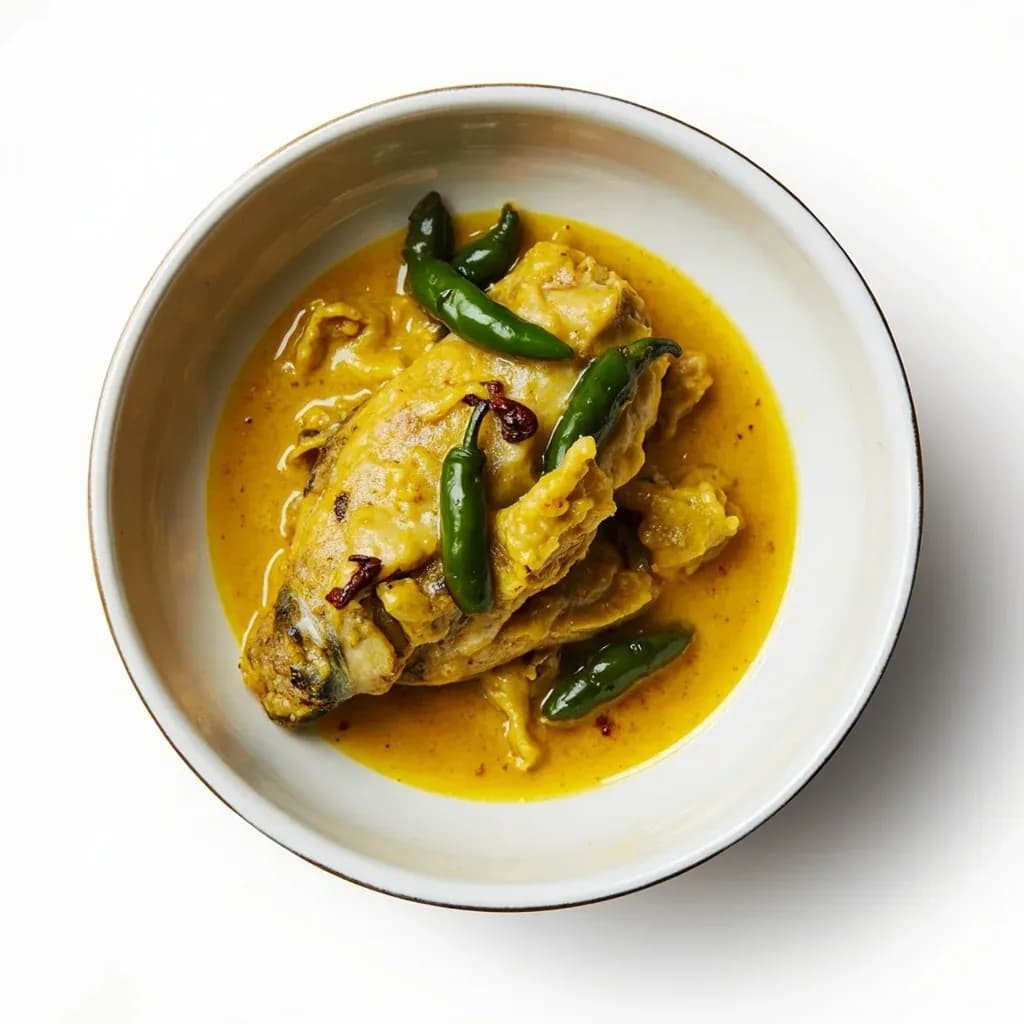
Jhal is a Bengali style of spicy gravy whose heat comes from ground mustard seed paste and green chilies rather than dried red chili. The mustard is ground fresh and simmered with fish or vegetables to make a pungent, nose-tingling sauce, classically used in dishes like shorshe maach. The mustard must be handled carefully, as over-grinding or overheating turns it bitter.
Jhal (ঝাল) is less a single dish than a finishing technique — the Bengali way of finishing a gravy with freshly ground black mustard paste so that the sharp, sinus-clearing pungency of allyl isothiocyanate rides on top of the dish rather than cooking away into the background. In Bengali home cooking, jhal sits beside bhaja, bhaape, chorchori, and tok as one of the recognized flavor families, and a Bengali cook is expected to know, with the same instinct, when to reach for mustard paste, when to steam with it, and when to leave it alone.
The technique is defined by two non-negotiable rules. First, the mustard paste is added in the last two or three minutes of cooking only — prolonged heat volatilizes the very compounds that give jhal its identity, leaving a flat, dull gravy that tastes of nothing in particular. Second, the seeds are ground with a splash of warm (not hot) water to activate myrosinase, the enzyme that liberates the pungent isothiocyanates, before the paste is stirred into the simmering gravy to finish. Everything else — the protein, the vegetables, the supporting spices — is built to frame that final mustard hit without competing with it.
In practice, jhal is a fat-based finishing method that uses a small amount of added water only to create the gravy the mustard paste will finish. The mustard oil it is traditionally built in is heated to a smoking haze to soften its raw bite, then tempered with nigella and dried red chili (not a full panch phoron, whose fenugreek and fennel would clash), and the mustard paste is stirred in at the end so the pungency arrives on the plate intact.
- Difficulty
- Medium
Types & varieties
The everyday home-style jhal; built on golden-fried potato wedges, the benchmark dish for the technique
Prawn jhal; shell-on prawns give body to the gravy and may be enriched with a little coconut paste
Fish jhal, classically rohu (rui) or hilsa (ilish); a lighter, more refined version with less water
Hard-boiled egg halves simmered in mustard gravy; the quickest weeknight jhal
Chicken jhal, with or without bone; richer and longer-cooked than the seafood versions
Okra jhal; the vegetable's natural mucilage thickens the gravy
Potato and prawn together — considered a complete one-pot meal with rice
Brinjal/eggplant jhal, often with the vegetable scored and shallow-fried before joining the gravy
How to do it
- 1
Soak and grind the mustard paste
Soak 2 tablespoons of black mustard seeds in warm water for 15–20 minutes. Drain, then grind with 2–3 slit green chilies and 1–2 tablespoons of water (or a teaspoon of mustard oil) to a thick, smooth, almost spoonable paste. Set aside at room temperature — do not refrigerate, which dulls the pungency.
- 2
Smoke the mustard oil
Heat 3–4 tablespoons of mustard oil in a heavy kadai or deep pan over medium heat until it just begins to smoke. Lower the heat and let it cool 10 seconds. (Skip this step if using a neutral oil; smoked mustard oil is the traditional base.)
- 3
Temper with kalo jeera and dried chili
Add 1/2 teaspoon of nigella seeds (kalo jeera) and 1–2 broken dried red chilies to the hot oil. Let them sizzle 10–15 seconds — the seeds should crackle, not darken. Avoid a full panch phoron here; its fenugreek and fennel clash with the mustard's sharpness.
- 4
Build the onion base
Add 1 cup of finely sliced or pasted onions with a pinch of salt. Sauté 6–8 minutes until soft and lightly golden at the edges. Stir in 1 teaspoon of ginger paste (and 1/2 teaspoon garlic paste, if using) and cook 1 minute more.
- 5
Bloom the dry spices
Add 1/2 teaspoon turmeric, 1/2–1 teaspoon red chili powder, and salt to taste. Stir into the oil for 20–30 seconds — the mixture should look glossy and smell toasted, not raw and dusty.
- 6
Add the anchor ingredient
Add 500 g of your main ingredient — potato wedges pre-fried to a golden crust, shell-on prawns, fish steaks, halved hard-boiled eggs, or chicken pieces. Toss to coat and sear 2–3 minutes so the surface picks up the spice base.
- 7
Add water and simmer
Pour in 1 to 1.5 cups of water (more for fish, less for potato). Bring to a simmer, partially cover, and cook until the main ingredient is nearly done — about 8 minutes for prawns, 10–12 for potatoes or chicken, 6–8 for fish.
- 8
Finish with mustard paste
Stir the prepared mustard paste into the gravy along with 1–2 fresh slit green chilies. Simmer gently, uncovered, for 2–3 minutes — just enough to cook off the raw paste flavor, not enough to flatten the pungency. A tight lid will trap steam and dull the dish; keep it loose or off.
- 9
Rest and serve
Remove from heat, cover loosely, and rest 5 minutes. The gravy should coat a spoon and the pungency should smell integrated, not raw. Serve with steamed white rice and a fried side such as beguni or fish fry.
The chemistry of mustard heat
The bite in jhal is not chili heat. It is the volatile, almost nose-clearing pungency of allyl isothiocyanate, a compound that does not exist in the whole seed — it is created on the spot when the seed is crushed. Inside each mustard seed, the enzyme myrosinase and its substrate (a glucosinolate called sinigrin) are stored in separate cells. Soaking in warm water and grinding brings them together; myrosinase cleaves sinigrin and releases allyl isothiocyanate within seconds. Two consequences follow for the cook: the water used to soak and grind must be warm, not hot (hot water deactivates myrosinase and you lose the pungency entirely), and the finished paste must be cooked only briefly, because allyl isothiocyanate is volatile and boils off in a few minutes. This is why jhal is a finishing move, not a base spice.
Where jhal sits in the Bengali kitchen
Bengali cooking recognizes a small set of distinct flavor finishes, and a fluent cook moves between them depending on the ingredient, the season, and the time available.
- Bhaja — pan-fried, often as a dry side (beguni, peyaji, fish fry)
- Bhaape — steamed with a mustard-and-coconut paste, the lightest expression of mustard
- Chorchori — mixed-vegetable stir-fry with a small amount of spice paste
- Jhal — wet clinging gravy finished with raw mustard paste
- Tok — sour-tangy finish, built on tamarind or raw mango, no mustard
- Doi-macher, kalia, dopiaza — the richer, Mughal-leaning curries that sit outside the mustard family
Common uses
Tips & pitfalls
- Soak black mustard seeds in warm (not hot) water for 15–20 minutes before grinding; hot water deactivates myrosinase and kills the pungency at the source.
- Add the mustard paste in the final 2–3 minutes of cooking only. Prolonged heat volatilizes the isothiocyanates and leaves the dish flat and dull — the single most common jhal failure.
- Grind the mustard with a green chili and a splash of water or mustard oil; the paste must be thick and almost spoonable, never a dry crumb, or it will sit on top of the gravy and taste raw.
- Use black or brown mustard seeds; yellow mustard is a different species and noticeably milder, and will not give an authentic jhal.
- Smoke the mustard oil to a haze before adding aromatics — this tempers its raw bite and adds a toasted base note that neutral oils cannot replicate.
- Temper with kalo jeera (nigella) and dried red chili, not a full panch phoron; fenugreek and fennel in the five-spice blend clash with mustard's sharpness.
- Rest the finished dish off-heat for 5 minutes before serving so the pungency settles into the gravy rather than sitting raw on the surface.
- If the mustard reads harsh, a pinch of sugar or a small spoonful of tomato can round the edges — but use sparingly, because the bite is the point of the dish.
Good to know
- Origin
- Bengal (eastern India and Bangladesh)
- Cuisine
- Bengali home cooking
- Primary pungent agent
- Freshly ground black mustard seed paste (rai bata / sorisha bata)
- Mustard variety
- Black or brown mustard (Brassica nigra / juncea); yellow mustard is not traditional
- Traditional cooking fat
- Mustard oil (sarson tel), heated to a smoking haze
- Signature tempering
- Nigella seeds (kalo jeera) and broken dried red chilies
- Heat chemistry
- Isothiocyanates (mainly allyl isothiocyanate), released from glucosinolates by the enzyme myrosinase when seeds are crushed with water
- Texture
- Wet, clinging gravy — never dry, never soupy
- Color
- Pale gold to deep saffron, set by turmeric and chili powder
- When the paste goes in
- Last 2–3 minutes of cooking only, off a hard boil
- Category
- Filed under 'Water & Steam' for braising-liquid purposes, though jhal is fundamentally an oil-and-gravy finish technique
Also called
jhal · mustard gravy
Related

Boil
Cook in vigorously bubbling liquid at full rolling heat

Simmer
Hold liquid at a gentle shimmer for tender, unhurried cooking

Poach
Cook gently in barely-trembling liquid for silky, tender results

Steam
Cook in rising vapor to keep color, nutrients, and shape intact

Blanch
Plunge briefly in boiling water, then shock cold to lock color

Braise
Sear, then cook slow in a little liquid until fall-apart tender

Stew
Simmer bite-sized pieces fully submerged into a rich, unified pot

Sous-Vide
Seal and cook in precise warm water for edge-to-edge doneness