Prep & Assembly
Lomi (Hand-Massaging / Mixing)
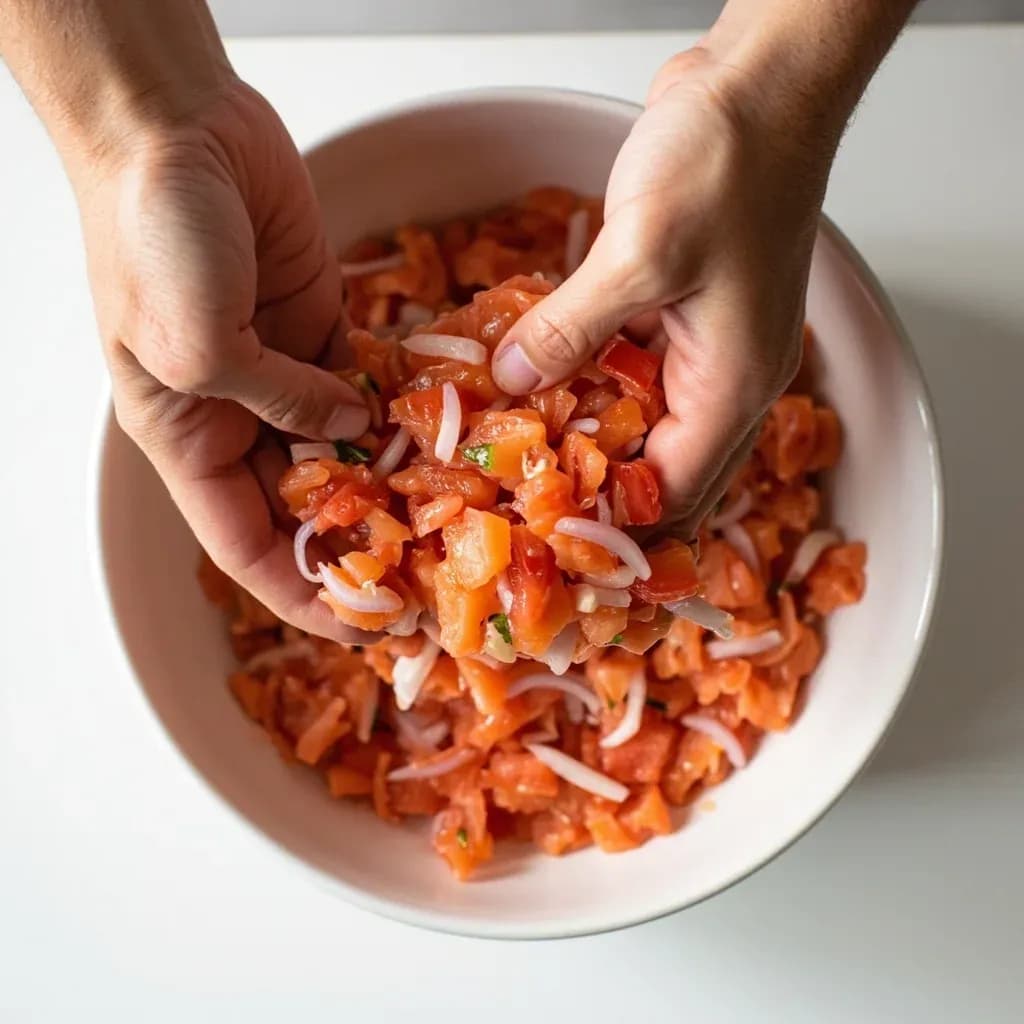
Massaging ingredients by hand to break them down and blend flavors evenly.
Lomi, from the Hawaiian for to massage, works ingredients between the fingers to soften, mix, and meld them, as in lomi-lomi salmon where salted fish, tomato, and onion are kneaded together. The same hand action is used to relax noodle dough (momi) or to wilt and season greens. The warmth and pressure of hands distribute salt and release juices that a spoon cannot.
Lomi is a hand-working technique in which ingredients are pressed, rolled, and broken apart between the pads of the fingertips rather than cut with a knife. From Hawaiian (ʻōlelo Hawaiʻi), the verb literally means to massage, knead, or rub, and it is most famously expressed in lomi-lomi salmon, where salted fish is rubbed apart with ripe tomatoes and onions until a loose, juicy salad forms. The defining feature is that the cook's hands replace both the knife and the mixing spoon, controlling the size of each piece by feel and coaxing the ingredients to release their natural juices in the bowl.
The technique matters because it produces a texture no mechanical tool can quite replicate. Finger pads apply uneven, gentle pressure, so ingredients end up as small, irregular fragments suspended in a light, self-made dressing — neither a uniform chop nor a purée. That middle ground is what gives lomi-lomi salmon its character: distinct flakes of fish, pebbly tomato pieces, and translucent onion shards resting in a pool of pink, savory juice.
Beyond the classic Hawaiian dish, lomi is a useful general method whenever you want to break down ingredients by feel, distribute salt evenly, or wilt and season sturdy produce. It is fast, quiet, and forgiving — a low-tech technique that rewards a cook with a good sense of touch more than a sharp blade.
- Difficulty
- Easy
Types & varieties
The canonical Hawaiian preparation: salted salmon rubbed apart with ripe tomatoes and onions into a juicy, loose salad.
Used on sturdy greens (kale, cabbage) and firm vegetables; salt is worked in by hand to wilt and season the leaves.
Used for dishes like lion's head meatballs or Salisbury-style patties, where tossing and smearing the meat between the palms develops a tender, bouncy bind.
A softer application: ripe tomatoes, avocado, or stone fruit gently lomi-ed with salt and aromatics for chunky salsas and crudo-style toppings.
Citrus or salt is massaged into raw seafood or thinly sliced vegetables to draw out moisture and lightly set the proteins.
How to do it
- 1
Prep the bowl and ingredients
Choose a non-reactive bowl (glass, ceramic, or wood) large enough to work in with both hands. Cut the tomatoes, onions, and any firm vegetable into roughly 1-inch pieces so they break down evenly under the fingertips. If using cured salmon, cut it into 1- to 2-inch chunks and pat the surface dry.
- 2
Start with the firmest ingredient
Place the cured salmon in the bowl alone. Press and roll it between the pads of your fingertips, turning the pieces over, until the flesh separates into small, loose flakes — about 1 minute. There should be no large chunks left and no smeared paste.
- 3
Add the softer ingredients
Add the tomatoes, onions, and any aromatics (chili, scallion) to the bowl. Continue to lomi, pressing the tomatoes against the side of the bowl so they burst and release their juice while still keeping small, visible pieces. Work another 1–2 minutes, turning the mixture over so the juice coats everything.
- 4
Blend, season, and rest
Fold the mixture gently between your fingers to even out the distribution of fish, tomato, and onion. Taste and adjust with salt, chili, or a squeeze of citrus. Let the bowl sit 5–10 minutes at cool room temperature (or chilled) so the flavors meld and the juices settle.
- 5
Stir and serve
Stir once more with a spoon just before serving. Do not drain the pooled juices — they are the dressing. Serve chilled or at cool room temperature, traditionally as part of a Hawaiian plate lunch alongside rice, poi, or grilled meat.
Reading the texture: when to stop
Lomi is governed by feel rather than time, which can unsettle cooks who prefer a timer. The reliable signal is the mixture itself: stop when the firmest ingredient (fish, kale rib, ground meat) has been reduced to roughly pea-sized bits, the softer ingredients are in pieces you can still see, and a thin layer of liquid has pooled at the bottom of the bowl. If you keep going past that point, the tomatoes lose their shape and the whole mixture slides toward a sauce. It is always easier to lomi a little more than to undo a purée, so err on the side of restraint — you can finish with a spoon.
- Stop when the largest pieces are about the size of a pea.
- Stop as soon as the bowl shows a sheen of released juices.
- The mixture should look loose and rough, not glossy or homogeneous.
- A second, gentler pass is safer than one long, heavy one.
Choosing the salmon for lomi-lomi
Traditional Hawaiian lomi-lomi salmon is built around ʻiʻa paʻakai, salmon that has been salt-cured and sometimes lightly fermented until deeply savory and almost silky. Outside Hawaii, that flavor is approximated with gravlax, a salt-and-sugar-cured salmon, or with smoked salmon (lox) for a softer, rounder result. Whichever you choose, the fish should be cold and reasonably firm so it breaks into flakes rather than smearing; very oily or freshly smoked pieces can turn to paste under the fingertips.
- Gravlax is the most common substitute for ʻiʻa paʻakai; it lomis cleanly and seasons the dish with salt and dill.
- Cold-smoked salmon (lox) works but is more delicate; lomi briefly and gently to avoid mushing.
- Skip hot-smoked salmon unless you plan to flake it very coarsely; it tends to disintegrate.
- Always chill the fish and the bowl beforehand — cold hands keep the fat firm.
Common uses
Tips & pitfalls
- Use only the pads of the fingertips, not the whole hand or the palm — this gives control and prevents crushing ingredients into a paste.
- For fish applications, chill your hands, the bowl, and the salmon beforehand; cold hands slow fat breakdown and keep the texture loose rather than mushy.
- Add salt early when massaging greens; it draws water out of the leaves and helps them wilt evenly within a minute or two.
- For ground meat, lift and smear the meat against the side of the bowl repeatedly; this develops myosin for a springy, tender bind without overworking the proteins.
- Stop as soon as the mixture looks evenly combined and the ingredients are broken to the size you want — over-lomi-ing turns a chunky texture into a purée.
- Keep nails short and clean; the technique relies on direct hand contact, and a stray nail can shred delicate ingredients like fish or ripe tomato.
- If the dish feels dry toward the end of lomi-ing, add a small splash of lemon juice, brine, or the ingredient's own released juices rather than more oil, which would weigh the dish down.
- Reserve a few of the prettiest tomato and onion pieces to fold in at the end for visible texture in the finished dish.
Good to know
- Origin
- Hawaiian (ʻōlelo Hawaiʻi); the verb means to massage, knead, rub, or work between the fingers.
- Closely related term
- Lomi-lomi — used either as the verb form or as the noun for the resulting dish (e.g., lomi-lomi salmon / lomi iʻa).
- Classic application
- Hawaiian lomi-lomi salmon: salted salmon broken apart by hand and combined with ripe tomatoes and onions.
- Body part used
- Pads of the fingertips, occasionally the heel of the hand for sturdier work like ground meat.
- Texture goal
- Small, irregular bits — not puréed — with natural juices forming a light dressing in the bowl.
- Typical ratio (lomi-lomi salmon)
- Roughly equal parts salted salmon to ripe tomato, with about one-quarter as much onion by volume; chili is optional.
- Time
- Usually 2–5 minutes of active massaging for a typical bowl.
- Equipment
- A non-reactive bowl (glass, ceramic, or wood) and clean hands; no knife needed for the breaking step.
Also called
Hand-Massaging Noodles (Momi)
Dishes that rely on it
Related

Whisk
Beat ingredients smooth and aerated with a looping wire motion

Sift
Pass dry ingredients through mesh to aerate and remove lumps

Strain
Pour through mesh to separate solids from liquid for a smooth result

Filter
Pass liquid through fine material to clarify out the smallest particles

Rice
Press cooked potatoes through small holes for fluffy, lump-free texture

Mash
Crush soft cooked food into a rustic, creamy purée

Grind
Crush food into a coarse to fine texture, from spices to meat

Grate
Shred food into fine bits against a sharp-toothed surface