Heat & Fire
Mallung (Shredded-Greens Stir-Fry)
A quick Sri Lankan stir-fry of finely shredded greens with grated coconut, onion, and spices.
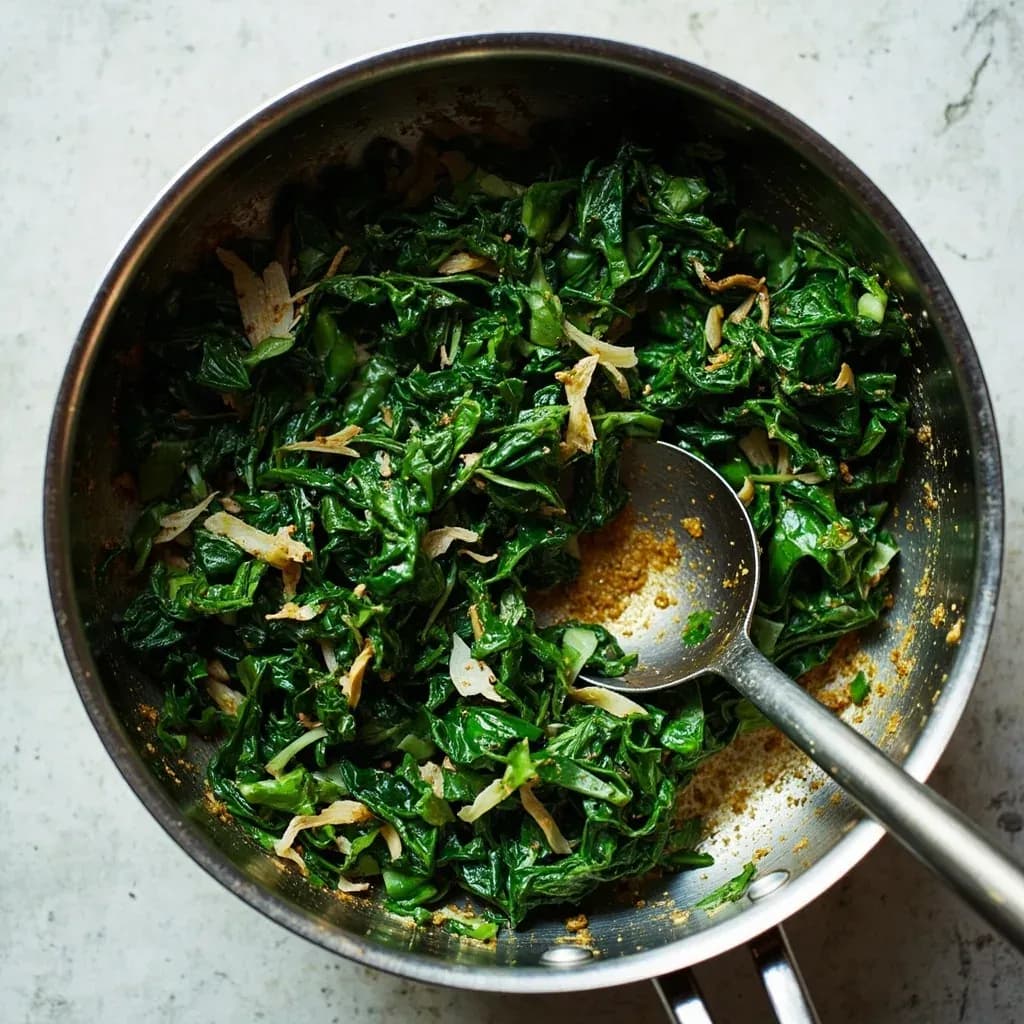
Mallung is the Sri Lankan technique of briefly stir-frying very finely shredded leafy greens with freshly grated coconut, onion, chile, and turmeric. The greens are cooked fast over high heat so they wilt but keep their color and freshness, while the coconut adds richness and bulk. It is a light, nutritious side that turns humble greens into a fragrant dish in minutes.
Mallung (also spelled mallum, malung, or malu) is a Sri Lankan technique for handling leafy greens and other vegetables so quickly that the ingredient barely knows it has been cooked. The defining moves are three: shred the greens almost to a mince, give them less than two minutes in a hot pan with aromatics, and fold in freshly grated coconut off the heat with a squeeze of lime. The result is a loose, dry, brightly green side dish that sits beside rice and curry the way a chopped salad might sit beside a roast — as a cooling, textural counterpoint rather than another saucy vegetable. It belongs to both Sinhalese and Sri Lankan Tamil cooking and is so fundamental that the dish is best understood as a method rather than a single recipe.
What makes the technique worth learning is what it preserves. Most stir-fries drive water out of greens, dull their color, and collapse them into a wet tangle. Mallung avoids all three by leaning on extremely fine shredding (which exposes surface area quickly), a wide hot pan (so moisture flashes off as steam), and the dry, absorbent mass of fresh coconut (which soaks up any liquid that does escape). The aromatics — curry leaves, green chili, shallot or red onion tempered in coconut oil — carry almost all of the flavor, while Maldive fish (dried, smoked tuna flakes, called umbalakada in Sinhala) is the optional umami accelerator. Acid goes in last, and only off heat, both for brightness and to keep the chlorophyll green.
In practice, mallung is forgiving in proportion but strict in execution: once the greens are cut fine enough, the dish essentially makes itself in under five minutes. The closeness of related dishes — Kerala's thoran and the broader South Indian poriyal tradition — is real, but those cousins usually cook the coconut briefly with the greens, which gives a softer, slightly greasier result. The Sri Lankan discipline of folding coconut in cold is what keeps mallung dry, fluffy, and almost confetti-like in the mouth.
- Difficulty
- Easy
Types & varieties
Made with Centella asiatica (pennywort); one of the most traditional Sinhalese versions, slightly mineral in flavor
Moringa or drumstick leaves; earthier and faintly peppery, a protein-rich staple
Shredded cabbage as the base; the everyday home and restaurant version across Sri Lanka
Modern adaptation; holds up well but benefits from a slightly longer wilt than softer greens
Cooks fastest of all; use mature spinach rather than baby to avoid a soggy result
Uses beet greens; the coconut turns a striking pink-magenta from the pigments
Shredded carrot replacing greens; same technique, slightly sweeter profile
With mung bean sprouts; the lightest, crunchiest version, almost no cooking at all
How to do it
- 1
Wash and dry the greens
Rinse the greens in several changes of cold water. Spin in a salad spinner or pat thoroughly with a clean towel — moisture clinging to the leaves is the single most common reason mallung turns soggy and dull.
- 2
Shred very finely
Stack or roll the leaves tightly and slice crosswise into thin ribbons, then turn the bundle 90 degrees and cut again into a cross-hatch. The pieces should look almost minced. A mezzaluna over a wooden board is the classic home shortcut; a food processor with brief pulses works in a pinch but tends to bruise the leaves.
- 3
Prepare the coconut and aromatics
Finely chop or thinly slice a small red onion or 2–3 shallots, 2–3 green chilies (split lengthwise if you want more heat), and a small handful of curry leaves. Grate about half a cup of fresh coconut — roughly half the volume of the greens. If using Maldive fish, crush a tablespoon to a fine powder in a mortar or with the back of a knife.
- 4
Temper the aromatics
Heat 1 tablespoon coconut oil (or a neutral oil) in a wide pan over medium heat. Add the curry leaves, green chilies, and onion and sauté 30–60 seconds, just until the onion turns translucent and the leaves smell toasted — not browned.
- 5
Add the greens briefly
Tip in all the shredded greens with a small pinch of salt. Toss continuously for 45–90 seconds until they are just wilted and still vividly green. They should look almost raw; if they look cooked, you have gone too far.
- 6
Fold in the coconut off heat
Pull the pan off the burner. Add the grated coconut (and the Maldive fish powder, if using). Toss and fold — this is the literal 'mallung' action — until the coconut is evenly distributed through the greens.
- 7
Finish and serve
Squeeze in fresh lime juice to taste, give one final toss, and serve immediately. The dish should be loose, dry, and fragrant, never sitting in liquid. Covering the pan after cooking will trap steam and turn the greens olive-grey, so serve right away or leave uncovered.
The three rules that make mallung work
Get the proportions and timing right and almost any green will yield a good mallung. The technique is built on three non-negotiables:
- Shred finer than feels reasonable. The pieces should read as confetti or coarse sand, not ribbons. This is what lets the greens wilt in under two minutes without going watery.
- Cook briefly, in a wide pan, with the lid off. A crowded pan will steam the greens instead of flash-frying them, turning them olive and limp.
- Fold the coconut in cold. The moment the pan leaves the heat, the coconut goes in — it softens from residual warmth without absorbing oil or going mushy.
Regional cousins and what makes mallung different
The closest relatives of mallung come from across the Palk Strait, and the differences are instructive rather than trivial.
- Kerala thoran uses the same coconut-and-greens pairing but typically sautés the coconut briefly with the greens, giving a softer, more cohesive (and slightly greasier) result.
- Tamil Nadu poriyal shares the off-heat coconut fold and is the closest structural match; Sri Lankan mallung tends to shred even more finely and finishes with lime more reliably.
- Sri Lankan Tamil 'poriyal' tradition (the local usage of the term) is essentially the same dish, confirming how deeply this technique is shared across the island's communities.
Working ratio to remember
If you learn only one number, learn this one. It scales to any green and any pan size.
- Roughly 2 parts finely shredded greens to 1 part freshly grated coconut by volume.
- Onion or shallot making up another small portion — about a quarter of the greens volume.
- Curry leaves, green chili, salt, oil, and lime scaled by feel; Maldive fish, if used, at roughly 1 tablespoon per 4 cups of greens, crushed to powder.
Common uses
Tips & pitfalls
- Shred the greens finer than feels reasonable — the texture should read as almost confetti, not ribbons. This is what lets them wilt in under two minutes.
- Use freshly grated coconut; desiccated coconut is a clear downgrade. If you must use it, rehydrate it in a tablespoon of warm water for 5 minutes first so it does not steal moisture from the dish.
- Temper the aromatics first and let the pan cool briefly before adding greens — letting the heat drop slightly preserves color better than a hard sear.
- Do not overcook: greens should be just wilted and still vivid green, typically 60–90 seconds in the pan. Past two minutes, mallung becomes 'cooked greens' and loses its character.
- Add lime juice off heat only. Acid added during cooking dulls the chlorophyll green and mutes the brightness the dish depends on.
- If using Maldive fish, crush it to a powder and toss it in with the raw coconut so it distributes evenly without overpowering any single bite.
- Salt lightly. The coconut and lime do most of the seasoning work; over-salted mallung tastes flat and heavy.
- Avoid covering the pan after cooking — trapped steam will turn the greens olive-grey within minutes.
Good to know
- Origin
- Sri Lanka; common to both Sinhalese and Sri Lankan Tamil home cooking
- Name variants
- Mallung, mallum, malung, malu — all refer to the same mixed/shredded technique
- Etymology
- From Sinhalese 'malu' meaning 'mixed'; refers to the folding/tossing motion used to combine greens and coconut
- Defining element
- Finely shredded greens folded with freshly grated coconut and aromatics off heat
- Cooking time
- Under 5 minutes total once prepped; greens wilt for only 45–90 seconds
- Shredding style
- Very fine, almost minced — cross-hatch slicing or a mezzaluna on a board
- Traditional tools
- Curved 'kathi' blade, cylindrical 'wattiya' chopper, and coconut scraped on a 'hiraman' (serrated stool-blade)
- Coconut
- Freshly scraped or grated; desiccated coconut is a clear downgrade
- Heat level
- Mild; green chilies and curry leaves add fragrance more than heat
- Optional umami
- Maldive fish (umbalakada), dried shrimp, or dried anchovies, crushed to a powder
- Finish
- Lime juice added off heat; salt used sparingly
- Texture target
- Loose, dry, and fluffy — never saucy or wet
Also called
stir-frying-mallung · shak-stir-frying · Mallum
Related

Sear
Blast the surface hot for a deep-browned, savory crust

Sauté
Cook quickly in a little fat over lively heat, tossing as you go

Stir-Fry
Toss bite-sized pieces over roaring heat for fast, smoky cooking

Pan-Fry
Crisp food in a shallow layer of hot fat, turning once or twice

Deep-Fry
Submerge in hot oil for an all-over crackling crust

Roast
Cook uncovered in dry oven heat for browned edges and tender centers

Bake
Cook with steady, surrounding oven heat — the soul of bread and pastry

Broil
Hit food from directly above with fierce overhead heat