Knife Skills
Medium Dice
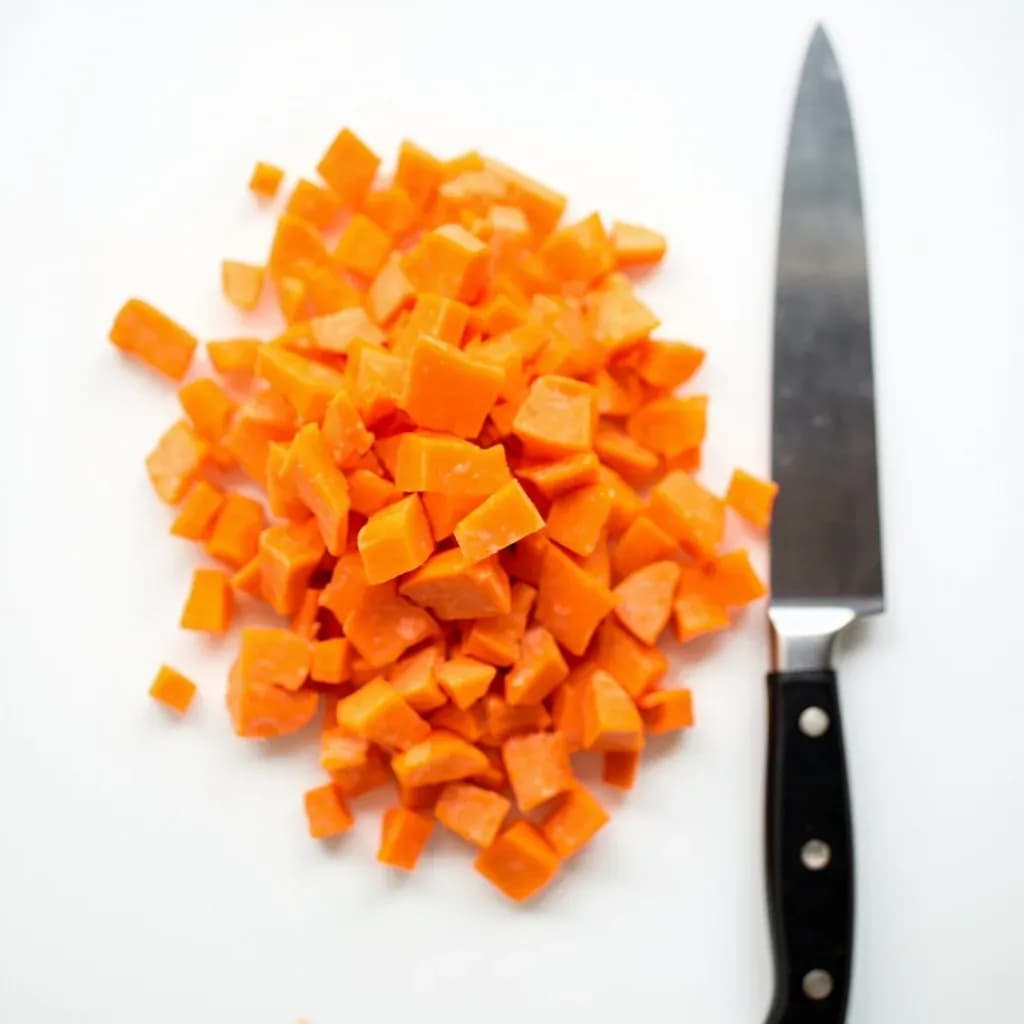
Cutting food into uniform cubes about one centimeter on each side for even cooking.
Medium dice produces uniform cubes roughly 1 cm (about half an inch) per side, between the larger large dice and the finer small dice. The even size ensures pieces cook at the same rate and look consistent in stews, mirepoix, salsas, and roasted vegetable mixes. It starts by squaring off the food into planks, then sticks, then crosscutting the sticks into cubes.
Medium dice is the workhorse cube of the professional kitchen — uniform pieces roughly 1/2 inch (about 1 to 1.5 cm) on each side, cut from a vegetable, fruit, or other firm ingredient that has first been squared off into a stable block. In classical French cooking the same cut is called macedoine, and the word is still used for a mixture of vegetables prepared this way. It sits squarely in the middle of the standard dice hierarchy, between the brunoise (3 mm) and the large dice (about 2 cm), and is the size most home cooks reach for without thinking about it.
Uniformity is the whole point. When pieces are the same size, they cook at the same rate, so a sauté of carrots, celery, and onion will soften together rather than leaving you with crunchy carrot and mushy onion. Beyond even cooking, consistent dice gives a finished dish visual rhythm — a stew or a pasta sauce looks intentional rather than accidental — and it controls how the ingredient behaves in the mouth. Medium dice is large enough to hold its shape through a long simmer yet small enough to become tender in a 10-minute sauté, which is why it shows up everywhere from a basic mirepoix to a quick weeknight curry.
The cut itself is built on a simple principle: square the ingredient into a block, then slice it into planks, strips, and finally cubes. The first step is the one most home cooks skip, and it is the one that makes the rest of the work faster, safer, and more even. Once you have flat faces to work against, the dice almost cuts itself.
- Difficulty
- Easy
Types & varieties
3 mm cubes; the smallest classic dice, used as garnish and in clear soups and consommés
About 6 mm (¼ inch); finer than medium dice, used in quick sautés and sauces
About 1–1.5 cm (½ inch); the everyday workhorse for soups, stews, and sautés
About 2 cm (¾ inch); for long simmers, roasted vegetable chunks, and potato dishes (parmentier)
How to do it
- 1
Prepare the ingredient
Wash and, if needed, peel the vegetable. Trim any blemishes, root ends, or tough stems. Pat dry so the blade does not slip on the surface.
- 2
Square off into a block
Slice off the curved sides to create flat faces on all sides — top, bottom, and the four long sides — forming a neat rectangular block. This stable foundation is what makes the rest of the dice even and the knife work safe.
- 3
Slice into planks
Cut the block crosswise into planks of even thickness, about 1 to 1.5 cm depending on how large you want the final cubes. Keep the thickness consistent from plank to plank.
- 4
Stack and slice into strips
Stack a few planks together and slice them lengthwise into strips of the same thickness as the planks. These strips should all match in width so the final cubes come out even.
- 5
Cross-cut into cubes
Turn the strips 90 degrees and cut across them at the same width as the strips. You now have uniform medium dice. Repeat with the rest of the block.
- 6
Check for consistency
Pick out a handful of cubes and eyeball them. If any pieces vary noticeably in size, recut the outliers. Even dice means even cooking and a better-looking finished dish.
Choosing medium dice over the other sizes
The size you reach for should be driven by the cooking time and the role the ingredient plays in the finished dish. Medium dice is the right call in most everyday situations, but it pays to know when to step up or down.
- Use medium dice when you want pieces that hold their shape in a 20–45 minute simmer but still feel like distinct bites in a soup, stew, or braise.
- Step down to small dice or brunoise for quick sautés, sauces where the vegetable should almost melt in, or garnishes that need to look refined.
- Step up to large dice for long, wet cooking — pot roasts, winter stews, roasted root vegetables — where smaller pieces would turn to mush.
- Match the dice to the dish's other components: a medium-dice vegetable in a brothy soup will look right next to a fork-tender bean; a large-dice vegetable will look stranded.
Adapting the cut to different ingredients
The squaring-off method works for almost any firm, fleshy ingredient, but a few common ones deserve a note.
- Carrots, parsnips, celery root, and turnips square up cleanly and produce nearly zero waste; peel first, then trim.
- Onions are usually diced from pole to pole without fully squaring off — halve through the root, make horizontal cuts, then vertical and cross cuts — but the same plank-strip-cube logic applies.
- Potatoes and butternut squash benefit from a slightly larger medium dice (closer to 1.5 cm) because they lose volume as starch breaks down.
- Round or tapered vegetables like zucchini or carrot should be halved lengthwise before squaring, so the cubes don't taper to nothing at one end.
- For soft, watery items such as tomato or ripe stone fruit, use a serrated knife for cleaner edges; the same dimensions still apply.
Common uses
Tips & pitfalls
- Square off the ingredient first by trimming curved sides flat — this prevents rolling and gives you a stable base for every subsequent cut.
- Keep the knife tip on the board and use a rocking motion for longer cuts; lift the heel only as needed for shorter strokes.
- Use a claw grip, with fingertips tucked under and the thumb braced behind them, to guide the blade and protect your knuckles.
- A sharp knife is non-negotiable: a dull blade crushes cell walls, leaves ragged edges that release moisture, and slows you down.
- Aim for consistent dimensions rather than a precise measurement — pieces that vary by more than a couple of millimeters will cook at noticeably different rates.
- Cut similar ingredients in batches: do all the carrots first, then all the celery, and your dice size and pace will stay even throughout.
- For round or tapered vegetables like carrot or zucchini, halve lengthwise before squaring so the cubes don't taper to nothing at one end.
- If the last slice from a strip falls short, rotate it 90 degrees and trim rather than forcing a thin, wobbly piece that will cook unevenly.
Good to know
- Standard size
- Roughly 1/2 inch (about 1–1.5 cm) on each side
- French culinary term
- Macedoine
- Family
- Brunoise–dice family of classical French knife cuts
- Smaller relatives
- Brunoise (3 mm), small dice (6 mm / ¼ inch)
- Larger relatives
- Large dice (about 2 cm / ¾ inch), paysanne
- Primary equipment
- Sharp 8–10 inch chef's knife and a stable cutting board
- Typical yield loss
- About 5–10% as parings from squaring off
- Origin
- French classical cuisine, standardized in the Escoffier era
Also called
Medium Dice · Macédoine
Related

Chop
Cut into rough, irregular pieces — the everyday workhorse cut

Dice
Cut into uniform cubes for even cooking and a tidy look

Mince
Cut as fine as possible so flavor melts evenly into the dish

Slice
Cut into even, flat pieces for consistent cooking and presentation

Julienne
Cut into thin matchsticks for fast cooking and elegant garnish

Brunoise
Cut into tiny, precise cubes — the finest dice in the kitchen

Chiffonade
Roll and slice leafy greens into delicate ribbons

Batonnet
Cut into tidy sticks, thicker than julienne — think classic fries