Heat & Fire
Omelet Rolling
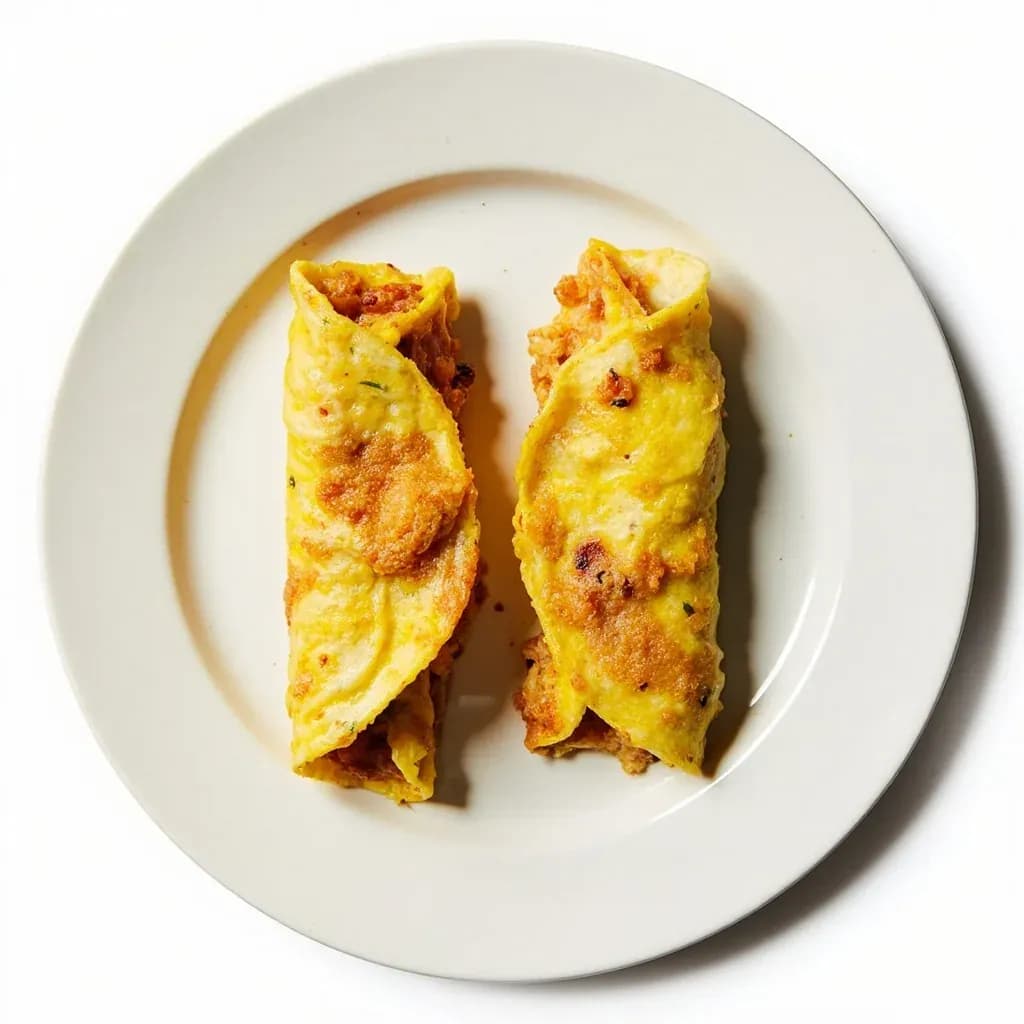
Folding and rolling cooked egg in the pan into a smooth, filled cylinder.
Omelet rolling cooks beaten egg in a hot buttered pan until just set, then tilts and folds the egg over itself into a neat rolled or trifold shape, often around a filling. The French-style version aims for a pale, soft, custardy interior with no browning, achieved with gentle heat and constant motion. The pan is tipped to coax the omelet onto the plate seam-side down for a tidy finish.
Omelet rolling is a pan-finishing method in which partially set eggs are folded and turned in a sloped skillet to form a smooth, filled cylinder. The cook's job is to manage heat and timing so the eggs reach a precise state — a soft, just-set bottom with a glossy, slightly wet top — at the exact moment a filling is added and the roll is executed. Get that window right and gravity, aided by the pan's tilt, does most of the work; get it wrong and the egg either tears, browns, or refuses to seal.
The technique matters far beyond breakfast. It is one of the clearest exercises in direct-heat control a cook can practice, and the same principles — low heat, ample fat, small curds, a sloped pan — underpin rolled omelet traditions across cuisines, from the strict French omelette roulée to Japanese tamagoyaki and Korean gyeran-mari. Mastering the French version, the most demanding of the three, builds a vocabulary of touch and timing that translates directly to the others.
What separates a properly rolled omelet from a folded one is seam integrity and surface color. A correct roll has no visible internal seam, no Maillard browning on the outside, and a tender, almost custardy interior. The pan is just a tool, but it must be the right tool: an 8-inch (20 cm) sloped non-stick or well-seasoned carbon-steel skillet for the French version, or a rectangular makiyakinabe for tamagoyaki. A cold plate is the enemy of a finished roll, because the residual heat is what fuses the seam and sets the final shape.
- Difficulty
- Medium
Types & varieties
The benchmark version: 2–3 eggs stirred into small curds and rolled into a smooth spindle on a sloped non-stick pan. Pale, no browning, often finished with fines herbes and Gruyère.
Japanese rolled omelet built by rolling multiple thin layers in a rectangular makiyakinabe pan. Flavored with dashi, soy, mirin, and a pinch of sugar; can be sweet (kasutera style) or savory.
Korean rolled omelet cooked in a small round or rectangular pan, often with finely diced carrots, scallions, ham, spam, or melted cheese folded into the final roll.
Thin crepe-like egg layer rolled around a filling such as scallion, cilantro, or shredded pork; sometimes pan-fried again to crisp the seam.
Looser, often thicker, rolled from a flat round pan with a spatula without first curding. Browning is acceptable.
Vegetables or potatoes pre-cooked and folded in before rolling; more rustic and not the smooth French cylinder.
How to do it
- 1
Crack and season the eggs
Crack 2–3 large eggs into a bowl. Add a generous pinch of fine salt and, if you want a slightly looser set, 1 teaspoon of water or milk. Beat with a fork for about 20 seconds until the yolks and whites are fully combined and the mixture is just foamy. Salt at least 30 seconds ahead of cooking; it weakens the proteins and produces more tender curds.
- 2
Heat and butter the pan
Set an 8-inch sloped non-stick skillet over medium-low heat. Add about 1 tablespoon of unsalted butter and swirl to coat the entire bottom and the lower sidewall. When the butter foams and the foam just begins to subside — but before it browns — pour in the eggs all at once.
- 3
Curd the eggs
Immediately draw quick figure-eights across the pan with the flat tines of a fork, pulling set curds from the edges into the wet center. Continue for 10–15 seconds, producing small, even curds with very little liquid remaining on top. Stop stirring the moment the bottom just sets; overworking at this stage produces a dense, dry interior.
- 4
Add the filling (optional)
Once the bottom releases freely when you shake the pan and the top is still glossy, scatter 2–3 tablespoons of filling in a line across the center — grated Gruyère and fines herbes, diced ham and soft cheese, or soft goat cheese and chives. More than this prevents a clean roll and tears the egg.
- 5
Roll the omelet
Tilt the pan away from you at about 20°. Use a silicone spatula to lift the near edge of the omelet and fold it over the filling. Tap the pan handle gently to nudge the roll forward, then rotate the pan a quarter turn and repeat the fold. Continue until the omelet reaches the far edge and forms a smooth, even cylinder.
- 6
Finish and plate
If the seam has not sealed, slide the omelet to the seam-side of the pan and press lightly with the spatula for about 5 seconds. Tip it onto a warm plate seam-down so the seal tucks under itself. Rub a small pat of butter over the top for a glossy finish and serve within 30 seconds, before the residual heat toughens the curd.
- 7
Tamagoyaki variation: layer and roll
Whisk 4 eggs with 2 tablespoons dashi, 1 teaspoon soy sauce, 1 teaspoon mirin, and a pinch of sugar. Heat a rectangular makiyakinabe over medium-low, brush lightly with neutral oil, and pour in about a quarter of the mixture. When the bottom sets but the top is still tacky, roll the thin layer to the far end of the pan, wipe the cleared space with an oiled folded paper towel, and pour the next quarter. Roll it over the first layer, repeat until all the egg is used, then slide the finished log onto a cutting board to rest a minute before slicing into 1-inch pieces.
Why the pan matters
The slope is not decorative. A pan with a 20° to 30° outward-sloping sidewall gives the spatula a smooth, angled surface to glide under without catching on a sharp corner. That same angle is what allows the near edge of the omelet to be lifted and folded over without sticking, tearing, or losing its shape. A flat-sided pan forces the cook to fight the spatula; a too-small pan doesn't leave room for a tuck-and-rotate motion; a cast-iron pan, even when well seasoned, holds too much heat for the gentle French standard and drives the surface past pale yellow into brown.
Reading the surface
The single most important skill in omelet rolling is knowing what the eggs should look like the moment you add the filling and begin the roll. The bottom should be set and slide freely when the pan is shaken, the curds on top should be small and uniform, and a thin sheen of wet, glossy egg should still cover the surface. If the top is matte and dry, the seam will not fuse and the finished roll will crack open on the plate. If the surface is still liquid, the filling will sink and the roll will weep. Aim for the moment the eggs look like a just-set custard with a soft sheen.
The French standard vs. Asian variants
The French version is the strictest: no browning, no internal seam, pale yellow throughout, and a tender interior that is almost baveuse (custardy). Tamagoyaki and gyeran-mari are more forgiving. Both tolerate light browning, and the multi-layer method actually depends on a touch of surface setting so the next pour of egg grips the previous roll. Treating tamagoyaki like a French omelet — keeping the heat so low that nothing browns — produces a flat, pale log that lacks the characteristic layered structure and gentle caramel notes.
Common uses
Tips & pitfalls
- Heat the pan to the point where a drop of egg sizzles gently but does not seize on contact; too hot browns the surface, too cool gives a flat, dry omelet that never sets properly.
- Use more butter than feels reasonable; the French roll is essentially basted in clarified butter, and the fat is what gives it a glossy, pale, tender surface.
- Stir the eggs with the flat of a fork in figure-eights while they are still mostly liquid, forming small, uniform curds. Stop stirring the moment the bottom sets; continuing produces a dense, rubbery interior.
- Roll across the pan, not away from you, by lifting the pan edge and using the spatula to tuck and rotate. Gravity does most of the work — the spatula should guide, not push.
- Let the omelet rest seam-down on a warm plate for 30–60 seconds. The residual heat finishes the cook and the weight of the omelet seals the seam without your needing to press it.
- For tamagoyaki, wipe the pan with a folded paper towel dipped in oil between every layer so each new pour of egg slides freely and does not stick or scorch.
- Common mistake: waiting until the top of the omelet is fully dry to roll. The surface must still be glossy and slightly wet for the seam to fuse — a matte top will crack open on the plate.
- Common mistake: overloading with filling. More than 2–3 tablespoons prevents a clean roll and tears the egg from the inside.
- Common mistake: using a flat-sided or cast-iron pan for the French version. The sloped non-stick pan is what makes the roll effortless.
Good to know
- Technique type
- Pan-finishing method for shaping a filled or unfilled omelet into a cylinder
- Typical pan
- 8-inch (20 cm) sloped non-stick or well-seasoned carbon-steel skillet (French); rectangular tamagoyaki pan (makiyakinabe) for the Japanese version
- Heat level
- Medium to medium-low for the French roll; medium-low for tamagoyaki layers
- Eggs per serving
- 2–3 large eggs (French); 4 eggs for a small tamagoyaki log
- Color target
- Pale yellow with no browning (French); pale yellow with light caramel streaks (tamagoyaki)
- Texture target
- Tender, moist interior and a smooth, seamless exterior
- Total time
- 60–90 seconds for a French rolled omelet; 5–8 minutes for tamagoyaki
- Difficulty
- Intermediate (French rolled); beginner-friendly (gyeran-mari); advanced (tamagoyaki)
- Key tools
- Sloped-sided skillet, silicone or wooden spatula, fork for curding, paper towel for wiping the pan between tamagoyaki layers
Also called
rolling an omelette · French omelette
Related

Sear
Blast the surface hot for a deep-browned, savory crust

Sauté
Cook quickly in a little fat over lively heat, tossing as you go

Stir-Fry
Toss bite-sized pieces over roaring heat for fast, smoky cooking

Pan-Fry
Crisp food in a shallow layer of hot fat, turning once or twice

Deep-Fry
Submerge in hot oil for an all-over crackling crust

Roast
Cook uncovered in dry oven heat for browned edges and tender centers

Bake
Cook with steady, surrounding oven heat — the soul of bread and pastry

Broil
Hit food from directly above with fierce overhead heat