Heat & Fire
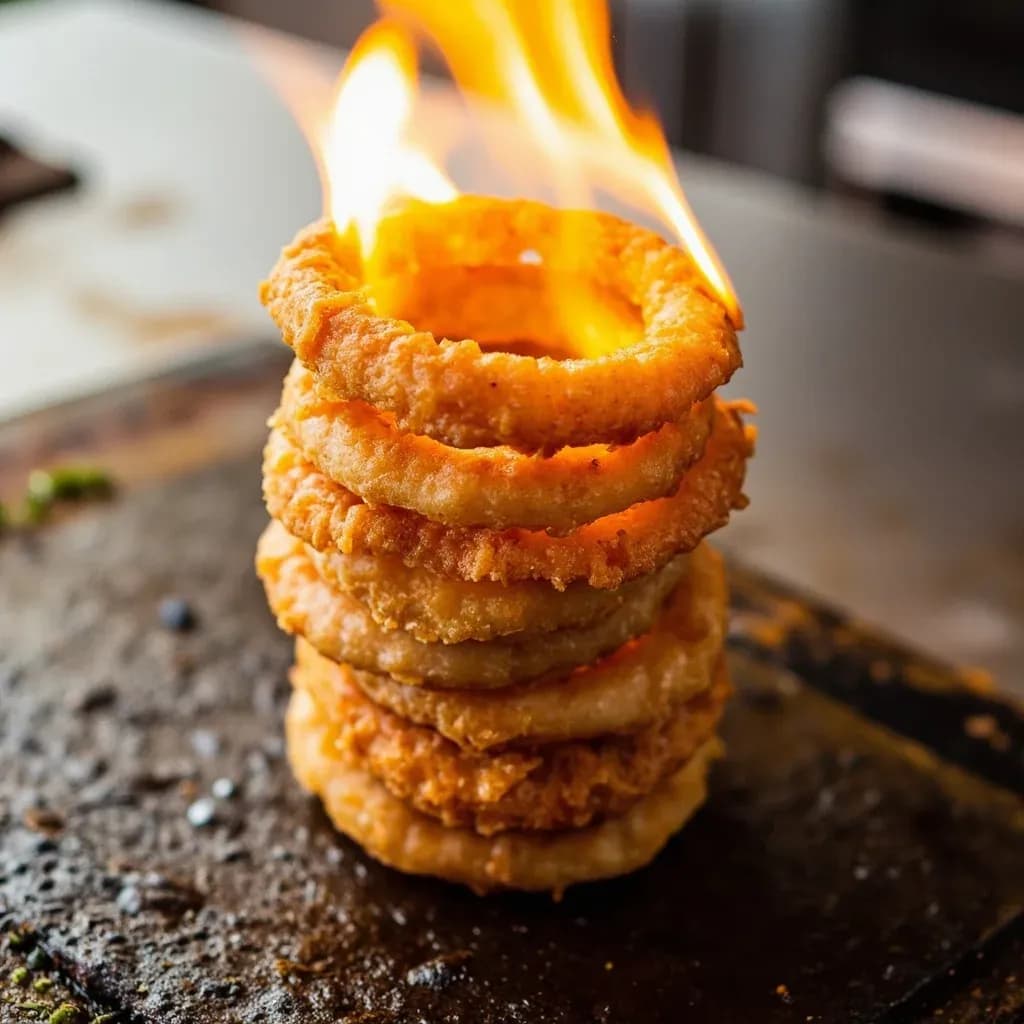
Onion Volcano
Teppanyaki showmanship trick of stacking onion rings and igniting them into a flaming volcano.
The onion volcano is a teppanyaki tableside flourish where sliced onion rings are stacked into a cone on the hot griddle, then filled with oil and a splash of liquor to be lit into a brief tower of flame and steam. It is pure entertainment that also lightly chars and caramelizes the onion. The trick relies on a very hot flattop and careful control of the flammable liquid.
The Onion Volcano is a tableside showpiece from the Japanese teppanyaki tradition, in which a stack of thick onion rings is hollowed into a cone, charged with a splash of high-proof alcohol, and set alight on the flat-top griddle. It is, at heart, a piece of edible theater: a few seconds of open flame that crowns a meal with the same kind of spectacle that defines the hibachi-style dining room. The flavor payoff is modest — the outer rings pick up a thin lacquer of caramelization from the burning vapor — but the visual payoff is enormous, and that is precisely the point.
The technique is older than the American chains that made it famous. Chefs in Japan have been building onion towers on the teppan for decades, and the flourish traveled west with the first wave of Japanese restaurants in the United States in the 1970s. Today it is a stock move in tourist-facing teppan rooms worldwide, frequently staged for birthdays, anniversaries, and any table that wants a photograph. The volcano also makes an unusually good classroom tool: it teaches flambé discipline, griddle timing, and the difference between cooking with flame and cooking with fire.
Treat it as a presentation technique first and a cooking technique second. The onion is inexpensive, the spirit is the only real consumable, and the rest is choreography. That choreography, however, is performed on a 200 °C griddle with vaporized alcohol and an open flame, so safety planning is not optional — it is the first step of the build.
- Difficulty
- Medium
Types & varieties
Alcohol is poured into the stacked-ring cavity and ignited; the flame burns for 15–30 seconds before being smothered with a dome lid or doused with a water squirt bottle.
After the flame dies, a splash of water is added to the hot cavity, producing a sudden steam eruption that mimics lava cascading down the sides.
The standard form: 4–6 thick rings nested from largest to smallest on a small metal ring mold or two crossed skewers to form a free-standing cone.
A taller, more sculptural version built around a vertical skewer or wire frame, often finished with a long pour of flaming alcohol down the inside.
Rings are nested to form a heart silhouette instead of a cone; common for Valentine's tableside service in modern teppan rooms.
How to do it
- 1
Slice and separate the rings
Peel a large, very firm white or yellow onion. Slice it crosswise into 8–12 mm (⅓–½ in) thick rounds. Gently separate the rounds into individual rings and sort them by diameter, keeping the largest rings for the base of the tower and the smaller inner rings for the top of the crater.
- 2
Stage the griddle and safety gear
Heat the teppan to roughly 200–220 °C (400–425 °F) — hot enough to vaporize alcohol on contact, cool enough that the onion does not scorch before ignition. Place a metal dome lid and a water squirt bottle within arm's reach, and confirm your extinguisher is accessible. This is the step most amateur cooks skip, and it is the one that prevents injuries.
- 3
Build the volcano
Lay two bamboo skewers in an X on the griddle, or set a small metal ring mold in place to give the base a footprint. Stack the rings concentrically, largest on the bottom and progressively smaller toward the top, so the cavity narrows like a crater. The finished tower should be 8–12 cm (3–5 in) tall and self-supporting. If a ring leans, restack — a leaning tower collapses the moment alcohol is added.
- 4
Charge with alcohol
Pour 15–30 ml (½–1 oz) of high-proof spirit (151-proof rum, vodka, or sake) directly into the central cavity just before ignition. Do not pour onto the hot griddle outside the rings; pooled alcohol flares unpredictably and can travel along the griddle surface toward the diner.
- 5
Ignite
Using a long-stem lighter or a flambé wand, light the vapor at the top of the cavity. The flame should bloom from the crater downward as the alcohol vapor ignites. Step back, keep your face out of the plume, and let it burn for 15–30 seconds. Do not lean across the griddle to inspect the flame.
- 6
Extinguish
Slide the dome lid over the volcano to smother the flame, or spray a short burst of water from the squirt bottle across the top to kill the vapor. Confirm that all flame and embers are out before you move on — alcohol vapor can re-ignite from a residual ember.
- 7
Optional geyser finish
Once the flame has died but the griddle and onion are still very hot, splash 30–60 ml (1–2 oz) of water into the cavity. The water flashes to steam and erupts upward through the crater, cascading down the sides of the volcano in a safe, non-flaming display. This is the cleanest flourish to add to a family table.
- 8
Rest and serve the onion
Let the tower rest 30–60 seconds after the flame is out so any residual alcohol burns off, especially if children will be eating from the rings. Slide the caramelized rings onto a cutting board, slice them into strips, and return them to the griddle to finish with the rest of the meal, or plate them as a side.
Safety planning
A volcano is a controlled fire on a hot surface, and the entire build should be staged around how you will end it. Before the first ring touches the griddle, position a snug-fitting metal dome lid and a water squirt bottle within arm's reach, and confirm a Class K or ABC extinguisher is on the line. Never pour more than 30 ml (1 oz) of spirit; a bigger pour does not give a bigger show, it gives a faster, less controllable fire. Keep your body, your face, and any loose sleeves or apron strings out of the plume above the crater.
Choosing the onion
A wobbly, old, or very watery onion will not hold the tower. Use a large, very firm, freshly cut white or yellow onion — sweet onions like Vidalia work, but their higher sugar content means they scorch faster and should be staged at a slightly lower griddle temperature. Rings should be cut 8–12 mm (⅓–½ in) thick; thinner rings burn through and collapse, thicker rings char on the outside before the flame finishes its work.
Common uses
Tips & pitfalls
- Use a large, very firm, freshly cut onion; older onions wilt and the tower collapses before ignition.
- Cut rings 8–12 mm (⅓–½ in) thick — thin rings burn through too fast, thick rings char on the outside before the flame finishes.
- Rest the stacked rings on a small circular mold, a tuna-can ring, or two crossed bamboo skewers laid flat on the griddle for stability.
- Pour only 15–30 ml (½–1 oz) of high-proof spirit; more alcohol makes a harder-to-control fire, not a better show.
- Light the alcohol with a long-stem lighter or flambé wand — never lean across the griddle with a short match.
- Have a snug-fitting metal dome lid and a water squirt bottle staged before ignition; smothering is safer than trying to blow out a flaming griddle volcano.
- Burn the alcohol until the flame visibly dies down before adding any water — adding water to a full flame throws burning alcohol and can cause burns.
- If the tower tips, slide it off the griddle with a spatula; do not try to catch it with your hands.
- Practice the build twice off-griddle to get the stacking sequence and timing locked in before doing it in front of guests.
Good to know
- Category
- Showmanship / tableside cooking technique
- Cuisine of origin
- Japanese teppanyaki, popularized in U.S. hibachi-style restaurants
- Primary ingredient
- Large white or yellow onion, cut into concentric rings
- Fuel
- High-proof alcohol (151-proof rum, vodka, sake, or mirin)
- Equipment
- Flat-top griddle, metal ring mold or crossed skewers, long-stem lighter
- Skill level
- Beginner to intermediate; the difficulty is fire safety, not knife work
- Flame time
- 15–30 seconds of active burn
- Flavor effect
- Alcohol burns off; outer rings caramelize lightly
Also called
flaming onion volcano · teppanyaki onion volcano
Related

Sear
Blast the surface hot for a deep-browned, savory crust

Sauté
Cook quickly in a little fat over lively heat, tossing as you go

Stir-Fry
Toss bite-sized pieces over roaring heat for fast, smoky cooking

Pan-Fry
Crisp food in a shallow layer of hot fat, turning once or twice

Deep-Fry
Submerge in hot oil for an all-over crackling crust

Roast
Cook uncovered in dry oven heat for browned edges and tender centers

Bake
Cook with steady, surrounding oven heat — the soul of bread and pastry

Broil
Hit food from directly above with fierce overhead heat