Water & Steam
Pilaf / Plov Layering
Building rice over a savory meat-and-aromatic base so it absorbs flavor as it steams.
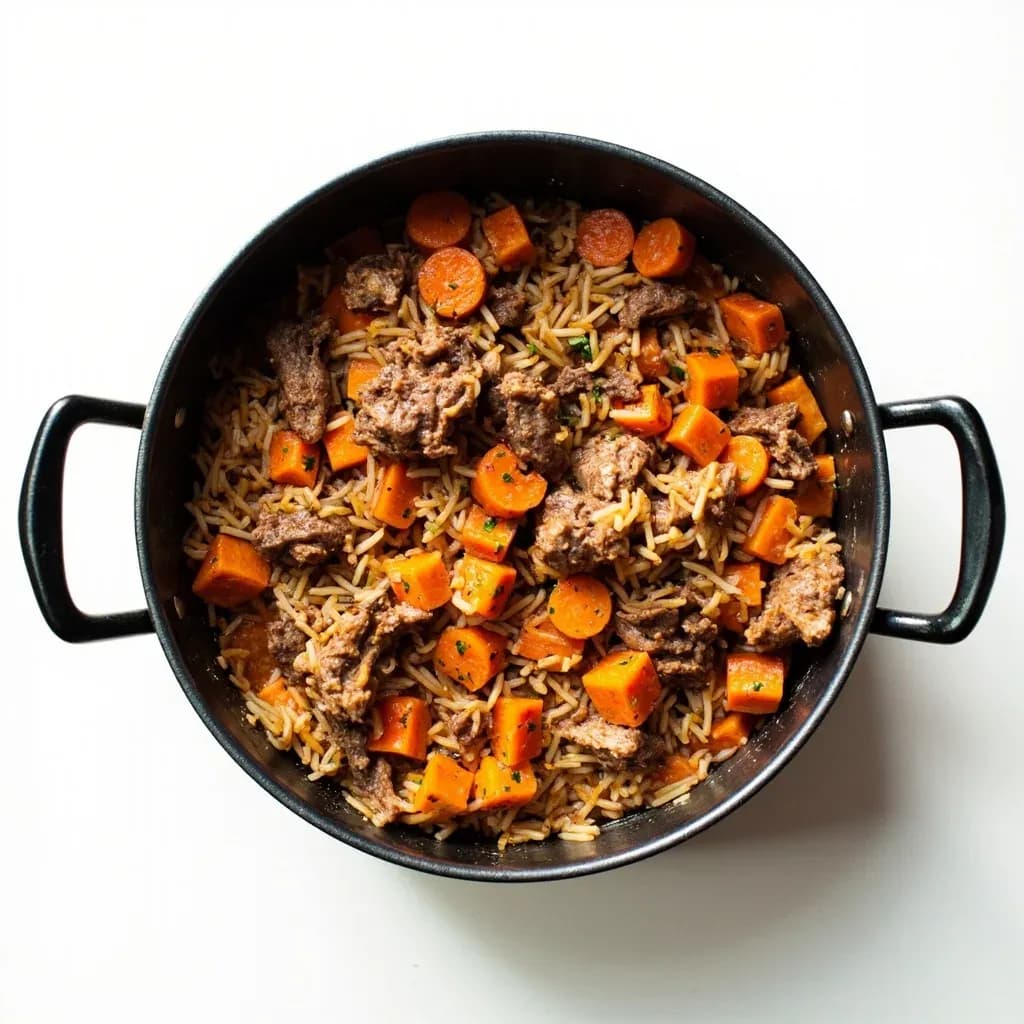
Pilaf or plov layering sets parboiled or rinsed rice over a cooked base of meat, onions, carrots, and spices (the zirvak), then steams it covered so each grain absorbs the seasoned liquid. It produces distinct, separate grains rather than a sticky mass and is central to Central Asian plov and many pilau traditions. Poking steam holes through the rice and keeping a tight lid ensures even cooking from the moisture below.
Pilaf layering is a method in which raw rice is spread in a single, undisturbed stratum over a fully cooked aromatic base — typically browned meat, caramelized onions, and often carrots — and then steamed in seasoned liquid until the grains have absorbed every drop. The defining behavior is largely gravitational: rich oil and rendered fat rise to form a colored cap on top, the seasoned rice settles into a fluffy white middle, and the concentrated meat-and-vegetable base anchors the bottom.
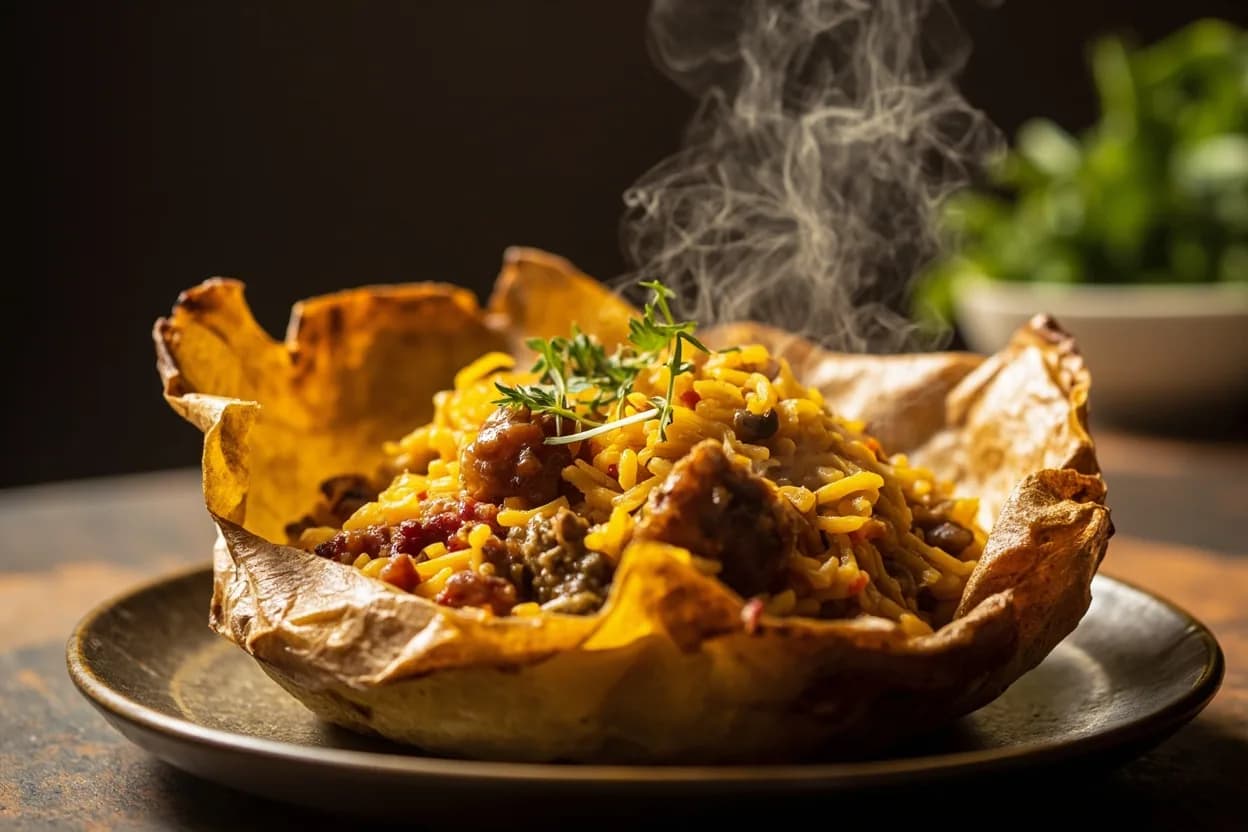
Unlike risotto, nothing is stirred after the rice goes in. Unlike simple steamed rice, the cooking liquid carries deep flavor because it has been seasoned over the base before the rice ever touches it. The technique underlies a vast family of dishes — Uzbek plov, Persian chelo with khoresh, Afghan Kabuli pulao, Indian biryani in its dum and kacchi forms, Iraqi timman z'affaran, and Azerbaijani plov — and is the common thread across them.
Success depends less on skill than on discipline: the right rice, a tight lid, and the willpower not to stir. When properly executed, the pot turns out as an intact dome showing three clearly separated strata, which is the visual test every cook should aim for.
- Difficulty
- Hard
Types & varieties
Lamb or beef fried with julienned yellow carrots and onions, rice layered on top, finished with whole garlic heads and chickpeas; Uzbekistan's national dish, traditionally cooked over open flame in a kazan
Rice par-cooked in a separate pot then layered over the zirvak for the final steam — produces exceptionally fluffy, separate grains
Uses both yellow and dark carrots, lamb tail fat (kurdyuk) for richness, often finished with raisins and barberries
Includes dried fruits (apricots, plums, raisins) and chickpeas; milder and sweeter than Tashkent plov
Dozens of named varieties — şah plov wrapped in flatbread, fisincan plov in ground-lamb casing, toyuq plov with chicken, südlü plov baked with milk
Plain white basmati served beside or layered with separately cooked khoresh; the prized feature is the tahdig crust at the bottom
Lamb or chicken layered with basmati, fried carrots, raisins, pistachios, and almonds; steamed under a tight cloth-sealed lid
Whole-spice-tempered ghee base with rice layered on top; typically milder than biryani, often with vegetables or meat
Par-cooked rice layered over a separately prepared meat masala, then dum-steamed; Kolkata and Lucknow styles are most distinctly stratified
Saffron-basted rice layered over a tomato-braised meat base, served with clarified butter (gheyta) drizzled between strata
Ceremonial Uzbek plov built in 100+ kg quantities by the oshpaz (plov master), assembled in rigorously sequenced layers
How to do it
- 1
Prepare the aromatic base (zirvak)
Render fat (lamb tail fat, ghee, or oil) in a heavy pot over medium-high heat. Brown the meat in batches until a deep crust forms and fond develops on the pot bottom. Remove meat, then sweat sliced onions until caramelized. Add julienned carrots and cook until just tender but still holding their shape. Return the meat to the pot with whole garlic heads, chickpeas if using, and any dried fruits or barberries. Season with salt, cumin, coriander, and any whole spices.
- 2
Add liquid and bring to a boil
Pour in hot stock or salted water until the base ingredients are just covered. Bring to a vigorous boil and skim any grey foam. The liquid should taste noticeably seasoned — it is the seasoning source for the entire rice layer above.
- 3
Layer the rinsed and soaked rice
Drain soaked rice and spread it gently in an even layer over the base, leveling the surface with a spatula. Do not stir or push the rice below the liquid line. The rice should sit in a clean horizontal stratum above the meat and vegetables.
- 4
Adjust the liquid level
Liquid should cover the rice by roughly 1.5–2 cm (about the depth of a knuckle). If low, add hot broth down the inside wall of the pot. Bring back to a boil over medium-high heat.
- 5
Boil vigorously until the waterline recedes
Maintain a strong boil until the surface liquid disappears into the rice and small craters form when you press the surface with the back of a spoon. This typically takes 8–12 minutes and is when the rice drinks the bulk of the liquid.
- 6
Reduce heat and seal the lid
Drop the heat to the lowest possible setting. If using a cloth or flour-paste seal, apply it now. Place the lid on top, weighted if possible, and seal tightly. If you want a bottom crust (tahdig/kazan), lay a disc of lavash bread or a buttered plate on the rice surface before sealing.
- 7
Steam undisturbed
Cook on low for 20–40 minutes without lifting the lid. The rice finishes by absorbing steam rising from the wet base below and from its own trapped moisture. Do not stir or peek during this phase — every lid lift costs you temperature and steam pressure.
- 8
Rest off the heat (dam)
Remove the pot from heat and keep it sealed for another 15–20 minutes. This rest redistributes internal moisture so the top layer is not dry and the bottom layer is not wet, and it lets the grains firm up for serving.
- 9
Test and serve in layers
Open the lid, fluff the top rice gently with a fork, and check a center grain for doneness — it should be tender with a slight chew. To plate, scoop straight down through all three strata so each serving shows the colored oil on top, the white rice in the middle, and the meat-and-carrot base below. This stratified presentation is the hallmark of a properly layered pilaf.
Anatomy of a Properly Layered Pilaf
A correctly built pilaf has three visually distinct strata that announce themselves the moment the lid comes off, and they form because each component behaves differently during the steam phase.
- Top stratum — colored oil cap: rendered fat, saffron butter, or ghee migrates upward through the rice and pools at the surface as a glossy layer.
- Middle stratum — fluffy rice: each grain stands separate, lightly tinted by the cooking liquid but otherwise white and intact; this is where most of the eating happens.
- Bottom stratum — zirvak base: the concentrated meat, carrots, onions, and aromatics, often anchored by a crisp golden crust (tahdig, kazan, or kruk) where the rice meets the pot.
- Strata integrity depends on never stirring after the rice goes in — once disturbed, the layers collapse into a homogeneous stew.
Regional Schools and How They Differ
The layering principle is shared, but the execution diverges sharply between traditions. These differences are worth understanding before committing to a recipe, because the rice-to-liquid ratio and the steam time both shift with the school.
- Central Asian plov is the most rigidly codified: precise proportions, kazan geometry, and a cloth-sealed lid; carrots cut in long matchsticks (3–4 mm), never rounds.
- Persian chelo often pairs separately cooked rice with a stew (khoresh) rather than steaming them together; the tahdig crust is the prized feature.
- South Asian biryani splits into two camps: 'pakki' (fully cooked meat layered with par-cooked rice, then dum-steamed) and 'kacchi' (raw marinated meat layered with raw rice, cooked together).
- Azerbaijani plov is the most varied — dozens of named forms including flatbread-wrapped, ground-meat-stuffed, milk-baked, and chicken-based versions.
Common uses
Tips & pitfalls
- Toast the rice briefly in oil or butter before adding liquid; this hardens the grain exterior so individual kernels stay separate during steaming.
- Do not stir once the rice is added — stirring releases starch and collapses the strata into a porridge-like stew.
- Rinse basmati or devzira until the water runs clear, then soak 30–60 minutes; this is the single biggest determinant of fluffy layered rice.
- Use a tight-fitting lid and seal any gaps with a damp cloth or flour paste — steam escape is the most common cause of dry, uneven texture.
- Salt the cooking liquid more boldly than for plain boiled rice, because it seasons only the outer layer of each grain.
- Carrots for plov should be cut in long 3–4 mm matchsticks, not rounds; rounds release more water and muddy the layer.
- Brown the meat deeply — fond on the pot bottom is the primary flavor source for the rice layer above.
- Match pot size to rice amount: an over-full pot steams unevenly, while a too-large pot leaves a thin, dry, under-developed layer.
Good to know
- Also known as
- Pilau, pulao, pilaw, plov (palov/osch), polo, chelo
- Origin region
- Persianate world — Iran, Central Asia, Caucasus, South Asia, Anatolia, and the Levant
- Earliest documented reference
- Medieval Arabic and Persian cookery manuscripts, including al-Baghdadi's 13th-century Kitab al-Tabikh
- Core method
- Cook an aromatic base (zirvak), layer raw rice on top, add seasoned liquid, then steam covered until absorbed
- Ideal rice
- Long-grain, low-starch, aged rice — basmati, devzira (Red Caracol), or sella/parboiled basmati
- Liquid-to-rice ratio
- Roughly 1.6–2:1 by volume depending on rice age and variety; always stock or salted water, never plain water for best flavor
- Signature vessel
- Kazan (cast-iron or hammered-steel wok-like pot) for Central Asian plov; Dutch oven or heavy lidded pot elsewhere
- Defining visual test
- Pot turns out as an intact dome with three separate strata: colored oil cap, white rice middle, concentrated base below
Also called
Pilau Layering · Zirvak Building · Pilaf Steaming · Rice Pilaf
Dishes that rely on it
Related

Boil
Cook in vigorously bubbling liquid at full rolling heat

Simmer
Hold liquid at a gentle shimmer for tender, unhurried cooking

Poach
Cook gently in barely-trembling liquid for silky, tender results

Steam
Cook in rising vapor to keep color, nutrients, and shape intact

Blanch
Plunge briefly in boiling water, then shock cold to lock color

Braise
Sear, then cook slow in a little liquid until fall-apart tender

Stew
Simmer bite-sized pieces fully submerged into a rich, unified pot

Sous-Vide
Seal and cook in precise warm water for edge-to-edge doneness