Prep & Assembly
Poke Test
Pressing dough or proofing bread with a finger to judge whether it has risen enough.
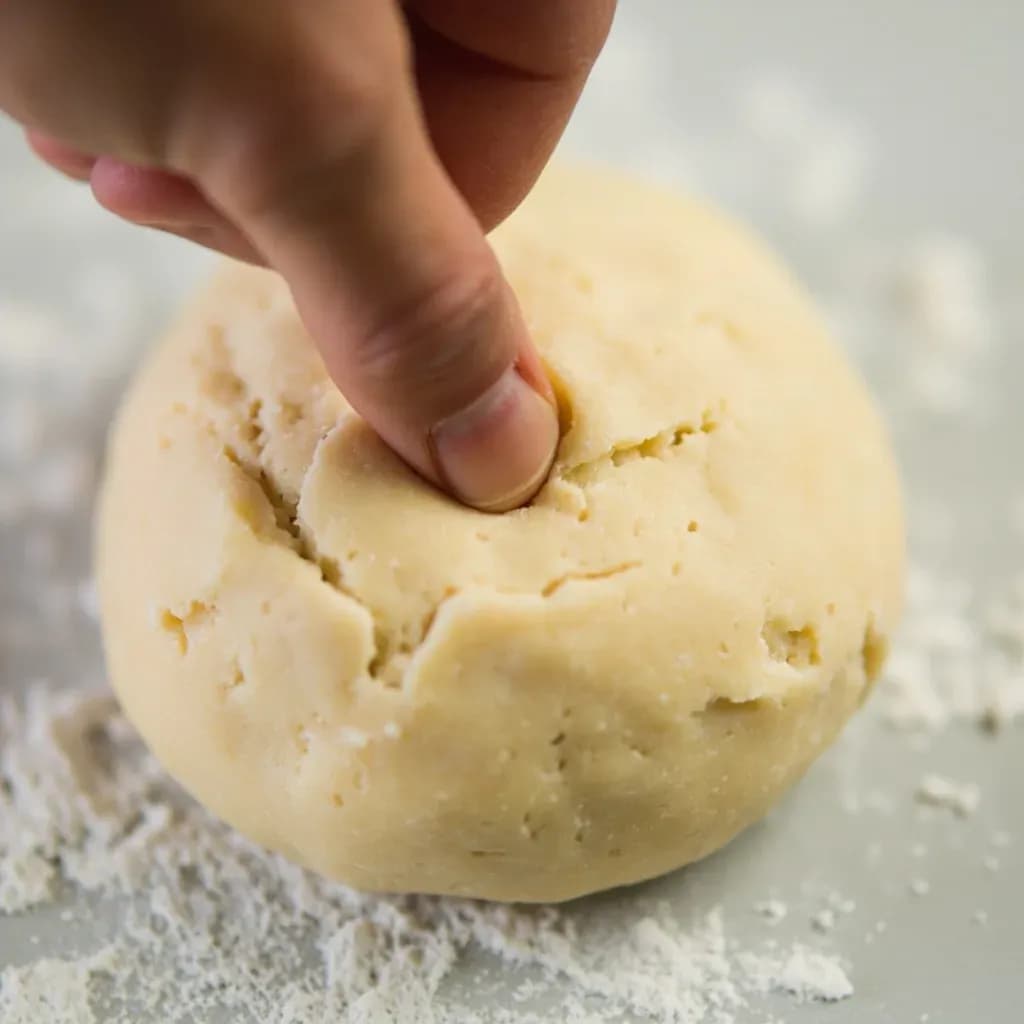
The poke test gauges fermentation by gently pressing a finger into proofing dough and reading how the dent springs back. A dent that fills slowly and partway means the dough is perfectly proofed and ready to bake; an instant rebound signals it needs more time, while a dent that stays put warns the dough is overproofed. Bakers also use a version of it to check doneness of cooked proteins by feel.
The poke test is the baker's most direct way to ask dough a question: are you ready? A clean finger is pressed gently into the surface of a fermenting mass, and the way the dough answers — how quickly it springs back, how deeply it holds the impression, whether it relaxes halfway or collapses — tells the baker whether bulk fermentation has finished, whether a shaped loaf has finished its final proof, or whether the dough has tipped into over-proofing. It is a tactile reading, not a measurement, and it sits alongside visual cues (a domed top, bubbles under the skin), aromatic cues (a sweet, faintly alcoholic fermentation smell), and elapsed time as one of the four classical signals bakers use to judge dough.
The test matters because recipes can only give approximate timings. Ambient temperature, the vitality of the starter or yeast, flour strength, and hydration all shift how fast a dough ferments, and a kitchen running five degrees warmer than the recipe author's will move a fermentation cycle noticeably faster. The poke test converts that variability into a felt judgment, letting the baker hold the dough to its own clock rather than the recipe's. It is fast — seconds — and non-destructive when done correctly, so it can be repeated at intervals as the dough approaches readiness.
Its reliability climbs sharply with experience and varies with dough type. Moderately hydrated yeasted breads (sourdough boules, country loaves, sandwich loaves, rolls, pizza) read beautifully. Very stiff doughs (bagels, pretzels), very wet high-hydration loaves (open-crumb ciabatta, focaccia), and dense whole-grain or rye doughs are harder to read by finger alone and benefit from the other sensory cues. The test is also a teaching tool: it forces a new baker to slow down, touch the dough, and begin building the feel-based intuition that separates recipe-followers from bakers.
- Difficulty
- Easy
Types & varieties
Dust the finger with flour to keep it from sticking; the standard technique for moderately hydrated lean doughs.
Dampen the finger before pressing so high-hydration doughs don't tear on the way out; preferred for ciabatta, focaccia, and wet sourdough.
Lightly oil the finger for enriched doughs like brioche, challah, and panettone, which have a soft, buttery skin that grabs a dry finger.
Use a knuckle rather than a fingertip for deeper bulk-fermentation checks on large dough masses; gives a broader read.
Press with two fingers side by side; some bakers use this on shaped loaves to gauge final proof across a wider surface.
How to do it
- 1
Prepare your hand
Lightly flour, dampen, or oil the pad of one index finger so it will not drag or tear the dough's surface. Match the prep to the dough: flour for lean, damp for wet, oil for enriched.
- 2
Choose a representative spot
Pick a spot away from the bowl's edge and away from any seam, fold, or shaped seam on a loaf. The center of the dough's smoothest face gives the truest read; dough near the edges of a bowl often proofs faster in a cool kitchen.
- 3
Press gently to about ½ inch
Push in steadily but softly — roughly the weight of a finger resting, not the force of a stab — to a depth of about ½ to 1 inch (1.25–2.5 cm). Do not jab, twist, or press twice in the same spot.
- 4
Withdraw cleanly
Pull the finger straight back without dragging. Watch the dent, not your finger.
- 5
Read the response over 2–5 seconds
Three outcomes: springs back fast and almost fully — under-proofed, give it more time; springs back slowly, leaving a soft impression that partly fills in — properly proofed, proceed to shape or bake; stays flat, deflates, or feels slack and gassy — over-proofed, bake immediately or shape gently without further proof.
- 6
Cross-check with other cues
Confirm with a domed, pillowy appearance, a sweet or faintly beery fermentation aroma, and elapsed time against recipe guidance. If two cues agree, move on; if they conflict, trust the dough.
Reading the response
The dent tells three stories depending on what happens in the seconds after the finger is withdrawn. None of the readings is about the depth of the press — that should be roughly the same each time — but about how the dough recovers. With experience the read becomes near-instantaneous, which is why the test is useful in a working bakery where decisions happen every few minutes.
Poke test versus other fermentation cues
The poke test is one of four classical signals a baker reads during fermentation. Used together they are far more reliable than any one alone, because each compensates for the weaknesses of the others. A timed schedule drifts with temperature; a visual cue can be fooled by a false dome; an aroma can be masked by other smells in the kitchen. The poke test engages the sense of touch, which time and sight cannot replace.
- Visual: a domed, pillowy surface, bubbles visible under a taut skin, edges pulling slightly away from the bowl.
- Aromatic: a sweet, yeasty, or faintly beery fermentation smell, often strongest as the dough approaches peak activity.
- Time: a tracked schedule adjusted for ambient temperature, dough temperature, and the vitality of the yeast or starter.
- Tactile (poke test): the spring-back behavior of a gentle finger press over a 2–5 second read.
Limitations and where the test struggles
The poke test is least useful on doughs that resist or distort the read. Stiff doughs (bagels, pretzels, some rye) dent less and recover unpredictably because their structure is more about gluten tightness than gas pressure. Very wet doughs dent deeply and stay dented because their own weight relaxes the surface, not because they are over-proofed. Cold-retarded dough straight from the refrigerator will read as firm no matter what stage it is in — let it warm until just shy of room temperature before judging. Chemically leavened batters (pancakes, muffins, cakes) are not poked; their readiness is judged by visual rise and set.
Common uses
Tips & pitfalls
- Press gently — about the weight of a finger, not the force of a stab. A deep jab compresses gas and gives a false read.
- Test in two or three spots; dough near the edges of a bowl often proofs faster than the center in cool kitchens, so a single poke can mislead.
- Under-proofed dough springs back quickly and almost fully, as if it had never been touched. Give it another 15–30 minutes.
- Properly proofed dough leaves a shallow indentation that slowly relaxes about halfway back. This is the target.
- Over-proofed dough feels slack, deflates on contact, or holds the dent without any recovery at all. Bake immediately if possible.
- Wet or lightly oil your finger when working with sticky, enriched, or high-hydration doughs so the surface does not tear on the way out.
- Combine the poke with other cues — a domed surface, a slightly puffy feel, a sweet or beery aroma, visible bubbles under the skin — rather than relying on it alone.
- Lean and high-hydration doughs are more forgiving of slight under-proofing than slight over-proofing; when in doubt, err on the early side.
- Enriched doughs (brioche, challah, panettone) hold their dent longer than lean doughs at the same stage; calibrate your read with time and experience.
- Do not poke dough straight from the refrigerator; let it warm until just shy of room temperature so the read reflects fermentation, not chill.
- For very stiff doughs (bagels, pretzels) the test is less useful; rely on look, feel of the bulk, and elapsed time.
- The poke test is not a substitute for tracking time and temperature — treat it as confirmation of those signals, not as a replacement.
Good to know
- Also known as
- Finger poke test, finger dent test, indentation test
- Category
- Bread baking assessment / fermentation check
- Equipment needed
- A clean floured, dampened, or lightly oiled finger
- Indentation depth
- Roughly ½ to 1 inch (1.25–2.5 cm), adjusted to dough hydration and stage
- Reading time
- 2–5 seconds of observation after the press
- Skill level
- Beginner-friendly at first read; accuracy grows with experience
- Applies to
- Most yeasted doughs: lean, enriched, rolls, pizza, and sourdough
- Reliability
- High when combined with visual, aromatic, and timing cues; limited in isolation
- When used
- End of bulk fermentation and end of final proof on shaped loaves
- Inventor
- No single inventor; a traditional bakery technique passed down through generations
Also called
Finger Dent Test · Finger Poke Test
Related

Whisk
Beat ingredients smooth and aerated with a looping wire motion

Sift
Pass dry ingredients through mesh to aerate and remove lumps

Strain
Pour through mesh to separate solids from liquid for a smooth result

Filter
Pass liquid through fine material to clarify out the smallest particles

Rice
Press cooked potatoes through small holes for fluffy, lump-free texture

Mash
Crush soft cooked food into a rustic, creamy purée

Grind
Crush food into a coarse to fine texture, from spices to meat

Grate
Shred food into fine bits against a sharp-toothed surface