Water & Steam
Potjiekos (Slow Pot Stewing)
Slow-cooking layered meat and vegetables in a cast-iron three-legged pot over coals, without stirring.
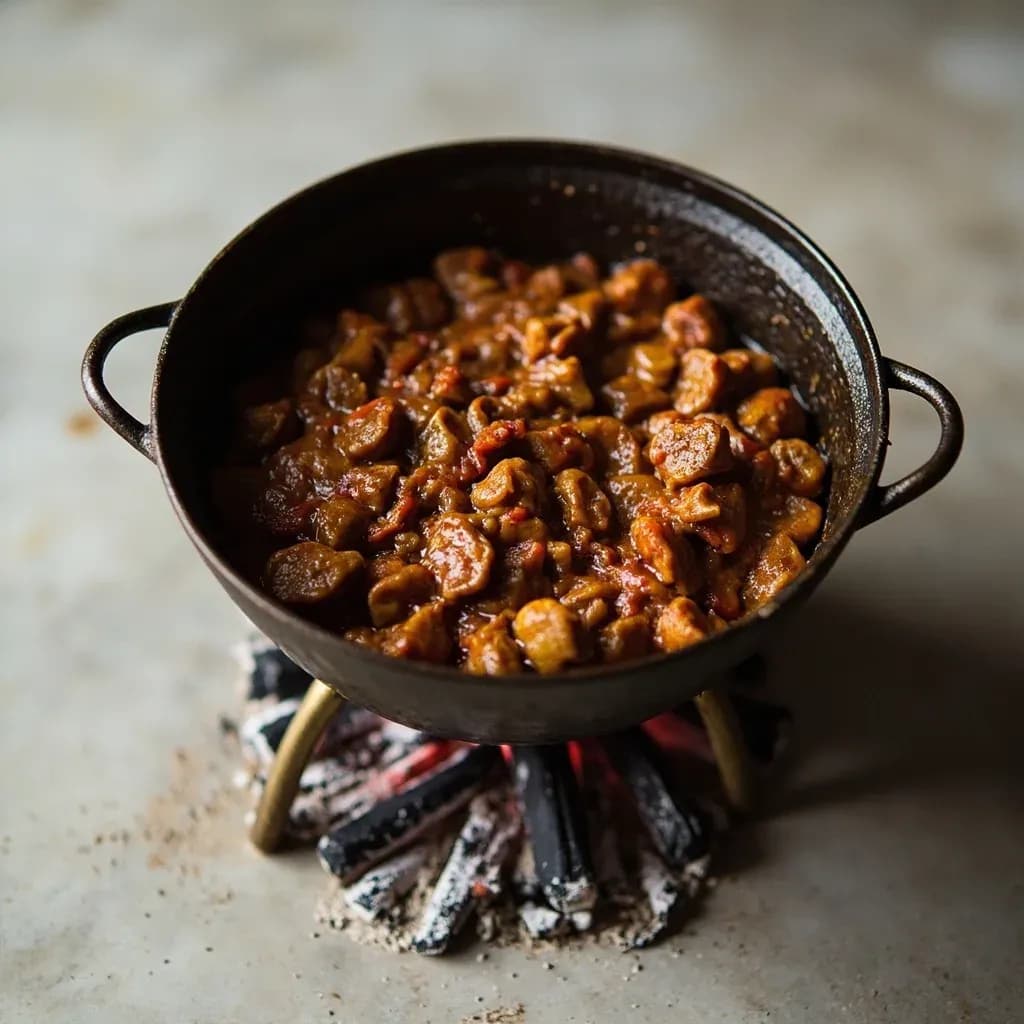
Potjiekos is the South African technique of slow-stewing layered ingredients in a round, three-legged cast-iron pot set over low coals. Meat is browned first, then vegetables are layered on top and the dish cooks gently with the lid on, traditionally without stirring so the layers steam and braise in their own juices. The long, undisturbed cook melds the flavors into a rich, tender stew.
Potjiekos — pronounced 'poy-kee-kos', from Afrikaans for 'small pot food' — is a South African slow-stewing technique built on three uncompromising principles: a heavy cast-iron three-legged pot, glowing wood or charcoal embers in place of a flame, and a layered arrangement of ingredients that is sealed with a lid and left strictly undisturbed. The dish descends from 17th- and 18th-century Dutch settler cookery, particularly the layered 'voerlappen' and 'hutspot' of the Low Countries, but its character is unmistakably African: the tripod pot sits stably on uneven ground beside a braai fire, the cooking is communal and unhurried, and the pot arrives at the table to be served from.
The genius of the method is that nothing is stirred. Tough, bone-in meat — lamb neck, mutton, oxtail, venison — goes on the bottom where rendered fat and juices slowly baste everything above; firm root vegetables (carrots, potatoes) follow; the most delicate items (green beans, mushrooms, baby marrows) sit at the top, cooking almost entirely in the rising steam. With only a cup or so of liquid added, the pot simmers at a temperature just below a real boil, concentrating flavor into a glossy, gelatin-rich sauce rather than diluting it.
A potjie is forgiving once assembled, but it rewards patience and the right equipment. A correctly sized pot (#2, around 2.5 L, is the family workhorse), a deep bed of embers rather than flame, embers shoveled onto the lid for top-down heat, and a long-handled potjie-tang for lifting are the small details that separate a memorable potjie from a burnt bottom and undercooked vegetables.
- Difficulty
- Medium
Types & varieties
Classic meat potjie: lamb, mutton, or beef on the bone, layered with root vegetables
Chicken potjie, often with bacon, mushrooms, and white wine or cream stirred in at the end
Game-meat version using venison, kudu, springbok, or warthog; often marinated in vinegar and bay
Cape Malay-influenced curry potjie, built on masala, turmeric, and dried fruit like raisins or apricots
Coastal seafood potjie, faster cooking, with linefish, mussels, prawns, and tomato
Bean-forward potjie, often including sugar beans, lamb, and smoked sausage (wors)
All-vegetable potjie, sometimes with samp (cracked maize) or barley, for fasting or side dishes
Long, gelatin-rich collagen cut cooked very low for the deepest, most unctuous gravy
How to do it
- 1
Prepare the coals and preheat the pot
Build a fire at least 45 minutes ahead so you have a deep bed of glowing embers — no flames. Place the empty three-legged pot on the embers for 10–15 minutes to heat through evenly. Cold cast iron is prone to sticking and uneven browning.
- 2
Heat fat and sweat aromatics
Add a generous splash of sunflower oil, butter, or rendered mutton fat. When it shimmers, add thickly sliced onions and a pinch of salt. Cook gently, stirring just at this stage, until softened and translucent (5–7 minutes).
- 3
Toast the spices and brown the meat
Push the onions aside. Add ground coriander, smoked paprika, a stick of cinnamon, juniper berries, and bay leaves; stir for 30 seconds until fragrant. Add the meat (bone-in lamb chops, neck, shin, oxtail, or stewing beef) in a single layer and sear briefly on one side — do not crowd. This step is optional in the strictest traditional method, but it deepens the gravy.
- 4
Begin layering (the point of no return)
Return any seared meat to the pot as the bottom layer, with bones and shanks placed snugly. From this point on you do not stir. Top with carrots, then potatoes and sweet potato, then butternut or pumpkin, and finish with the most delicate items — green beans, mushrooms, baby marrows, cauliflower florets, or baby onions.
- 5
Add liquid and final seasonings
Pour in stock, dry wine, or a mix — about 1–1.5 cups for a size #2 pot, just enough to come roughly one-third up the side. The vegetables will release their own moisture. Add a few whole peppercorns, extra bay leaves, and a sprig of thyme. Salt lightly; remember the sauce will concentrate.
- 6
Close the lid and position the coals
Place the lid on. Move the pot so it sits beside the hottest embers rather than over them, and use a shovel or tongs to pile a few embers on the lid. Top-down heat prevents the bottom from burning and gently steams the upper vegetables.
- 7
Cook undisturbed for 2–4 hours
A size #2 typically needs about 2.5 hours; larger pots and tougher game may need 4. Do not lift the lid. If the embers die down, gently rake fresh ones under and over the pot to keep a steady medium heat. You should hear a very gentle, almost silent simmer — not a vigorous boil.
- 8
Rest, finish, and serve
Lift the pot off the fire with a potjie-tang and set it on a wooden board or heat-safe mat to rest for 10–15 minutes. Optionally swirl in a knob of butter, a splash of cream (for hoenderpotjie), or fresh chopped parsley. Serve from the pot at the table, spooning the rich concentrated sauce over each portion alongside rice, pap, or crusty bread.
On the Table: Traditional Accompaniments
A potjie is rarely served alone; in the braai tradition it sits at the center of a spread of starches, salads, and condiments chosen to soak up the rich sauce and cut its concentration.
- Pap — plain maize-meal porridge, or tinged with tomato and onion as 'sous'
- Roosterkoek — griddle-cooked bread, split and buttered, for tearing and dipping
- A sharp green salad with vinaigrette to balance the gravy
- Atchar (Cape Malay pickle) alongside kerriepotjie
- Steamed rice or crusty country bread as modern alternatives
Caring for a Cast-Iron Potjie
A potjie is seasoned, not washed. With use the interior develops the same patina as a black skillet, and a new pot is best broken in with several rounds of fatty meat before being trusted with delicate fish or vegetable versions.
- After cooking, rinse with hot water only — never soap or harsh scrubbers
- Dry the pot on the embers or over low heat until all moisture has evaporated
- Wipe the interior thinly with sunflower oil or lard while still warm
- Store with the lid slightly ajar so air circulates and no musty odor develops
- A rusty pot is rescued by a salt-and-oil scrub, re-oiling, and a slow re-season
Common uses
Tips & pitfalls
- NEVER stir once the layering is complete — the no-stir rule is the defining principle; steam and rendered juices do the work of mixing.
- Layer in this order: meat (and bones) on the bottom, firm root vegetables next, the most delicate items (green beans, mushrooms, baby marrows) on top so they steam rather than crush.
- Preheat the empty potjie on the embers for 10–15 minutes, then brown the meat and sweat the onions in oil first — a dry sear develops the Maillard base that gives the gravy its depth.
- Add far less liquid than you think — typically 1 to 1.5 cups for a size #2 pot. The meat and vegetables release substantial juice; too much liquid turns the pot into a boil and dilutes the sauce.
- Place the pot beside the hottest embers rather than directly on top of them, and shovel a few embers onto the lid as well — top-down heat cooks the vegetables gently and prevents scorching on the bottom.
- Resist lifting the lid. Each lift costs 15–20 minutes of lost heat and steam. If you must peek, rotate the lid slightly to glimpse rather than removing it.
- Common mistake: using lean cuts such as sirloin or chicken breast. The dish needs fat and connective tissue to self-baste and to give the sauce body — choose shoulder, neck, shin, oxtail, or bone-in chops.
- Common mistake: opening the lid repeatedly to 'check'. Trust the layering, the coals, and the clock. The potjie has been cooking itself in South African backyards for centuries without a thermometer.
Good to know
- Origin
- South Africa, Afrikaner tradition, with roots in 17th–18th century Dutch settler cookery
- Language
- Afrikaans; 'potjie' = small pot, 'kos' = food
- Pronunciation
- poy-kee-kos (the pot itself: poy-kee)
- Skill level
- Beginner to intermediate; the technique is forgiving once assembled
- Active time
- 20–40 minutes of prep; otherwise hands-off
- Traditional equipment
- Three-legged cast-iron pot ('potjie'), sized #1 to #5; #2 (~2.5 L / 2.6 qt) is the family workhorse
- Heat source
- Wood or charcoal embers (coals), not open flame
- Cooking time
- 2–4 hours for a #2 pot; 4–5+ hours for #4–#5 competition pots
- Yield
- Size #2 feeds 3–4; size #3 (about 4.5 L) feeds 6–8
- Cousin traditions
- Dutch hutspot/voerlappen, French pot-au-feu, Brazilian panelada — all layered, slow, no-stir stews
- Cultural role
- Centerpiece of a 'braai' (South African cookout); often cooked competitively
Also called
sealing-cassola · Potjie · Pot Stewing
Related

Boil
Cook in vigorously bubbling liquid at full rolling heat

Simmer
Hold liquid at a gentle shimmer for tender, unhurried cooking

Poach
Cook gently in barely-trembling liquid for silky, tender results

Steam
Cook in rising vapor to keep color, nutrients, and shape intact

Blanch
Plunge briefly in boiling water, then shock cold to lock color

Braise
Sear, then cook slow in a little liquid until fall-apart tender

Stew
Simmer bite-sized pieces fully submerged into a rich, unified pot

Sous-Vide
Seal and cook in precise warm water for edge-to-edge doneness