Water & Steam
Stewing
Slow-cooking bite-sized food fully submerged in liquid into a rich, tender dish.
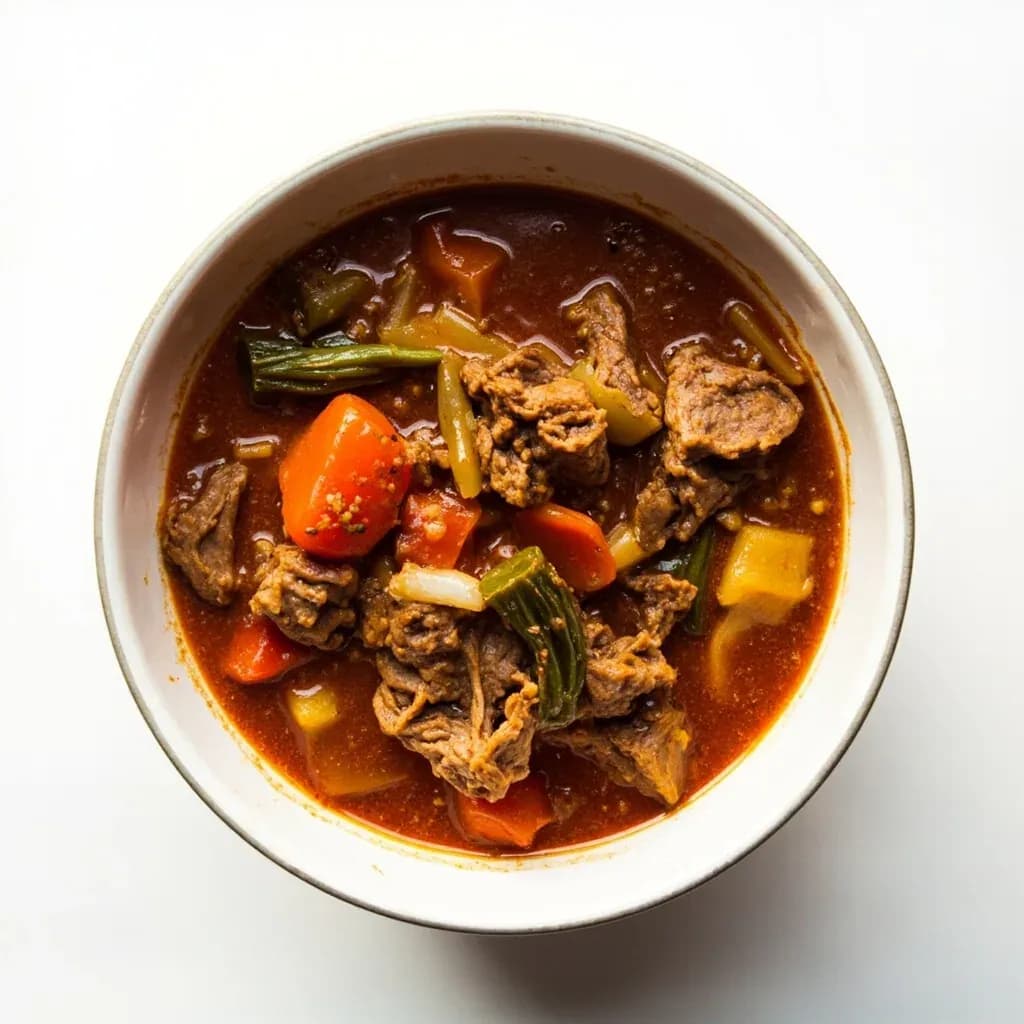
Stewing simmers small pieces of meat and vegetables fully covered in liquid over low heat for a long time, so everything turns tender and the liquid becomes a flavorful sauce. Unlike braising, the food is generally cut small and submerged rather than partly. It is the basis of countless one-pot dishes from Balkan gjelle to hearty meat-and-vegetable stews.
Stewing is the moist-heat technique of cooking small, uniform pieces of food fully submerged in a flavored liquid at a gentle simmer, typically 85–96°C / 185–205°F. It is one of the oldest and most economical methods in the kitchen, designed to transform tough, collagen-rich cuts of meat and fibrous vegetables into tender, deeply flavored dishes over the course of one to three hours. The slow, steady heat allows connective tissue to break down into gelatin, which both tenderizes the protein and gives the cooking liquid a silky, naturally thickened body that needs no additional flour or starch to coat a spoon.
Unlike braising, which surrounds larger cuts with a modest amount of liquid, or boiling, which uses vigorous 100°C heat, stewing keeps everything in continuous contact with the liquor. This constant immersion is what allows flavors to meld into a single, integrated sauce rather than a separately reduced gravy, and why the finished dish tastes unified rather than assembled. The result is a cohesive one-pot meal in which the meat, vegetables, and broth each carry notes of the others.
Because the food is cut small and the temperature is held low, stewing is remarkably forgiving. Meat cannot easily overcook at a bare simmer, and the liquid bath keeps the proteins moist throughout. The cook's real challenges are maintaining the correct temperature, layering ingredients by cooking time, and developing enough depth of flavor in the base through browning and fond before the liquid goes in.
- Difficulty
- Easy
Types & varieties
Meat is seared before liquid is added, producing deep color and a rich, glossy sauce.
White stew, classically poultry or veal, thickened with a roux and finished with cream or an egg-yolk liaison.
Provençal beef stew braised in red wine with aromatics, sometimes garnished with olives, mushrooms, and orange peel.
Belgian and northern French beef stew cooked in dark beer, often with onions and a touch of mustard or sugar.
French lamb stew with turnips, carrots, and spring vegetables, traditionally finished with pearl onions and peas.
Hungarian beef stew heavily seasoned with sweet and hot paprika, often thickened with flour or potatoes.
Lamb (sometimes mutton) stewed with potatoes, onions, and water or light stock; classically unthickened.
English lamb stew topped with overlapping slices of potato and baked long and slow.
Provençal fish stew with saffron, fennel, and leek; traditionally served with rouille and toasted baguette.
Italian-American seafood stew originating in San Francisco, built on a tomato and wine base with shellfish and firm fish.
North African stew named for the conical clay pot it cooks in; sweet-savory profiles with dried fruit, preserved lemon, and warm spices.
Polish hunter's stew of cabbage, sauerkraut, mushrooms, and mixed cured and fresh meats.
Southern U.S. stew traditionally made with squirrel or rabbit, now often chicken, with lima beans, corn, and tomatoes.
French boiled beef and root vegetables served in two courses: the broth first, then the meat and vegetables.
General French term for a stew, usually with seared meat and a thickened brown sauce.
Kentucky stew of mixed meats, often slow-cooked in large cauldrons for community gatherings.
How to do it
- 1
Prepare and cut the ingredients
Trim sinew and excess fat from the meat. Cut meat and vegetables into uniform 1–2 inch (2.5–5 cm) pieces so they cook at the same rate. Pat the meat dry with paper towels and season generously with salt and pepper. Have stock, wine, aromatics (onion, garlic, carrots, celery), herbs, and spices measured and ready.
- 2
Brown the meat in batches
Heat a heavy-bottomed pot or Dutch oven over medium-high with a thin film of oil or rendered fat. Sear the meat in small batches, turning to develop a deep brown crust on all sides. Transfer each batch to a plate. Do not crowd the pan — crowding causes steaming rather than searing.
- 3
Sweat the aromatics
Reduce the heat to medium. In the rendered fat, sweat diced onion, carrot, and celery until softened and lightly caramelized, 6–8 minutes. Add minced garlic and any dry spices (paprika, cumin, black pepper, peppercorns, bay leaf) and cook for 30–60 seconds until fragrant.
- 4
Deglaze the pot
Pour in wine, brandy, or stock and scrape the bottom of the pot with a wooden spoon to release the fond — the browned bits stuck to the surface. Reduce the liquid by about half to concentrate flavor and burn off raw alcohol.
- 5
Build the cooking liquid
Return the meat and any accumulated juices to the pot. Add stock, beer, crushed tomatoes, and/or water in enough quantity to fully submerge the ingredients. Tuck in bay leaves, thyme, parsley stems, and any other long-cooking herbs. Bring the liquid just up to a simmer.
- 6
Skim and hold at a simmer
As the liquid heats, skim gray foam and rising fat from the surface with a ladle or flat spoon. Once the liquid reaches a bare simmer — small bubbles breaking gently at the edges, not a rolling boil — partially cover the pot and reduce the heat to maintain that gentle temperature.
- 7
Add vegetables in stages
Add long-cooking root vegetables (carrots, potatoes, parsnips, turnips) about 45–60 minutes into the simmer. Add quicker-cooking vegetables (peas, green beans, leafy greens, sliced mushrooms) in the last 10–15 minutes so they retain color and texture.
- 8
Finish and rest
Cook until the meat is fork-tender and the liquid has reduced to a sauce that lightly coats a spoon. Taste and adjust salt, pepper, and acid. Stir in fresh tender herbs (parsley, chervil, tarragon), a knob of butter for sheen, or a splash of vinegar or lemon juice to brighten. Rest 10–15 minutes off the heat before serving.
How Stewing Differs from Braising, Boiling, and Poaching
Stewing is often confused with the moist-heat methods that surround it, but it sits in a precise middle ground defined by cut size, liquid volume, and temperature. The differences matter because each method produces a different texture, sauce, and finished dish.
- Braising uses large cuts (whole roasts, shanks, whole birds) and only enough liquid to partially submerge the food, typically finishing in the oven. Stewing uses small, bite-sized pieces fully submerged on the stovetop.
- Boiling operates at a full rolling boil of 100°C / 212°F and is reserved for pasta, grains, legumes, and stock production. The turbulence of a boil toughens proteins and emulsifies fat into cloudy liquid — the opposite of what a stew wants.
- Poaching uses even gentler heat (70–85°C / 160–185°F) and is reserved for delicate proteins like eggs, fish fillets, and chicken breasts. Poached proteins cook in minutes, not hours.
- The hallmarks of a true stew are small uniform pieces, full submersion in liquid, simmer-level heat, and a long enough cook time (typically 90 minutes or more for meat) to convert collagen into gelatin, giving the finished dish body, richness, and a naturally thickened sauce.
Common uses
Tips & pitfalls
- Cut meat and vegetables into uniform pieces so they finish cooking at the same time; mismatched sizes are the most common cause of uneven texture.
- Pat meat dry before searing — surface moisture prevents proper browning and a true crust.
- Brown meat in small batches; overcrowding the pot steams the meat and ruins the fond that gives the stew its base flavor.
- Hold a bare simmer — small bubbles breaking lazily at the edges. A hard boil toughens proteins and emulsifies fat into a greasy, cloudy sauce.
- Skim gray foam and excess surface fat during the first 30 minutes of cooking for a cleaner, more refined sauce.
- Layer ingredients by cooking time: roots and tough cuts go in first, tender vegetables and fresh herbs go in near the end.
- Deglaze the pot with wine or stock after browning to dissolve the fond into the sauce base — leaving it behind wastes the most flavorful part of the sear.
- Bloom dry spices (paprika, cumin, peppercorns) with the aromatics in fat so their flavors dissolve into the oil rather than washing away in liquid.
- Finish with a small splash of acid (vinegar, lemon juice, or wine) to lift and brighten the final dish after hours of slow cooking.
- Rest the stew 10–15 minutes off the heat so fat rises and flavors settle, and remember that most stews taste even better the next day once the ingredients have had time to meld.
Good to know
- Heat method
- Moist-heat, gentle simmer just below a true boil
- Temperature
- Approximately 85–96°C / 185–205°F
- Liquid level
- Food fully submerged in cooking liquid
- Typical cut size
- Uniform pieces, roughly 1–2 inches (2.5–5 cm)
- Cook time
- 1.5–3 hours for most meat stews; 30–60 minutes for seafood or vegetable stews
- Best cuts of meat
- Tough, collagen-rich cuts: chuck, shank, brisket, round, oxtail, pork shoulder, lamb neck
- Equipment
- Heavy-bottomed pot such as a Dutch oven, rondeau, or cast-iron vessel; slow cooker; or a clay vessel like a tagine
- Etymology
- From Old French 'estuver' meaning to enclose in a heated space; English noun 'stew' attested from the 14th century
Also called
Stew · Gjellë
Dishes that rely on it
Related

Boil
Cook in vigorously bubbling liquid at full rolling heat

Simmer
Hold liquid at a gentle shimmer for tender, unhurried cooking

Poach
Cook gently in barely-trembling liquid for silky, tender results

Steam
Cook in rising vapor to keep color, nutrients, and shape intact

Blanch
Plunge briefly in boiling water, then shock cold to lock color

Braise
Sear, then cook slow in a little liquid until fall-apart tender

Stew
Simmer bite-sized pieces fully submerged into a rich, unified pot

Sous-Vide
Seal and cook in precise warm water for edge-to-edge doneness