Prep & Assembly
Pounding Sambal (Sambal Matah/Goreng)
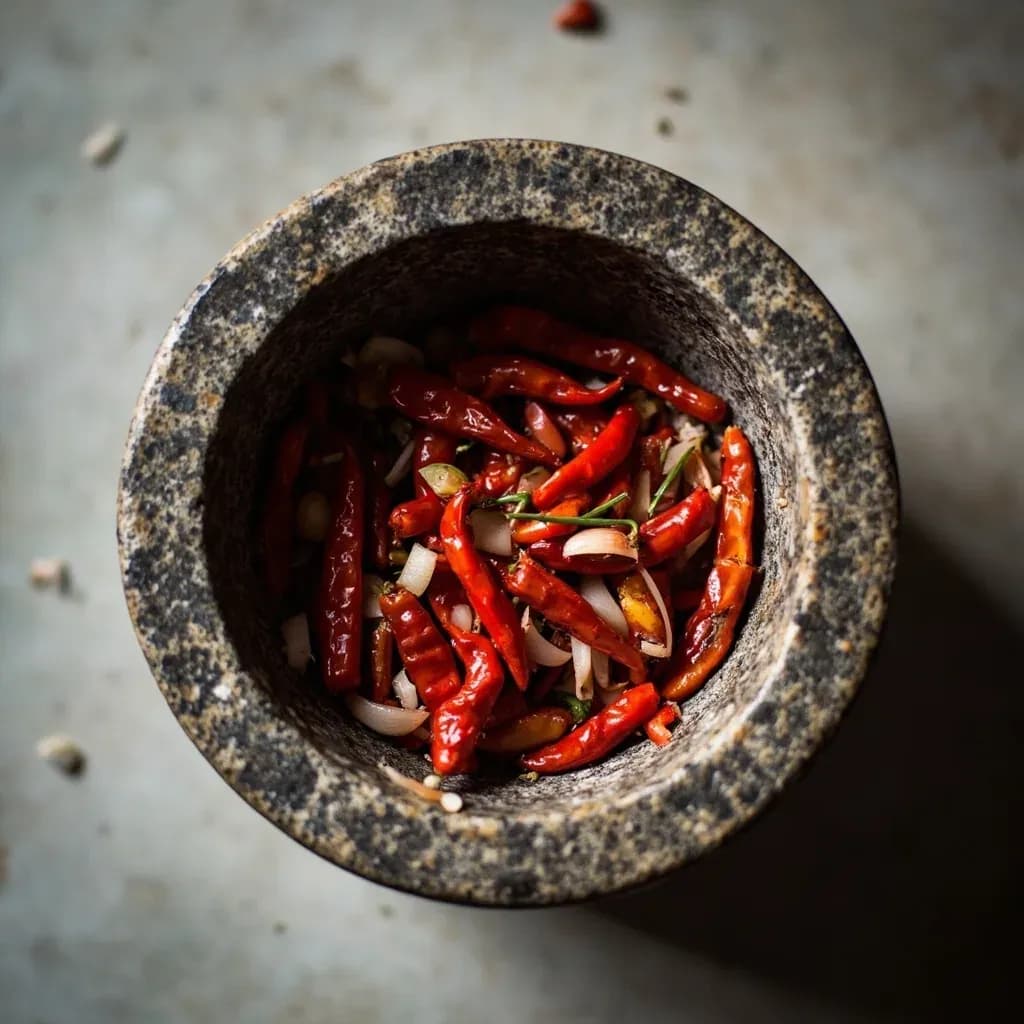
Crushing chilies, shallots, and aromatics in a mortar into Indonesian sambal paste.
Pounding sambal grinds fresh chilies, shallots, garlic, and aromatics in a stone mortar (cobek) into the rough, fragrant relish at the heart of Indonesian cooking. The pounding bruises and releases oils more flavorfully than a blender, giving sambal its characteristic uneven, lively texture. The raw version becomes sambal matah while the fried paste becomes sambal goreng, both built on this hand-crushed base.
Pounding sambal is the foundational Indonesian technique for turning chilies, shallots, and aromatics into the country's most important table condiment. Unlike a food processor, which chops at high speed and ruptures cells indiscriminately, a stone mortar and wooden pestle crush ingredients under controlled pressure — releasing essential oils from lemongrass, kaffir lime, and terasi while keeping the chili flecks intact and aromatic. The result is a coarse, fragrant paste with visible character that sits at the center of nearly every Indonesian meal, from a Balinese warung to a Javanese home kitchen.
The technique matters because texture is inseparable from flavor. A coarse paste delivers heat in bursts as you chew, releases aroma gradually on the palate, and holds its bright color better than a pulverized one. Pounding also lets you control which ingredients break down completely (hard candlenuts, fibrous lemongrass) and which stay ragged and chunky. It is the difference between a sambal that tastes alive on the tongue and one that reads as flat and one-noted.
Two major endpoints share this technique: Sambal Matah, a Balinese preparation that is classically knife-sliced but is increasingly light-pounded in modern versions, dressed with lime juice and wilted by smoking-hot oil; and Sambal Goreng, a fried paste that anchors stir-fries and table condiments. Both demand the same rhythm — rolling pressure rather than hammering, and the discipline to stop while the mixture still looks chopped rather than puréed.
- Difficulty
- Medium
Types & varieties
Balinese raw sambal; classically thinly sliced by knife, but modern home versions use a light pound. Shallot, lemongrass, kaffir lime leaf, bird's eye chili, toasted terasi, sea salt, and lime juice, often 'cooked' by pouring smoking-hot oil over the raw mixture.
Fried sambal; paste is pounded then sautéed in oil until fragrant and darkened. Anchors dishes like Sambal Goreng Ati (chicken liver) or Sambal Goreng Kentang (potato).
Sundanese/Javanese style; toasted shrimp paste is pounded in early so it emulsifies into the chili-shallot base.
Garlic-forward with a high garlic-to-chili ratio, pounded fine and fried until mahogany; long shelf life.
West Sumatran (Padang); green bird's eye chilies and green tomatoes, pounded and lightly cooked.
North Sulawesi; intensely hot, often including ginger, turmeric, and basil, pounded coarse.
Batak (Sumatra); combines chili with the uniquely citrusy-numbing andaliman pepper.
Manado specialty incorporating smoked roa fish, pounded together with chili for a pungent, savory paste.
Sliced (not pounded) raw chilies in sweet soy sauce — included as a sibling to clarify what 'sambal' covers.
How to do it
- 1
Prepare the ulekan and ingredients
Rinse and dry the stone mortar. Peel shallots and garlic; trim the tough outer leaves of lemongrass and bruise the lower third. Stem the chilies and decide whether to keep the seeds (full heat) or remove them (milder). Have coarse sea salt at the ready.
- 2
Start with the hard, dry, or oily aromatics
Add about 1 tsp coarse salt, 1–2 candlenuts (or a thumbnail-sized piece of toasted terasi), and any galangal or torch ginger. Pound first — these hard, gritty ingredients do the abrasive work that lets the alu break down everything that follows.
- 3
Pound shallots and garlic
Add peeled shallots and garlic cloves. Use a rolling-press motion: push down while turning the alu in a small circle. Aim to break each clove open, not to obliterate it. Stop when the pieces are split and ragged, about 1–2 minutes.
- 4
Add chilies
Tip in the chilies a handful at a time. Pound just enough to rupture the skins and seeds and bind the mixture into a coarse, damp paste with visible flecks. Do not chase a smooth result — over-pounding releases water and turns the sambal soupy and dull in color.
- 5
Add lemongrass and softer aromatics
For Sambal Goreng, pound the white part of the lemongrass in now. For Sambal Matah, slice the lemongrass paper-thin by knife and add at the end, along with thin-sliced kaffir lime leaves folded in last so they stay bright green and aromatic rather than bruised and bitter.
- 6
Season and finish
Stir in additional salt to taste. For Sambal Matah, add the juice of 1–2 limes and a small spoon of toasted terasi crumbled in. For Sambal Goreng, heat 2–3 tbsp neutral oil in a pan until shimmering, add the pounded paste, and fry 3–5 minutes until darkened and the oil begins to separate at the edges.
- 7
Rest and serve
Raw sambal tastes best after 10–15 minutes of rest so the salt can draw out juices and meld the aromatics; serve at room temperature alongside rice and protein. Sambal Goreng can be served warm or cold and improves on standing overnight in the refrigerator.
Matah vs. Goreng: where the technique splits
Both styles begin in the mortar and end with a coarse, aromatic paste, but they diverge sharply at the finish. Sambal Matah classically stays raw and unheated: shallots, lemongrass, and chilies are sliced paper-thin by knife, bound with lime juice and sea salt, and a small amount of smoking-hot oil is poured over the top to wilt the herbs and bloom the chili's perfume without actually cooking the mixture. Modern home cooks often collapse that knife work into a light pound for speed — the result is still raw, still acidic, but with slightly more ragged pieces. Sambal Goreng, by contrast, is fried. The pounded paste goes into hot oil and cooks 3–5 minutes until the color darkens to a brick red and the oil begins to separate at the edges — a sign the water has cooked off and the flavors have concentrated. The two share a tool and a rhythm, but Matah is about freshness and acid, Goreng about depth and shelf life.
- Matah: raw, lime-bright, served within hours; chili stays vivid red or green.
- Goreng: cooked, oil-rich, deeper and more stable; keeps a week or longer refrigerated.
- Both should keep visible flecks — a glossy, uniform paste has been overworked or blended.
The role of salt and grit
The first ingredient into the mortar is not chili — it is coarse sea salt (or a candlenut, or a thumbnail of toasted terasi). The reason is mechanical: a stone surface needs an abrasive to break chili skins efficiently, and the wooden alu alone tends to skate across wet ingredients. Salt crystals, candlenut meal, or crumbled terasi act as the sandpaper that lets the pestle grip, crush, and rupture cells rather than push them around. This is why a paste pounded without any abrasive turns into a thin, dull slurry — the chilies rupture from shear alone and never release their oils properly.
Common uses
Tips & pitfalls
- Add coarse sea salt or a candlenut first — the grit is the abrasive that lets a wooden alu break down chili skins without crushing the seeds to dust.
- Pound firm, fibrous ingredients (galangal, lemongrass, candlenut, terasi) before softer ones; softer ingredients crush faster and turn to mush if hit first.
- Use a rolling-pressing motion — push down while rotating the pestle in a small circle — instead of straight-down hammering; this ruptures cells without pulverizing them.
- Stop while the texture is still coarse. A common mistake is over-pounding into a wet slurry; sambal should look chopped, not puréed.
- For Sambal Matah, slice the kaffir lime leaves and most of the lemongrass thinly by knife and fold in at the end — pounding them too hard releases bitter chlorophyll and dulls the citrus aroma.
- Toast terasi wrapped in foil or over a flame for 30–60 seconds before pounding; raw terasi tastes flat and soapy.
- A blender or food processor gives the wrong texture and oxidizes chilies; reserve it only for large-batch Sambal Bawang where a finer result is acceptable.
- Deseed chilies for a milder paste; keep seeds for full heat. Indonesian cabe rawit is noticeably hotter than Thai bird's eye of the same size — adjust accordingly.
Good to know
- Origin
- Indonesia, archipelago-wide; the canonical raw version (Sambal Matah) is specifically Balinese
- Tool of choice
- Ulekan (granite mortar) with alu (wooden pestle); a Mexican molcajete is a workable substitute
- Core ingredients
- Bird's eye chilies (cabe rawit), shallots, garlic, coarse salt; matah adds lemongrass, kaffir lime leaf, terasi, and lime; goreng adds oil and often tomato or candlenut
- Pounding motion
- Rolling, downward-and-arc pressure — never straight hammering — crushes fibers without liquefying
- Target texture
- Coarse paste with visible flecks, never a smooth purée like a processor produces
- Active time
- Roughly 10–20 minutes of pounding for a small batch (4–6 servings)
- Yield
- About 100–150 g of paste from 50 g chilies, 100 g shallots, and aromatics
- Difficulty
- Moderate; easier than Thai curry paste, harder than chopping — requires rhythm and pressure control
- Storage
- Raw sambal: 3–5 days refrigerated under a thin oil cap; Sambal Goreng: up to 2 weeks refrigerated
Also called
Cobek Pounding · Sambal Grinding
Dishes that rely on it
Related

Whisk
Beat ingredients smooth and aerated with a looping wire motion

Sift
Pass dry ingredients through mesh to aerate and remove lumps

Strain
Pour through mesh to separate solids from liquid for a smooth result

Filter
Pass liquid through fine material to clarify out the smallest particles

Rice
Press cooked potatoes through small holes for fluffy, lump-free texture

Mash
Crush soft cooked food into a rustic, creamy purée

Grind
Crush food into a coarse to fine texture, from spices to meat

Grate
Shred food into fine bits against a sharp-toothed surface