Prep & Assembly
Sambusa Wrapping & Folding
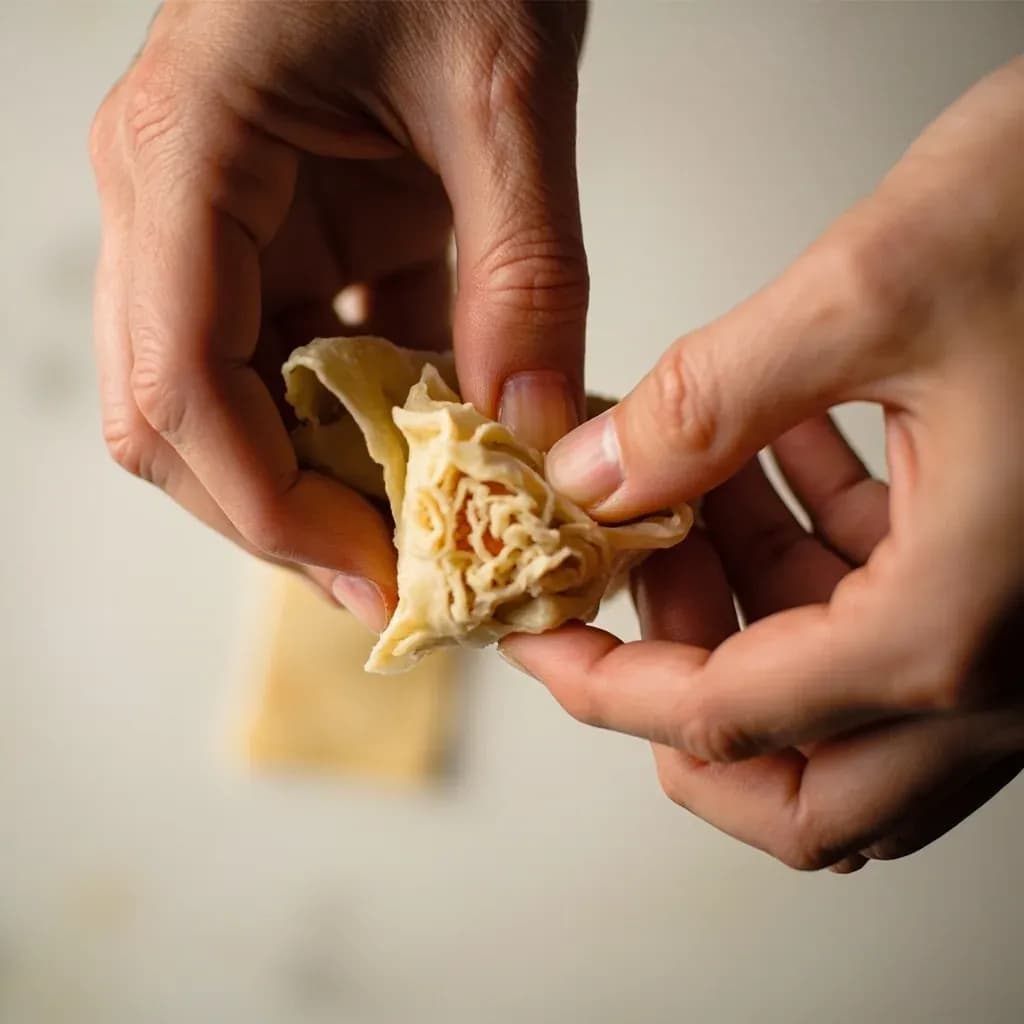
Folding pastry strips into neat sealed triangles around a savory filling.
Sambusa wrapping and folding turns a strip of thin pastry into a tidy triangular pocket around a spiced meat or vegetable filling, the East African and South Asian samosa. The strip is folded corner over corner into a cone, filled, then sealed with a flour-water paste so it stays closed when fried. Clean, tight folds and a good seal keep the filling in and the fried triangle crisp.
Sambusa folding is the hand skill that turns a flat sheet of dough and a spoonful of filling into a sealed, fryable pocket. In practice it covers two related but distinct techniques: building a cone from a round or half-moon of dough, and pleating a long rectangle into a continuous triangle. Both depend on the same three disciplines — a rested, evenly rolled wrapper; a cool, dry filling that mounds cleanly; and a reliable wet seal — and both reward the cook with the same payoff, a crisp, split-proof shell that shatters when bitten and steams the filling inside.
The name descends from Persian sanbosag, documented in 10th–13th century Arabic and Persian cookbooks including al-Warraq's Kitab al-Tabikh, and the technique spread along the Indian Ocean and Silk Road trade routes, settling into the Punjabi samosa, the Somali and Yemeni sambuusa, the Lebanese fatayer, the Turkish börek, and the Southeast Asian karipap along the way. Each cuisine adjusted the fold to suit its wrapper of choice: rounds and half-moons for cone-shaped samosas and fatayer, long rectangles for the flag-style triangle favored in the Horn of Africa and across the filo-using world.
Learning both folds is the real unlock. A cook who can shape a cone and pleat a triangle can move across half a dozen cuisines without changing the filling, switching between deep-fried street food, oven-baked party pieces, and frozen make-ahead batches using the same muscle memory.
- Difficulty
- Medium
Types & varieties
Triangular-pyramid cone from a single round or half-round of maida dough; deep-fried. The canonical Punjabi and Uttar Pradesh shape.
Three-cornered, flatter triangle folded from a long rectangle of filo or homemade dough; shallow- or deep-fried.
Closed triangle from a round of soft dough, sealed along the top with a rope-style crimp; usually baked.
Half-moon crescent and triangle both exist side by side, often with spiced meat or cheese fillings.
Thin yufka or filo sheets hand-rolled around filling in a single continuous triangular pleat.
Curry-puff variant: round wrapper folded in half into a half-moon, edges crimped with a fork.
Long rectangle wrapped in flag-style triangular pleats; the same technique behind Thai-style curry puffs made with spring-roll wrappers.
How to do it
- 1
Prepare the dough and filling
Make or unwrap your dough; let homemade dough rest 30 minutes wrapped in plastic so the gluten relaxes. Prepare the filling and cool it to room temperature, or chill it briefly. It should hold a mound on a spoon without weeping or slumping — wet fillings are the leading cause of split sambusa.
- 2
Portion the wrappers
For the cone method, roll dough to about 2 mm and cut 10–12 cm rounds, or halve them into half-moons. For the strip-fold, cut rectangles about 8 × 25 cm. Keep all cut pieces under a barely damp cloth; exposed dough dries in minutes and refuses to seal.
- 3
Form the cone
Take a round (or a half-round with the straight edge toward you). Brush the perimeter lightly with water or flour paste. Bring two opposite edges together so one overlaps the other by about 1 cm, forming a smooth cone with a sealed side seam and a 2–3 cm open top. Pinch the seam firmly to seal.
- 4
Fill the cone
Hold the cone upright in one hand. Drop in 1–2 teaspoons of cooled filling, roughly 15–25 g, never more than two-thirds full. Press the filling down gently with the spoon so air is not trapped at the bottom — trapped steam will burst the seal.
- 5
Close the cone
Brush the inner rim of the open mouth with water or flour paste. Fold the top edges down together over the filling, making two or three small pleats if needed, and press to seal flat. For the fatayer-style finish, pinch the mouth into a tight rope crimp by folding one side over the other in a zigzag along the seam.
- 6
Set seam-side down to rest
Place each finished piece on a parchment-lined tray with the seam or crimp facing down. The resting weight helps the seal set. Cover with a cloth and fold the entire batch before you start frying or baking so every piece has had a few minutes to dry-set.
- 7
Strip-fold a continuous triangle
Lay a long rectangle of filo or a spring-roll wrapper on the board. Place a tablespoon of filling near one short end. Fold that corner diagonally over the filling to make a triangle. Continue folding the triangle over itself along the strip, keeping the seam side down, until the strip is used up and you have a flat triangular packet. Seal the final loose tip with a dab of paste.
- 8
Fry or bake
Deep-fry 3–4 at a time at 170–180 °C / 340–355 °F until deeply golden, turning once, about 2–4 minutes total. For baking, brush with oil or egg wash and bake at 200–220 °C / 400–425 °F on a lined tray until golden and crisp, 18–25 minutes.
- 9
Drain and serve
Lift fried sambusa onto a wire rack rather than paper towels — trapped steam softens the crust. Serve hot, ideally within 10 minutes, with mint chutney, tamarind-date chutney, or zhoug.
Choosing the fold for the wrapper
Folding style is dictated by the shape you cut from the dough, and the shape is dictated by the wrapper. Rounds and half-moons yield cones; long rectangles yield continuous triangles. If you are working with commercial filo, think in rectangles: stack two sheets brushed with oil or ghee and cut 8 × 25 cm strips. If you are working with a homemade maida dough for samosa, roll and cut rounds about 10–12 cm across, or halve them into half-moons for smaller, neater cones. Wonton skins and brick wrappers are too small to pleat, so use them cone-style with a teaspoon of filling.
The three rules a sealed sambusa obeys
Every working fold comes back to the same three habits, and breaking any one of them is what causes a split in the fryer.
- Wrapper is rested, evenly rolled, and covered — dried edges will not seal and thick spots fry at a different rate from thin ones.
- Filling is cool and dry — steam from hot filling puffs the pastry apart; excess water from spinach, potato, or onion seeps through the seam and turns the crust soggy.
- Seam is wet, pressed, and rested seam-side down — gravity does half the work of setting the seal while the batch is assembled.
Reading the regional split
Across the sambusa world, the cone and the triangle are not just shapes but regional signatures. The Indian subcontinent, North African briouates, and the Levant lean cone and half-moon. The Horn of Africa, Yemen, and the broader filo-using Mediterranean world lean the three-cornered triangle. A cook who masters both can move from a Punjabi potato samosa to a Somali beef sambuusa without changing the filling — only the wrapper cut and the hand motion.
Common uses
Tips & pitfalls
- Roll homemade dough to a uniform 1.5–2 mm; thin spots and thick spots fry at different rates and crack open at the seams.
- Keep all cut wrappers under a barely damp cloth while you work — exposed dough dries in minutes and will not take a seal.
- If using filo, layer two sheets brushed with oil or melted ghee — a single sheet is too fragile to hold heavy fillings.
- Cool hot fillings to room temperature, or chill them, before folding. Steam from warm filling puffs the pastry and bursts the seal.
- Drain wet fillings thoroughly and sauté off excess moisture; onions, spinach, and potato should be pressed or cooked dry before they go into the dough.
- Use a thin flour-and-water paste (about 1:2) instead of plain water — it grips oily or egg-washed doughs much more reliably.
- Do not overfill. Leave at least 1 cm of clean dough above the filling line so the closing pleat has material to seal against.
- Fry in small batches. Crowding drops the oil temperature and yields greasy, splitting sambusa.
- Rest folded pieces seam-side down on the tray so the seal sets against gravity, and always drain fried sambusa on a wire rack, not paper towels.
Good to know
- Origin of the dish
- Persian sanbosag/sanbūsaj, attested in 10th–13th century Arabic and Persian cookbooks including al-Warraq's Kitab al-Tabikh.
- Two dominant fold families
- Cone (three-sided pyramid from a round or half-moon) and continuous triangle (flag-style pleating of a long strip).
- Common wrappers
- Hand-rolled maida-style wheat dough, filo/phyllo, brick (spring-roll) wrappers, wonton skins, and shortcrust-style dough for baked versions.
- Wrapper thickness
- Handmade dough rolled to roughly 1.5–2 mm; commercial filo used as-is at about 0.1 mm per sheet.
- Pastry-to-filling ratio
- Roughly 1:1 by volume; overfilling is the single most common cause of splitting in the fryer.
- Reliable sealant
- A thin flour-and-water paste (about 1 part flour to 2 parts water) grips better than plain water; egg white works on rich doughs.
- Frying window
- 170–180 °C / 340–355 °F for 2–4 minutes; baked versions at 200–220 °C / 400–425 °F for 18–25 minutes.
- Make-ahead storage
- Uncooked sealed pieces keep 24 hours refrigerated on a floured tray, or up to 3 months frozen on a parchment-lined sheet; fry straight from frozen, adding 30–60 seconds.
Also called
Samosa Folding · Sambusa Folding
Related

Whisk
Beat ingredients smooth and aerated with a looping wire motion

Sift
Pass dry ingredients through mesh to aerate and remove lumps

Strain
Pour through mesh to separate solids from liquid for a smooth result

Filter
Pass liquid through fine material to clarify out the smallest particles

Rice
Press cooked potatoes through small holes for fluffy, lump-free texture

Mash
Crush soft cooked food into a rustic, creamy purée

Grind
Crush food into a coarse to fine texture, from spices to meat

Grate
Shred food into fine bits against a sharp-toothed surface