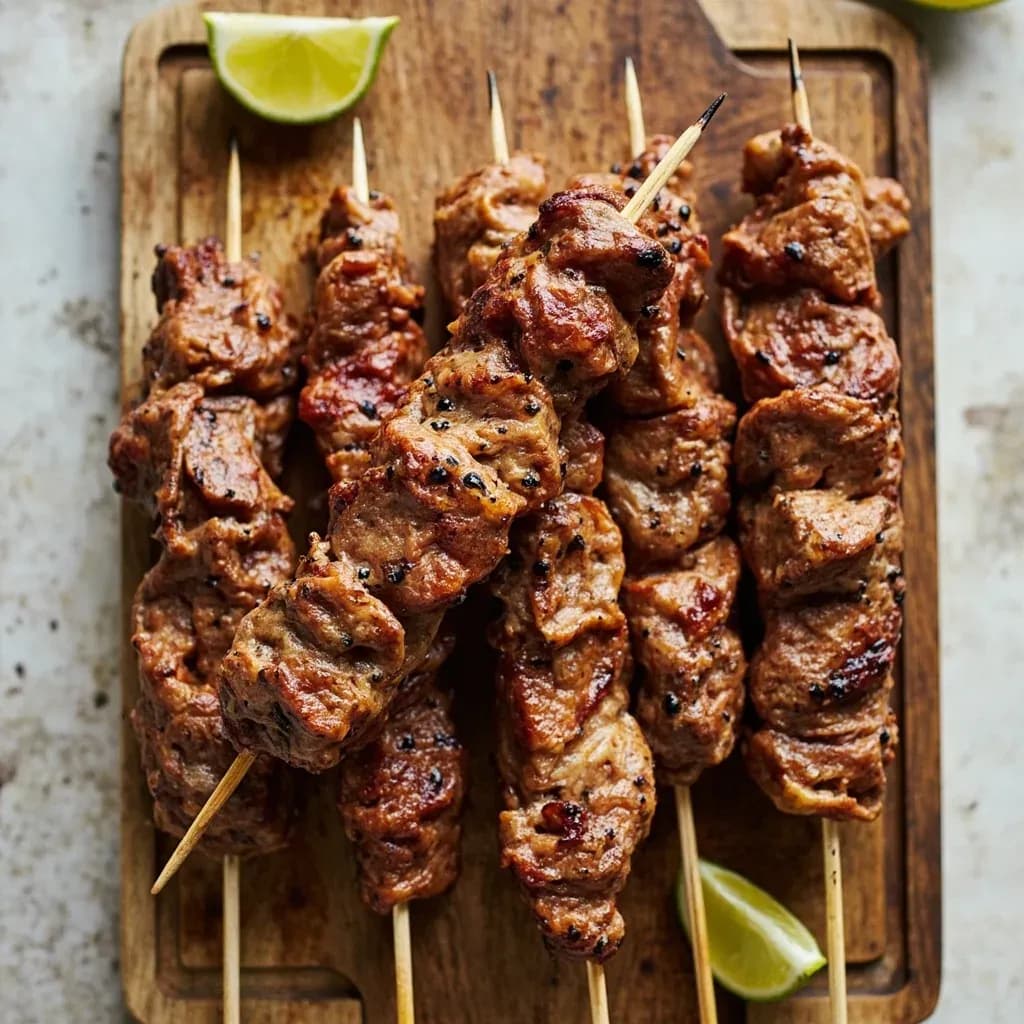
Prep & Assembly
Skewering Satay (Sate Lilit Moulding)
Threading or moulding seasoned meat onto skewers for grilling as satay.
Skewering satay threads marinated meat onto bamboo or metal skewers for grilling, while the Balinese sate lilit variant moulds a seasoned minced-meat paste around a flat lemongrass or bamboo stick. Even spacing and firm packing keep the meat from spinning and ensure it cooks uniformly over the fire. Pre-soaking bamboo skewers prevents them from burning on the grill.
Sate lilit moulding is a Balinese technique for making satay in which a highly seasoned, paste-like meat mixture is wrapped around flat bamboo skewers rather than threaded as cubes. The Indonesian word lilit means "to wrap around," and that single idea distinguishes the technique from the better-known Madurese, Padang, and Javanese satays built from chunks of meat on round sticks. The result is a continuous, sausage-shaped log of meat and coconut that grills evenly, picks up smoke uniformly, and stays moist thanks to the grated coconut folded into the mix.
The technique rests on three things working in concert. The meat must be finely minced or hand-chopped so it behaves as a cohesive paste, not as separate pieces. The skewer must be flat, not round, so the mixture has a surface to grip during flipping. And freshly grated coconut must be kneaded into the mix as both binder and signature aromatic — it is the element that makes sate lilit recognisable from the first bite. Once these are in place, the method is forgiving and scales linearly from a small starter portion to a crowd-sized batch.
Grilled over coconut-shell charcoal, the lilit blister lightly on the outside while the coconut toasts and perfumes the meat, producing a finish closer to a small grilled sausage than to a typical cubed satay. Sate lilit is eaten hot off the grill, traditionally with steamed rice, lawar, and sambal matah, and the contrast between the smoky, coconut-rich skewer and the fresh, raw shallot–lime relish is central to the dish.
- Difficulty
- Medium
Types & varieties
The classic Hindu-Balinese version, often considered the benchmark; the fat content keeps it moist on the grill
Leaner version; thigh mince is preferred over breast for juiciness
Commonly tuna (tongkol) or mackerel; the coconut ratio is often slightly higher to compensate for drier flesh
Less common in Bali, more typical outside the island; benefits from longer marination
Hand-chopped (not machine-minced) variant giving a looser, more rustic texture with visible meat strands
How to do it
- 1
Make the spice paste (base genep)
Finely grind or pound shallots, garlic, candlenuts, coriander seed, white pepper, turmeric, and a small knob of shrimp paste if using. The paste should be wet and almost smooth so it distributes evenly through the mince; a few coarse flecks are fine, but no whole seeds or chunks should remain.
- 2
Slice the aromatics
Very thinly slice the tender inner part of the lemongrass and stack-and-shred the kaffir lime leaves into a fine chiffonade. The pieces should be small enough to bind into the mince but still visible, so they perfume every bite rather than disappearing into the background.
- 3
Combine mince, coconut, and aromatics
In a mixing bowl, combine 500 g finely minced meat with 100–150 g freshly grated coconut, the spice paste, the sliced aromatics, 1 tsp salt, and 1 tsp palm sugar. Mix by hand in a single direction until the mixture becomes tacky and holds together cleanly when squeezed in the palm.
- 4
Marinate
Cover and rest at least 30 minutes at room temperature, or 2–4 hours in the refrigerator. Overnight is better still for pork and fish, because the grated coconut slowly absorbs the aromatics and the salt distributes through the proteins.
- 5
Wet hands and mould onto skewers
Hold a flat bamboo skewer in one hand. With the other hand dampened with cold water, pinch roughly 60–80 g of mixture and press it along the skewer, leaving 2–3 cm bare at one end as a handle. Smooth with damp fingers into an even cylinder about 1–1.5 cm thick, pressing firmly so the paste grips the flat surface.
- 6
Set aside on a tray
Lay the moulded lilit on an oiled or parchment-lined tray in a single layer; cover if not grilling within 30 minutes. Do not stack them, as the weight will deform the cylinders and they will not sit flat on the grill.
- 7
Heat the grill
Light coconut-shell charcoal (or charcoal briquettes) and wait until the coals are ashed over and glowing medium. You should be able to hold your hand 10 cm above the grate for 4–5 seconds; high heat will char the coconut before the centre cooks.
- 8
Grill, turning often
Lay the lilit perpendicular to the grill bars. Grill 2–3 minutes per side, turning every 30–45 seconds for even colour. The surface should be lightly blistered and golden-brown with a few charred edges, and the coconut should smell toasted, not burnt.
- 9
Check doneness and serve
Cut into the thickest lilit to confirm the centre is cooked through — no translucency in pork or chicken, and opaque flakes in fish. Serve immediately with steamed rice, sambal matah, and a wedge of lime.
The flat skewer principle
Sate lilit cannot be made on round skewers. The mince needs a flat surface to grip, and the broad contact area of a flat slat also helps the paste brown evenly against the grill. Round metal or bamboo skewers let the mixture slide off the moment it heats and loosens, which is why most failed lilit end up in the coals rather than on the plate.
- Use flat bamboo skewers cut to 15–20 cm; the typical lidi bambu pipih sold for Balinese grilling is ideal.
- If only round skewers are available, shave one side flat with a sharp knife to create a gripping surface.
- Soak briefly only if a long stretch of bare skewer is exposed to flame; the meat itself protects the rest.
Coconut as binder and signature
Freshly grated coconut does two jobs at once. It holds the mince together as a mouldable paste, and it perfumes the meat with a toasted, slightly sweet aroma as it grills. This is why sate lilit tastes the way it does, and why the dish cannot be made convincingly with desiccated coconut unless it is first rehydrated with a little warm water or coconut milk.
- Use freshly grated coconut at roughly 20–30% of the weight of the mince; less and the mixture will not bind, more and it will feel greasy.
- If the mix feels dry during moulding, a tablespoon of coconut milk restores tackiness without diluting flavour.
- Toast the grated coconut very lightly in a dry pan before mixing for a deeper, nuttier note.
Common uses
Tips & pitfalls
- Use flat, not round, skewers — round ones let the mince slide off the moment you flip them.
- Wet your hands with cold water before moulding; dry hands make the mixture stick to your palms rather than to the skewer.
- Press the mince firmly onto the skewer and smooth it; loose packing is the most common reason lilit falls into the fire.
- Aim for a uniform 1–1.5 cm thickness — too thick and the centre stays raw while the outside burns.
- Marinate longer than you think; the grated coconut absorbs flavour gradually and the texture firms up.
- Grill over medium heat, not high; high heat chars the coconut before the meat cooks through.
- Turn every 30–45 seconds for even colouring, and never leave a skewer stationary on one face.
- If the mixture feels dry, add a tablespoon of coconut milk or oil to restore tackiness.
Good to know
- Origin
- Bali, Indonesia — a regional variant of satay distinct from the cubed, threaded styles of Madura, Padang, and Java
- Also known as
- Sate Lilit Bali; 'lilit' means 'to wrap around' in Balinese
- Skewer type
- Flat bamboo skewers (lidi bambu pipih), 15–20 cm long; the flat profile is essential for the mince to grip
- Meat form
- Finely minced or hand-chopped — never cubed; the texture is paste-like so it can be moulded
- Key mix-in
- Freshly grated coconut (kelapa parut) — the signature ingredient that binds and perfumes
- Yield
- Roughly 60–80 g raw mixture per 18 cm skewer; about 10–12 skewers per 500 g mince
- Cook time
- 8–12 minutes over medium charcoal heat, turning frequently
- Internal target
- 74 °C / 165 °F for pork and chicken; 63 °C / 145 °F for fish
Also called
Sate Lilit Moulding · Satay Skewering
Related

Whisk
Beat ingredients smooth and aerated with a looping wire motion

Sift
Pass dry ingredients through mesh to aerate and remove lumps

Strain
Pour through mesh to separate solids from liquid for a smooth result

Filter
Pass liquid through fine material to clarify out the smallest particles

Rice
Press cooked potatoes through small holes for fluffy, lump-free texture

Mash
Crush soft cooked food into a rustic, creamy purée

Grind
Crush food into a coarse to fine texture, from spices to meat

Grate
Shred food into fine bits against a sharp-toothed surface