Heat & Fire
Smashing (Smash Burger)
Pressing a loose beef ball flat onto a screaming-hot griddle for a thin, lacy, deeply browned crust.
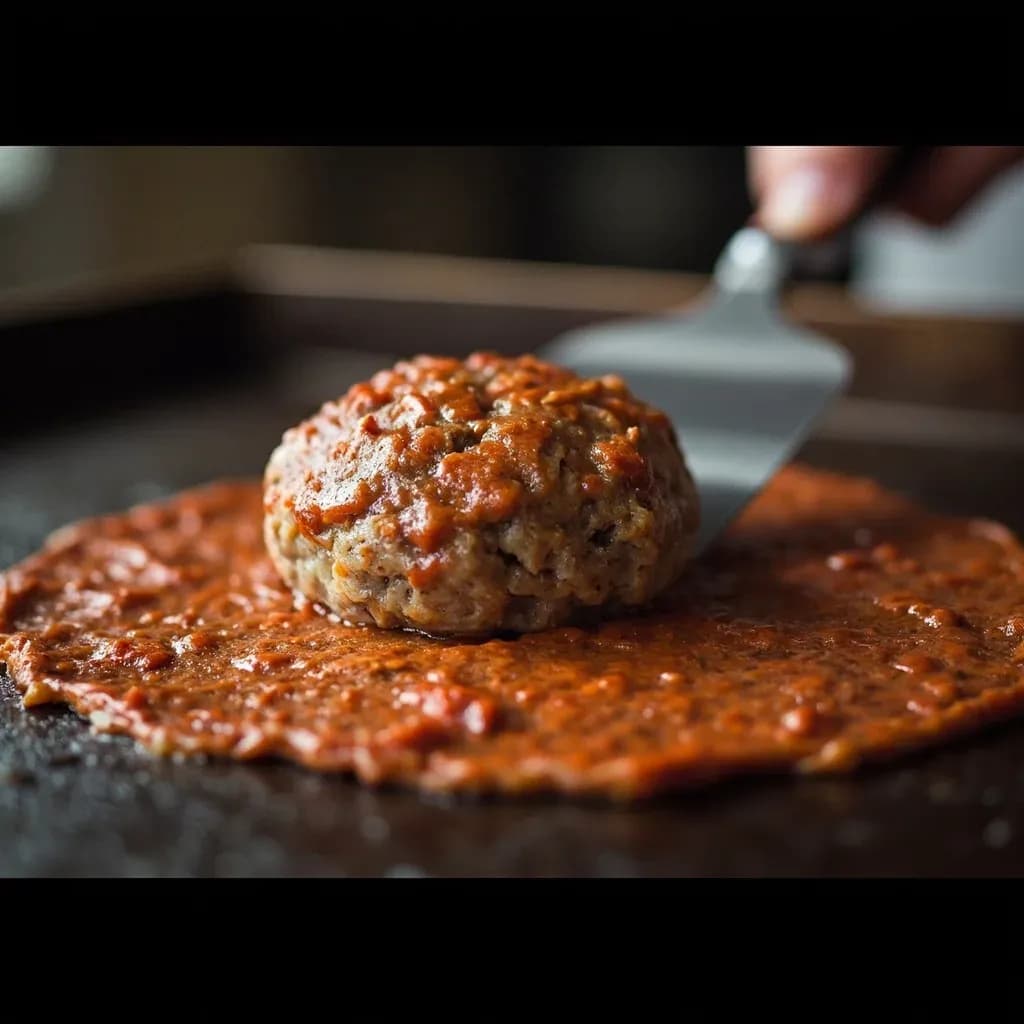
The smash technique drops a loose ball of ground beef onto a very hot flat-top and presses it hard and thin within seconds, maximizing contact for an intense Maillard crust. The thinness and direct steel contact create craggy, lacy, deeply browned edges that a thick patty cannot. The smash is done only once and only at the start, because pressing later would squeeze out the juices.
Smashing is the technique of pressing a loose ball of ground beef flat against a very hot, flat cooking surface within seconds of contact, then leaving it alone while a deep, lacy, mahogany crust develops. The defining goal is maximum surface contact between meat and metal, which drives a fast, intense Maillard reaction across the entire face of the patty. The result is a paper-thin, ultra-crisp outer shell that gives way to a juicy, lightly pink interior — a texture contrast that thicker patties cooked over open grates simply cannot reach. Smash-burger cooking is, in essence, controlled searing in two dimensions rather than three.
The technique's behavior is governed by a brief but critical sequence: when the cold meat hits a 450–550 °F surface, surface moisture flashes to steam, the patty momentarily lifts, and the dehydrating meat fuses to the metal. That bond is what browns. If the cook is timid, late, or uses lean beef, no fusion happens — the patty slides around grey and dry, and the signature crust is lost. Smashing is therefore less about ingredients than about timing, temperature, and pressure: a hard, single press held for ten to fifteen seconds, applied in the first moments, on a surface hot enough to sear instantly.
Historically the technique traces through Depression-era diners — most famously Steak 'n Shake in Normal, Illinois, where the 'Steakburger' on grilled bread dates to 1934, and the Oklahoma onion burger in El Reno, where sliced onions were smashed into the patty itself as a way to stretch cheap beef. A second wave of attention came in the 2010s from American burger bars that standardized the double-smash with American cheese as a house order. Today smashing is a default cookery skill rather than a regional curiosity, applied on flat-tops, cast iron, and even planchets in fine-dining kitchens.
- Difficulty
- Easy
Types & varieties
One thin patty, American cheese, onion, pickles, and sauce on a soft potato bun.
Two patties smashed separately with cheese laid between them so it melts into a single layer; the standard order at most dedicated shops.
Sliced onions are placed on top of the raw ball and smashed into the beef, caramelizing directly into the crust; originated in El Reno, OK in the 1920s.
Thin patty pressed onto buttered, grilled bread rather than a bun, served open-faced or flipped.
Four smashed patties layered with cheese; a hallmark of the 2010s American smash-burger revival.
Upscale variant using dry-aged or custom-blended beef (brisket, chuck, short rib, sirloin) on a cast-iron planchet, often with non-traditional toppings.
How to do it
- 1
Preheat the cooking surface
Bring a flat-top griddle or 12-inch cast-iron skillet to 450–550 °F (230–290 °C). The surface should be at the smoking point; a water drop should skitter and dance across the metal (the Leidenfrost point) before evaporating.
- 2
Portion cold beef into loose balls
Divide 80/20 (or 70/30) ground beef into 2–3 oz (55–85 g) loose balls. Do not compress, shape, or pack them — handle as little as possible, and keep refrigerated until the moment of cooking.
- 3
Place and smash
Set a ball on the hot surface. Within 5–10 seconds, press it flat with a stiff metal spatula (a small square of parchment between spatula and meat prevents sticking and tearing). Smash in one firm, even motion to about ¼-inch (6 mm) thickness and 4 inches (10 cm) wide. Hold pressure 10–15 seconds, then release.
- 4
Season immediately
Sprinkle the top surface generously with fine kosher or sea salt, and black pepper if desired. Do not season before smashing; salt drawn into cold meat before contact will pull moisture to the surface and prevent browning.
- 5
Sear undisturbed
Cook 60–90 seconds without moving the patty. It will release on its own when the crust is set; the edges should look deeply browned and lacy. Resist the urge to peek, prod, or re-press.
- 6
Scrape and flip
Slide the spatula cleanly under the patty, scraping the entire crust off the griddle in one pass, and flip in a single motion. The browned face is now up and will carry the visible lacy edge.
- 7
Add cheese and finish
Lay a slice of American cheese (boiled-rind style) on the cooked face; the residual heat and the steam released by the patty will melt it in 20–30 seconds. Optionally butter and toast the bun on the griddle during this window.
- 8
Assemble and serve
Stack onto a soft potato or brioche bun with pickles, raw or grilled onions, and sauce. Eat immediately while the crust is crisp — a smash burger waits for no one.
The science of the lacy edge
The 'lace' — the ragged, dark fringe that forms around a smashed patty — is not decorative. It is the visible record of what went right. As the loose, cold meat hits the hot surface, intramuscular fat and water begin to render and vaporize. The steam pushes outward, carrying tiny shreds of meat and melted fat with it. Those shreds lie in a thin film on the griddle, dehydrate almost instantly, and brown. The wider and thinner you smash, the more edge there is to lace. Pressing the ball into a 4-inch, ¼-inch-thick disc is the geometric sweet spot: large enough for dramatic edge, thin enough to cook through in 90 seconds.
Two conditions must hold for the lace to form. First, the fat ratio must be high enough to render quickly (this is why 80/20 is the floor and 70/30 is the ceiling of good smash-burger beef). Second, the surface must be hot enough to sear at the moment of contact — any delay and the meat merely steams. When both conditions are met, the patty fuses to the metal within a second or two, the steam escapes, and the surface dehydrates into a true crust rather than a stewed gray layer.
- Fat renders from the patty into the surrounding griddle film; that film becomes the lacy edge.
- A cold ball on a hot surface produces more steam and therefore more lace than a room-temperature one.
- Lean beef (90/10 or higher) will not lace well; the patty will tear when flipped and taste dry.
- The crust is the seasoning: a well-browned face carries more savory flavor than salt alone can deliver.
Oklahoma-style: onions smashed in
The Oklahoma onion burger is the most significant regional variation on the technique and the one that most directly changes what smashing does. A thin layer of raw, thinly sliced yellow onion is laid on top of the raw ball before the press. The smash drives the onion shards into the surface of the beef and onto the hot griddle, where they caramelize in the rendered beef fat. The onions effectively become part of the crust, and the result is a patty that tastes already sweet and savory before any condiment is added. This is a way of building flavor into the sear itself, and it is the reason the technique has endured for a century on hamburger budgets and haute-burger menus alike.
Common uses
Tips & pitfalls
- Use a stiff, flat-edged metal spatula — flimsy ones will not deliver a hard, even press and the patty will not fully fuse to the surface.
- Smash within the first 5–10 seconds of contact. Later than that, the surface has already begun to set and you will compress a partially cooked disc rather than a raw one, and the crust will be patchy.
- Press once, hard, for 10–15 seconds, then leave the patty alone. Pressing a second time squeezes out the fat that is meant to lubricate the sear and prevents crust formation.
- Salt only after smashing. Pre-salting draws moisture, steams the meat on contact, and is the single most common reason for a pale, soft crust.
- Keep the meat cold and the balls loose. Overworking tightens the texture, kills the ragged lacy edge, and makes the patty spring back from the press.
- Don't move the patty once it has stuck to the griddle — the bond is what creates the crust. It will release on its own when the underside is set.
- Scrape firmly when flipping. The entire browned crust must come off the griddle with the patty; what stays on the metal is flavor left behind.
- If using a skillet rather than a griddle, preheat until a water droplet skitters across the surface (the Leidenfrost point). Anything cooler will not produce a true smash.
- Common mistakes: smashing too late, smashing too gently, using lean beef, and re-pressing out of impatience. Any one of these will kill the crust.
Good to know
- Origin
- American; thin-smashed patties were popularized in the early- to mid-20th century at Midwestern diners, with Steak 'n Shake (Normal, IL, est. 1934) and the Depression-era Oklahoma onion burger from El Reno as the most-cited precedents.
- Primary equipment
- Flat-top griddle (preferred) or heavy 12-inch cast-iron skillet; a stiff, flat-edged metal spatula is essential.
- Surface temperature
- 450–550 °F (230–290 °C); the surface should be at the smoking point.
- Ideal fat ratio
- 70/30 to 80/20 ground beef; leaner than ~80/20 yields a dry, less flavorful crust.
- Meat temperature
- Beef is kept cold (≈35–40 °F / 2–4 °C) until placed on the griddle to maximize the initial sizzle and steam release.
- Patty weight (single)
- 2–3 oz (55–85 g) loose ball, smashed to roughly 4 in / 10 cm wide and ¼ in / 6 mm thick.
- Cook time
- 60–90 seconds per side; total contact about 2–3 minutes for a single.
- Seasoning moment
- Salt is applied immediately after the smash, never before, so it does not draw moisture and inhibit crust formation.
- Crust mechanism
- Maximum surface contact drives the Maillard reaction; trapped steam briefly lifts the patty, then the surface dehydrates and browns.
- Best melting cheese
- American cheese (boiled-rind style) — it melts fluidly over the hot patty and the steam released after flipping.
Also called
smash burger · smashed patty
Dishes that rely on it
Related

Sear
Blast the surface hot for a deep-browned, savory crust

Sauté
Cook quickly in a little fat over lively heat, tossing as you go

Stir-Fry
Toss bite-sized pieces over roaring heat for fast, smoky cooking

Pan-Fry
Crisp food in a shallow layer of hot fat, turning once or twice

Deep-Fry
Submerge in hot oil for an all-over crackling crust

Roast
Cook uncovered in dry oven heat for browned edges and tender centers

Bake
Cook with steady, surrounding oven heat — the soul of bread and pastry

Broil
Hit food from directly above with fierce overhead heat