Transform & Preserve
Spray Drying
Atomizing a liquid into hot air to instantly dry it into a fine powder.
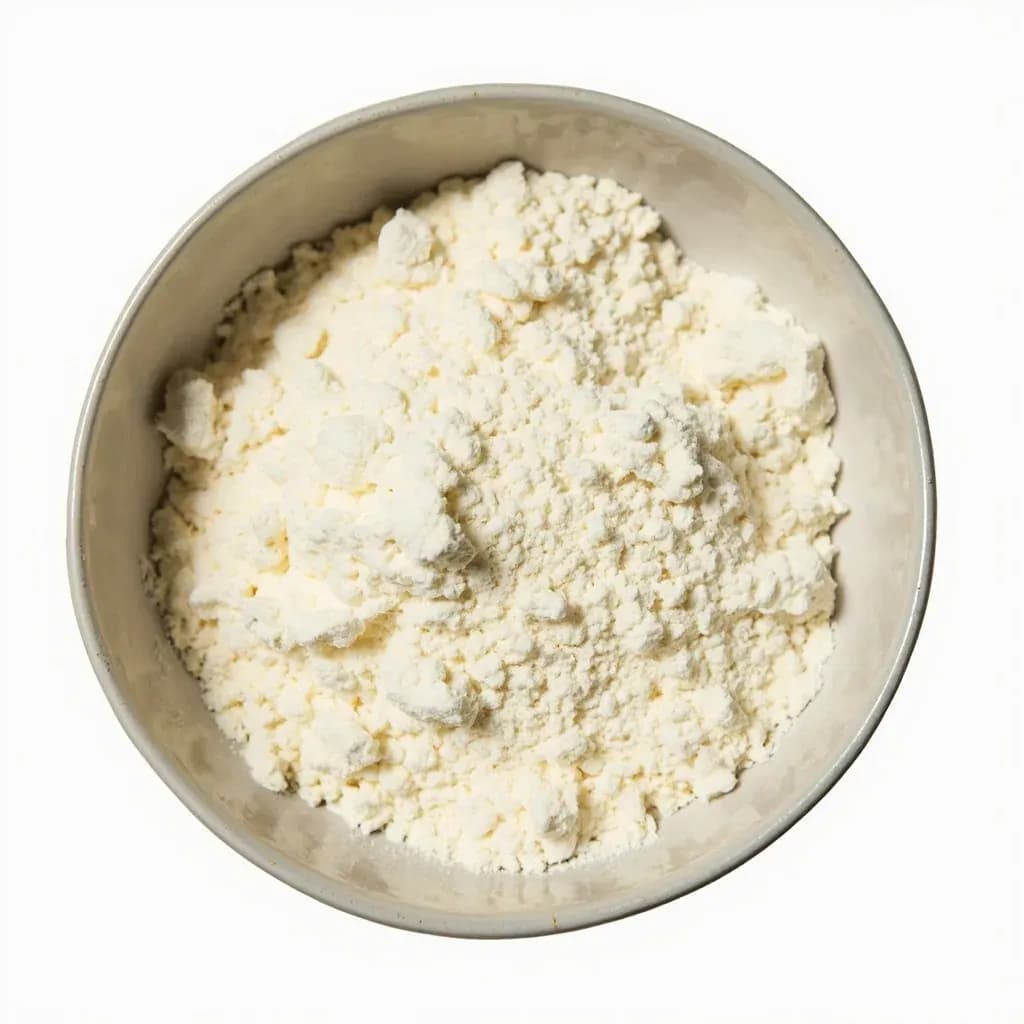
Spray drying pumps a liquid such as milk, coffee, or fruit juice through a nozzle into a chamber of hot air, flash-evaporating the water and leaving a free-flowing powder. It is the industrial method behind powdered milk, instant coffee, and many flavor powders. The very short heat exposure preserves more aroma and nutrients than slow oven drying.
Spray drying turns a liquid feed — milk, coffee extract, fruit juice, a flavor emulsion — into a dry powder by spraying it as a fine mist into a stream of hot gas. The droplets are so small (typically 10–500 µm) that moisture flashes off in milliseconds, and the dry particles ride out of the chamber in the exhaust air. What emerges is a free-flowing powder with a moisture content of just a few percent, ready for long storage without refrigeration.
Cooks don't run spray dryers in their kitchens, but they buy the results every day: instant coffee, milk powder, maltodextrin, whey protein, encapsulated citrus oils, bouillon powders, cocoa powder, and the dusty envelope inside a cup-of-soup mix. Understanding the technique explains why some of these powders dissolve cleanly in cold water while others turn gummy, float in clumps, or carry off-flavors. It also explains the carrier ingredients on a label — the maltodextrin or gum arabic that traps volatile flavors, keeps sugars from sticking to the chamber wall, and shapes mouthfeel the moment the powder meets liquid.
The product sees a brief but intense thermal journey. Inlet air often reaches 170–220 °C, but the droplet surface stays near the wet-bulb temperature for almost the entire residence time, cooled by its own evaporating water. Outlet air — usually 80–100 °C — is the real driver of heat damage. That thermal gentleness, combined with the speed of the process, is what lets manufacturers encapsulate delicate essential oils and probiotic cultures inside a protective carbohydrate matrix.
- Difficulty
- Hard
Types & varieties
Feed and air flow the same direction; the gentlest configuration, standard for milk, coffee, and heat-sensitive flavors.
Air rises against falling droplets; higher thermal efficiency but more heat stress on the powder.
Adds a vibrating fluid bed that agglomerates fines into instantized granules for cold-water solubility.
Recirculates an inert gas such as nitrogen; used for solvent-based feeds and oxygen-sensitive products like encapsulated flavors and oils.
Spinning disc at 10,000–25,000 rpm; handles viscous or abrasive feeds and gives a broad particle-size spread.
Forces feed through a small orifice; produces narrow, coarser particles typical of skim milk and detergent powders.
Compressed air shears the feed; ideal for low-viscosity feeds and bench-scale R&D work.
How to do it
- 1
Prepare the feed
Formulate and concentrate the liquid to 40–60% total solids. For oil or flavor encapsulation, homogenize an emulsion with a carrier such as maltodextrin or gum arabic (typically 20–40% carrier on solids). Deaerate the feed under vacuum to prevent foaming in the chamber.
- 2
Set up the dryer
Pre-heat the chamber and ducting to the target inlet temperature — commonly 170–200 °C for dairy, lower for heat-sensitive flavors. Verify the atomizer, cyclone, and bag filter are clean and that all CIP lines are clear.
- 3
Atomize the feed
Pump the feed at a controlled rate into the atomizer: a high-speed rotary wheel (10,000–25,000 rpm), a pressure nozzle, or a pneumatic (two-fluid) nozzle. The goal is a fine, uniform mist — primary droplet size is set here and largely determines the final particle.
- 4
Dry the droplets
Introduce hot air in the chosen flow pattern. In co-current dryers (the food-industry default) feed and air travel the same way, so the wettest droplets meet the hottest air and the driest particles meet the coolest, limiting heat damage. Evaporation cools the droplet surface, holding it near the outlet wet-bulb for almost the entire residence time.
- 5
Separate powder from air
Primary powder falls to the chamber cone. Fine carryover passes to a cyclone for recovery; residual fines are trapped in a bag filter. Adjust cyclone draft and filter cycles to keep product loss in the 1–5% range.
- 6
Agglomerate or finish-dry (optional)
For 'instant' powders, route the primary product into a vibrating fluidized bed. Fines stick to larger particles, building porous granules that wet out quickly in cold water and stop the bag from choking with dust.
- 7
Cool and condition
Cool the finished powder below about 30 °C before storage. Warm powder migrates moisture inside the bag and cakes within days.
- 8
Package in moisture- and oxygen-barrier containers
Fill into foil-lined bags, cans, or pouches with low water-vapor transmission. For sensitive products, flush with nitrogen or add an oxygen scavenger. Target finished moisture of 3–5%.
- 9
Clean in place
After the run, CIP the feed lines, nozzles, chamber, and product-contact ducting before product changeover or shutdown. Spray dryers are notorious for harboring residue that scorches into the next batch.
Spray Drying vs. Other Drying Methods
Spray drying is one of several industrial routes a kitchen professional will meet on an ingredient spec sheet. Each leaves a powder with a different density, solubility, and flavor fingerprint, and the differences show up the moment the powder hits water.
- Spray drying produces fine, low-density particles that dissolve readily; volatiles are partially lost with the exhaust air, so carriers like maltodextrin or gum arabic are essential for flavor work.
- Freeze drying (lyophilization) removes water by sublimation under vacuum. The granules are porous, sink instantly in cold water, and retain aromatics far better — the reason freeze-dried coffee commands a premium over spray-dried in the specialty market.
- Drum drying spreads a thin film of liquid onto a heated rotating drum, scrapes it off as a sheet, then mills it. It is cheaper than spray drying for viscous pastes and starchy mashes, but the long heat contact caramelizes sugars and darkens color.
- Foam-mat drying whips the liquid into a stable foam, dries it as a sheet, then crumbles it. Used for high-sugar or sticky juices that would plaster a spray-dryer wall.
- Particle density is the easiest tell: spray-dried coffee is light and dusty; freeze-dried coffee is chunky and sinks; drum-dried milk forms hard, dark granules.
Common uses
Tips & pitfalls
- Use a co-current dryer with maltodextrin or gum arabic as the carrier when encapsulating volatile flavors — the carrier traps aromatics before they escape with the exhaust air.
- Watch outlet temperature, not inlet. Inlet air at 200 °C sounds brutal, but the droplet surface never gets much above the wet-bulb; outlet temperature is what cooks the powder.
- Pre-concentrate the feed to 40–60% solids. Thinner feeds waste energy and overload the cyclones; thicker feeds may not atomize cleanly.
- Match the carrier's dextrose equivalent (DE) to the job: low-DE (10–20) maltodextrin is best for flavor encapsulation and for keeping powders non-hygroscopic; high-DE carriers dissolve faster but turn sticky in the chamber.
- Choose particle size with care. Finer particles dissolve faster and look smoother, but they dust badly, fly out of the bag, and are harder to recover from the exhaust.
- Mind the stickiness point. Feeds high in low-molecular-weight sugars, acids (citrus, tomato), or fructose are prone to wall deposits and may need a drying aid such as silicon dioxide or a higher carrier ratio.
- Recover fines with a cyclone plus a bag filter in series. Losing fines is losing paid-for solids — and fines are usually the most flavorful fraction.
- If you need a powder that dissolves in cold water on a spoon, plan for a two-stage dryer with agglomeration. Straight spray-dried powder rehydrates slowly and dusts the counter.
Good to know
- Inlet air temperature
- Typically 170–220 °C; outlet air 80–100 °C is the real driver of heat damage.
- Residence time
- Individual droplets dry in milliseconds; total chamber residence is only a few seconds.
- Particle size
- Generally 10–500 µm, tuned by atomizer speed, pressure, and feed rate.
- Feed solids
- Pre-concentrated to 40–60% total solids to minimize energy use and wall deposits.
- Atomizer types
- Rotary wheel, pressure nozzle, or pneumatic (two-fluid) nozzle.
- Common carriers
- Maltodextrin (DE 10–20), gum arabic, modified starch, whey protein.
- First commercial food use
- Milk drying patented by Samuel Cate Johnson in 1905; major milk powder production took off in the 1920s; instant coffee followed mid-century.
- Finished moisture target
- Usually 3–5% for shelf-stable food powders.
Also called
Atomization Drying
Related

Confit
Cook slowly submerged in fat for silky tenderness and keeping

Cure
Draw out moisture with salt and time to preserve and concentrate

Pickle
Steep in acidic brine for bright, tangy, crunchy preservation

Ferment
Let friendly microbes transform food into tangy, complex flavor

Marinate
Soak in a seasoned mix to flavor and tenderize before cooking

Brine
Soak in salt water so meat stays juicy and seasoned throughout

Dehydrate
Slowly dry out moisture to concentrate flavor and extend shelf life

Cold-Smoke
Perfume cured food with smoke without cooking it through