Prep & Assembly
Stirring Out
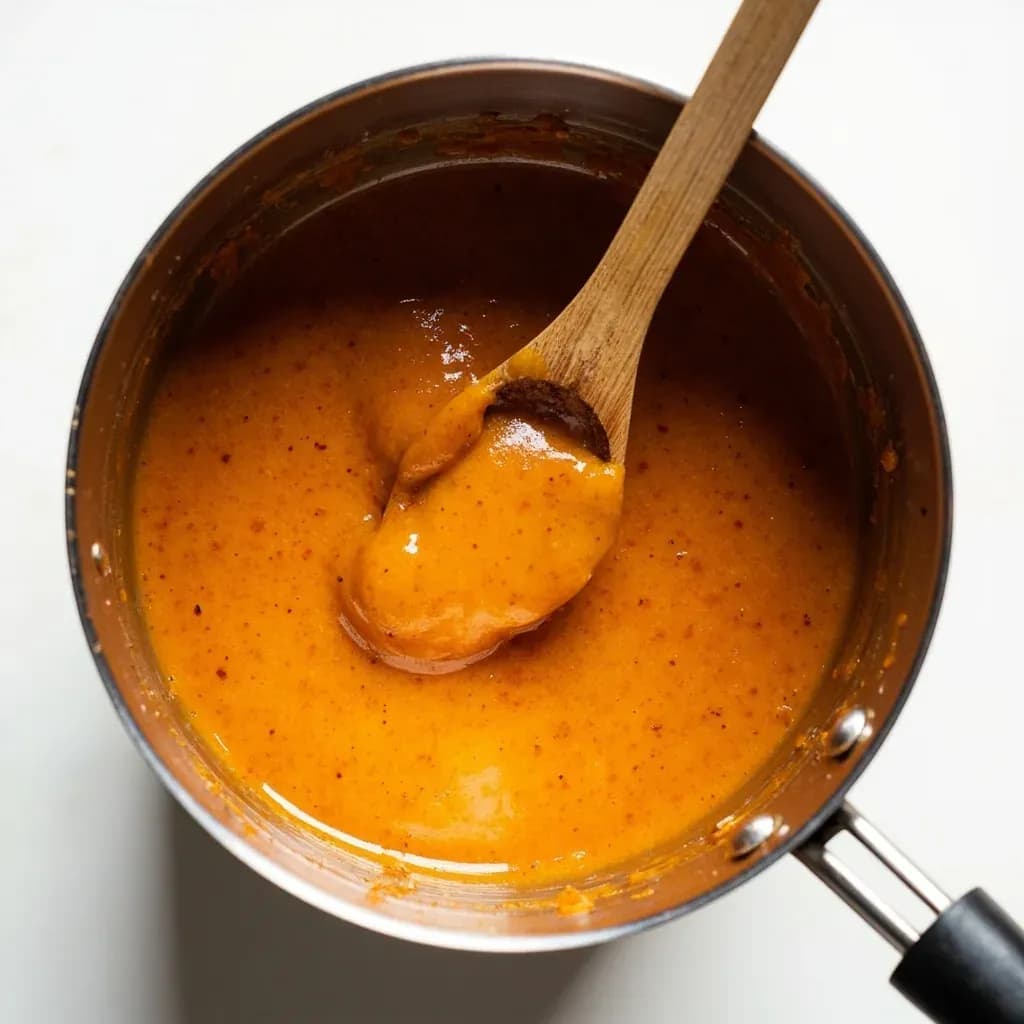
Continuous stirring to dissolve, smooth, or work air and lumps out of a mixture as it cooks.
Stirring out refers to working a mixture with constant motion to break up lumps, dissolve solids, and create an even, smooth texture, often as it heats. It is essential for sauces, custards, polenta, and batters where uneven heating would cause clumping or scorching. The technique also distributes heat so the mixture thickens uniformly without catching on the bottom.
Stirring out is the steady, continuous agitation of a mixture over heat until it becomes smooth, evenly hydrated, and free of raw flavor or trapped air. The phrase covers a small family of related practices: breaking up lumps of flour or cocoa, cooking the pasty taste out of a roux, smoothing a sauce to a glossy nappé, or quietly working air bubbles out of a custard before it sets. They share one mechanical truth — the mixture never sits still long enough for any one layer to overheat, scorch, or set before the rest catches up.
Why the motion matters: most of the things cooks want from a pan sauce, pudding, or risotto — gloss, body, creaminess, clean flavor — are products of even heat and even hydration. Starch needs to swell uniformly; egg proteins must coagulate gently below the curdling point; melted chocolate must give up its crystals without ever touching a drop of water. Standing still ruins all three; frantic motion ruins texture by overworking starch or whipping in air. The right pace is calm, mechanical, and relentless.
Most failures blamed on stirring are actually failures of heat control. A pan that's too hot will seize, lump, or scorch no matter how fast the spoon moves; a pan held at the right temperature forgives a great deal of imperfect motion. The cook's real job is to keep the layer of mixture touching the metal at a temperature the ingredients can tolerate, and stirring is the means by which that happens.
- Difficulty
- Easy
Types & varieties
Constant agitation to break up clumps of flour, cocoa, or starch so the mixture becomes glossy and even.
Sustained stirring over heat to dissipate the raw taste of flour, butter, or starch in a roux-based sauce.
Final-stage gentle stirring to bring a sauce to a glossy, uniform consistency and the desired coating thickness.
Slow, steady stirring (often off heat or very low) to release trapped air so a custard, pudding, or batter sets without holes.
A continuous figure-of-eight or scraping motion that pulls starch from grains into the liquid for creaminess, as in risotto and polenta.
How to do it
- 1
Choose the right tool and pan
Use a heavy-bottomed saucepan so heat is even, and pick a stirring implement that can reach the pan's edges: a flat wooden spoon or silicone spatula for thick sauces, a balloon whisk for thin liquids, or a flat/roux whisk as a versatile compromise.
- 2
Set the heat low and pre-warm the pan
Start at low to medium-low heat. High heat is the most common reason stirring-out fails — it sets the bottom before you can work the mixture smooth.
- 3
Begin stirring before the mixture heats through
Start the motion the moment ingredients hit the pan. A figure-of-eight or continuous circular sweep that scrapes the full bottom and corners is the standard pattern.
- 4
Maintain a steady, even rhythm
Keep the tempo constant. Too fast introduces air and splashes; too slow lets the bottom catch. The motion should feel mechanical, not hurried.
- 5
Watch for the key visual cues
Look for: the disappearance of dry flour patches (in roux-based sauces), the first bubble on the surface (a custard at the simmer point), a glossy sheen replacing a grainy look, or starch release turning a risotto's liquid cloudy and creamy.
- 6
Adjust heat, not speed, when trouble appears
If the mixture tightens, lumps, or threatens to scorch, drop the heat or pull the pan off the burner for a few seconds. Do not try to fix problems by stirring harder — the issue is almost always too much heat, not too little motion.
- 7
Cook out raw flavor where required
For sauces built on a roux, keep stirring 2–3 minutes after the last floury streaks vanish; for custards, hold at a bare simmer until the mixture coats the back of a spoon and a finger-drawn line holds its shape.
- 8
Finish, rest, and correct texture
Remove from heat. If small lumps remain, strain through a fine-mesh sieve or blitz briefly with an immersion blender. For custards, pour through a chinois into a clean bowl and press plastic directly onto the surface to prevent a skin.
How stirring out differs from whisking and beating
Stirring out sits in the middle of a spectrum of agitation techniques. Whisking is faster and more aerating — it incorporates air deliberately and is the right tool for thin liquids, emulsions, and deglazing. Beating is faster still, usually with a machine, and is about building volume or emulsifying fat. Stirring out is slower and more deliberate: the spoon or spatula moves at a steady pace, scraping rather than whipping. The goal is texture and evenness, not aeration. If you want a custard that sets without holes, a sauce that coats a spoon, or a risotto with creaminess instead of gumminess, this is the rhythm you want.
The visual cues that tell you it's working
- Disappearing dry patches: in a roux-based sauce, the last streaks of white flour signal that hydration is almost complete.
- First surface bubble: in a stirred custard, the first lazy bubble on top means the mixture has reached the simmer point and is thickening.
- Gloss replacing grain: when a sauce shifts from matte and slightly sandy to a smooth, reflective sheen, starch is fully gelatinized.
- Cloudy liquid: in risotto and polenta, the broth turns opaque and creamy as starch releases from the grains — that is the texture you are building.
- Coating the spoon: when the mixture clings to the back of a spoon and a finger-drawn line holds, the body is right for custards and pan sauces.
Common uses
Tips & pitfalls
- Match the tool to the viscosity: a balloon whisk for thin liquids, a flat whisk or wooden spoon/spatula once the sauce thickens, and a flat-edge silicone spatula for sweeping the pan's curves.
- Heat is the enemy you manage. If a custard starts to feel tight on the spatula or a starch sauce jumps from glossy to lumpy in seconds, pull the pan off the burner for 10–20 seconds while you keep stirring.
- Scrape the entire bottom, not just the center, and pay extra attention to the corners where the handle meets the pan — that's where most scorching starts.
- If lumps appear anyway, switch to a whisk for a minute, or pass the sauce through a fine-mesh strainer; do not try to whisk lumps out by raising the heat.
- For custards, think of the spatula as a thermometer: keep the mixture moving so the layer in contact with the pan never exceeds about 170–175°F / 77–80°C, the point where egg proteins seize.
- To cook out the raw-flour taste in a roux-based sauce, stir for a true 2–3 minutes after the roux foams; the pasty flavor disappears as the starch hydrates and the milk solids mellow.
- For melted chocolate, the pan should be dry and the heat off or on the lowest setting; even a trace of water will seize the chocolate and a moment of neglect will scorch it.
- In risotto and polenta, stir often but not frantically — vigorous nonstop beating can gum up the starch; a steady rhythm is enough to coax creaminess without making paste.
- If air bubbles are a problem (e.g., panna cotta, chocolate pudding), tap the pan on the counter after stirring out, and skim the surface with a spoon rather than stirring harder.
- Add liquid in stages when building a sauce: each addition should be fully incorporated and brought back to a simmer before the next, so the starch has time to swell evenly.
Good to know
- Also called
- Working out, cooking out, beating out (loosely)
- Heat level
- Low to medium; lower is safer for custards and starch-thickened sauces
- Motion
- Constant, even, scraping the full bottom and edges of the pan
- Primary tools
- Flat wooden spoon, silicone spatula, balloon whisk, or roux whisk (flat whisk)
- Where it matters most
- Starch-thickened sauces, egg-thickened custards, polenta, risotto, melted chocolate, pan gravies
- Duration
- 30 seconds to 20+ minutes depending on the mixture and goal
- Difficulty
- Low to moderate; mostly a function of attention and heat control
- Related techniques
- Whisking, beating, tempering, deglazing, mounting with butter
Also called
Stirring Out · Smoothing Out
Related

Whisk
Beat ingredients smooth and aerated with a looping wire motion

Sift
Pass dry ingredients through mesh to aerate and remove lumps

Strain
Pour through mesh to separate solids from liquid for a smooth result

Filter
Pass liquid through fine material to clarify out the smallest particles

Rice
Press cooked potatoes through small holes for fluffy, lump-free texture

Mash
Crush soft cooked food into a rustic, creamy purée

Grind
Crush food into a coarse to fine texture, from spices to meat

Grate
Shred food into fine bits against a sharp-toothed surface