Prep & Assembly
Swizzling (Dhal)
Rapidly spinning a stick between the palms to whip, froth, or temper dal and drinks.
Swizzling spins a notched stick or whisk rapidly between the palms to agitate a liquid, aerating it and blending in fats or tempering. With dal it smooths the lentils and works in the tempered spices; in bar work the swizzle stick froths and chills crushed-ice drinks. The friction of fast hand-rolling does the work that a whisk or blender would.
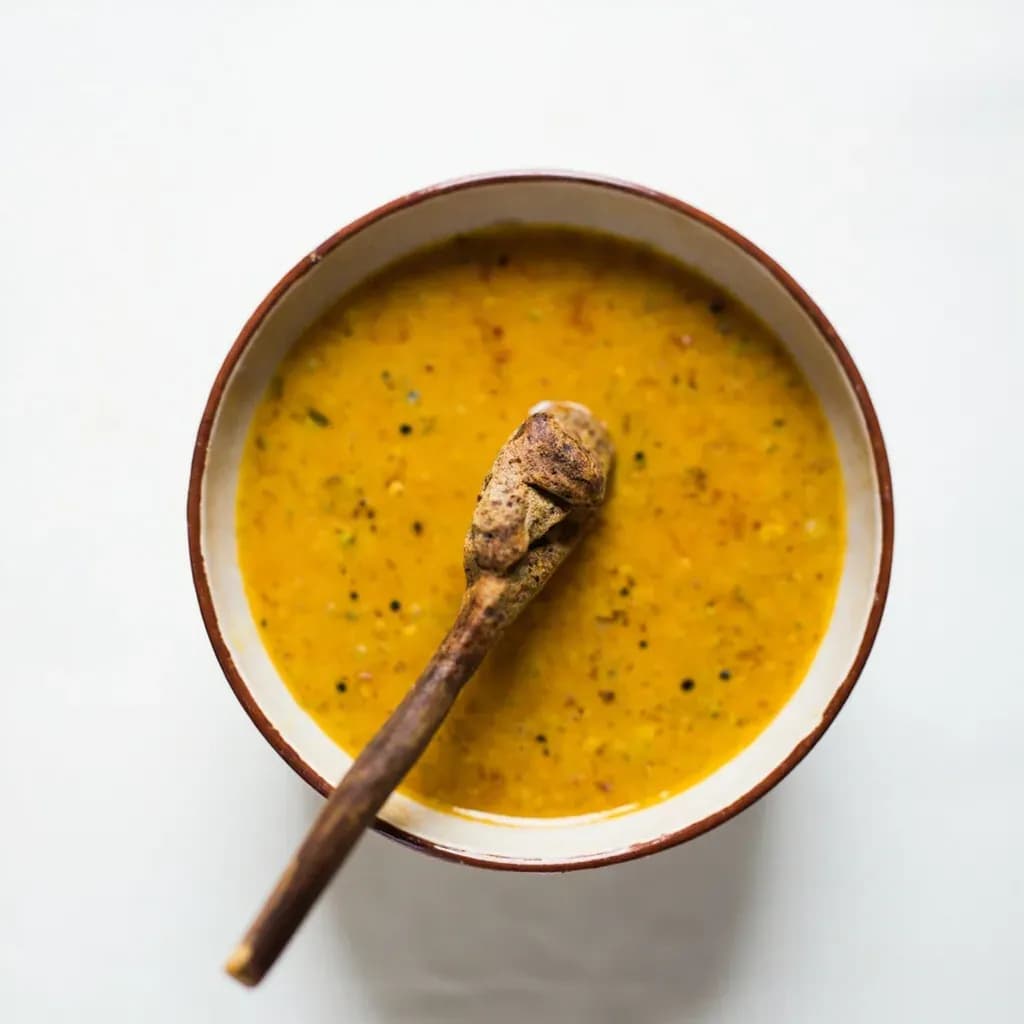
Swizzling is a manual mixing technique in which a straight stick, held vertically in a vessel, is spun rapidly between the palms of the hands. The rubbing palms transmit a twisting force down the rod, which rotates in place and churns the liquid around it. The motion produces three effects at once — chilling, controlled dilution, and emulsification of fats and starches — that no other single kitchen gesture delivers as efficiently. In its best-known setting, the Queen's Park Swizzle of Trinidad, it turns crushed ice, rum, lime, and demerara sugar into a frosty, faintly foamy drink in fifteen to twenty seconds. In a South Asian kitchen the same palm-driven spin is applied to a pot of just-tempered dal: a wooden stick is set in the hot lentils and whipped until the surface turns pale, glossy, and lightly foamy, the way it does in a restaurant dhal tank.
The technique sits at an unusual crossroads between two culinary worlds. In the bar, swizzling is a codified step with a dedicated tool, traditionally a peeled forked branch from Quararibea turbinata, the so-called swizzle stick tree, which gives the Caribbean family of drinks its name. In the dal pot, it is a finishing flourish used by cooks who want the emulsified texture of a hand-blended dal without the aeration and splatter of an electric blender. The physics are identical in both places: a vertical stick rotated by opposing palm motion generates a vortex that pulls air and liquid into the body of the drink or dal while driving suspended fat (ghee, cream of coconut) and starch into a fine, even suspension. The signal that the work is done is the same in both — a thin, persistent froth on the surface.
What separates a successful swizzle from a clumsy one is control of the stick's angle. The rod must stay plumb-vertical; the moment it tilts, it binds against the palms and either stalls or whips the liquid out of the vessel. Most of the difficulty of learning the technique is really about learning to relax the hands, keep the wrists loose, and let the stick do the work.
- Difficulty
- Easy
Types & varieties
The classic, codified use: spinning a stick in a tall glass of crushed ice, sugar, citrus, rum, and bitters (e.g., the Queen's Park Swizzle).
Whipping cooked, tempered dal with a wooden stick to emulsify the ghee tadka and produce a light, frothy top.
The same palm-spinning motion used to beat yogurt drinks to a frothy consistency: Punjabi lassi (yogurt thinned with water or milk, seasoned with salt or sugar) and South Indian majjige or neer mor (buttermilk spiced with green chili, ginger, and curry leaves).
A theatrical, bartender's flourish performed in front of the guest, often with a long ornamental swizzle stick.
How to do it
- 1
Cook and temper the dal
Simmer toor, moong, or masoor dal until completely soft, then thin with hot water to a pourable, cream-like consistency — roughly the thickness of heavy cream. In a small pan, bloom a tadka of ghee with cumin seeds, a pinch of hing, chopped garlic, and curry leaves until the seeds crackle and the leaves crisp. Pour the sizzling tadka over the hot dal.
- 2
Set the stick vertical
Place a long, smooth wooden stick (a dedicated swizzle, the handle of a wooden ladle, or a plain dowel) in the center of the pot so it stands plumb-vertical. The top of the stick should clear the rim by 4–6 inches so your palms have room to spin. If the dal is in a serving bowl rather than a pot, use the same setup, keeping the stick centered while it rotates.
- 3
Spin between the palms
Cup both hands around the top of the stick. Rub your palms briskly back and forth as if warming them, letting the stick rotate freely between them. Keep the motion smooth and continuous for 30–60 seconds. Stop as soon as the surface turns pale, glossy, and lightly foamy.
- 4
Adjust and serve
Taste for salt, acid, and chili, give one or two final spins if the froth has settled, and ladle immediately. The foam is at its best within a minute or two of whipping.
- 5
Build the cocktail (Queen's Park Swizzle style)
Pack a tall highball or Collins glass with crushed ice to the brim. Add demerara syrup, fresh lime juice, and overproof rum (and Angostura bitters, if using). Insert the swizzle stick so it stands vertically, the forked end submerged and the top rising several inches above the glass.
- 6
Spin and frost the glass
Cup both hands around the top of the stick and rub palms briskly back and forth for 10–20 seconds, until the outside of the glass frosts and a thin foam cap forms. The stick should float in the liquid; if you hear scraping, lift it slightly.
- 7
Finish and serve
Withdraw the stick, top with a fresh mound of crushed ice, garnish with a mint bouquet and a lime wheel, and serve with a straw.
Why the froth matters
A fine, even froth is not a garnish — it is the visible proof that swizzling has done its real work. When a stick spins in a liquid, it drags the surface down into a small vortex, which pulls colder liquid, melted ice water, or hot ghee from the tadka down through the body of the drink or dal. At the same time, the agitation shears fat globules into smaller droplets and suspends them among the starches, proteins, or sugar. The result in a dal is the same thing a blender does, but gentler: the ghee stops pooling on top and the lentils thicken into a homogeneous, glossy pour. In a cocktail, the crushed ice is simultaneously being crushed finer, melted, and aerated, so what reaches the drinker is colder and more dilute than the glass was a moment earlier.
The froth is fragile. In a dal it begins to settle within a minute or two of stopping, which is why restaurant dhal is whipped in the service pot, not the cooking pot, and ladled immediately. In a cocktail the froth sits on top of the crushed-ice mound and holds long enough to be sipped through, but it is part of the texture, not a separate layer.
Common uses
Tips & pitfalls
- Keep the stick plumb-vertical and centered in the glass or pot; a tilted stick binds against the palms and splashes instead of spinning.
- For dal, the lentils must be hot and thin (pouring-cream consistency); cold or thick dal will not froth — the fat stays pooled and the starches seize rather than emulsify.
- Pour the hot ghee tadka into the dal first, then swizzle; the heat keeps the fat fluid long enough to be sheared into a stable emulsion.
- For cocktails, fill the glass to the brim with crushed ice before starting — the ice bed is what the stick 'chews' through to chill and dilute properly.
- Stop as soon as you see a fine, even froth; over-swizzling dal overworks the starches and gives a gluey, gummy texture.
- Use a stick long enough that the top clears the rim of the vessel by 4–6 inches so your palms have clearance to spin without scraping the edge.
- Common mistake: grinding the stick against the bottom of the glass or pot. The spin should float in the liquid; if you hear scraping or feel resistance, lift the stick a quarter inch.
- Common mistake: gripping the stick with the fingers. The palms should lightly cup it; squeezing with the fingers kills the rotation.
Good to know
- Primary origin
- Caribbean (Trinidad and the West Indies), popularized in late 19th-century bars and clubs.
- Traditional tool
- A peeled, forked branch from Quararibea turbinata (the 'swizzle stick tree') or similar Caribbean hardwood; modern bars use stainless or plastic rods, while South Asian kitchens use a plain wooden stick or the handle of a wooden ladle.
- Mechanism
- Stick held vertically in the vessel; palms placed on either side of the top are rubbed back and forth so the stick spins rapidly between them.
- Effects on liquid
- Chills, lightly dilutes, and incorporates a small amount of air for a frothy head or sheen.
- Typical duration
- 10–25 seconds for a tall drink; 30–60 seconds when whipping dal to a froth.
- Difficulty
- Easy to attempt; takes practice to keep the stick spinning smoothly without splashing or jamming.
- In South Asian use
- The same rapid palm-spinning motion is used with a wooden stick (sometimes called a madhki, mathu, or simply a swizzle) to whip tempered dal, lassi, or majjige (spiced buttermilk) to a frothy, emulsified consistency.
- Related technique
- Tadka/chaunk — tempering spices in hot ghee or oil is sometimes finished or distributed by a quick spin of a stick through the dal.
Also called
Swizzling · Swizzle Stick Method
Dishes that rely on it
Related

Whisk
Beat ingredients smooth and aerated with a looping wire motion

Sift
Pass dry ingredients through mesh to aerate and remove lumps

Strain
Pour through mesh to separate solids from liquid for a smooth result

Filter
Pass liquid through fine material to clarify out the smallest particles

Rice
Press cooked potatoes through small holes for fluffy, lump-free texture

Mash
Crush soft cooked food into a rustic, creamy purée

Grind
Crush food into a coarse to fine texture, from spices to meat

Grate
Shred food into fine bits against a sharp-toothed surface