Beef — Primal & Subprimal
Beef Round & Rump Cuts
Also: beef round primal, top round, bottom round, eye of round, rump roast, sirloin tip
The round primal — the entire hind leg and rump — is the largest and leanest primal, yielding economical roasts and thin-sliced cuts best suited to low-and-slow or high-acid preparations.
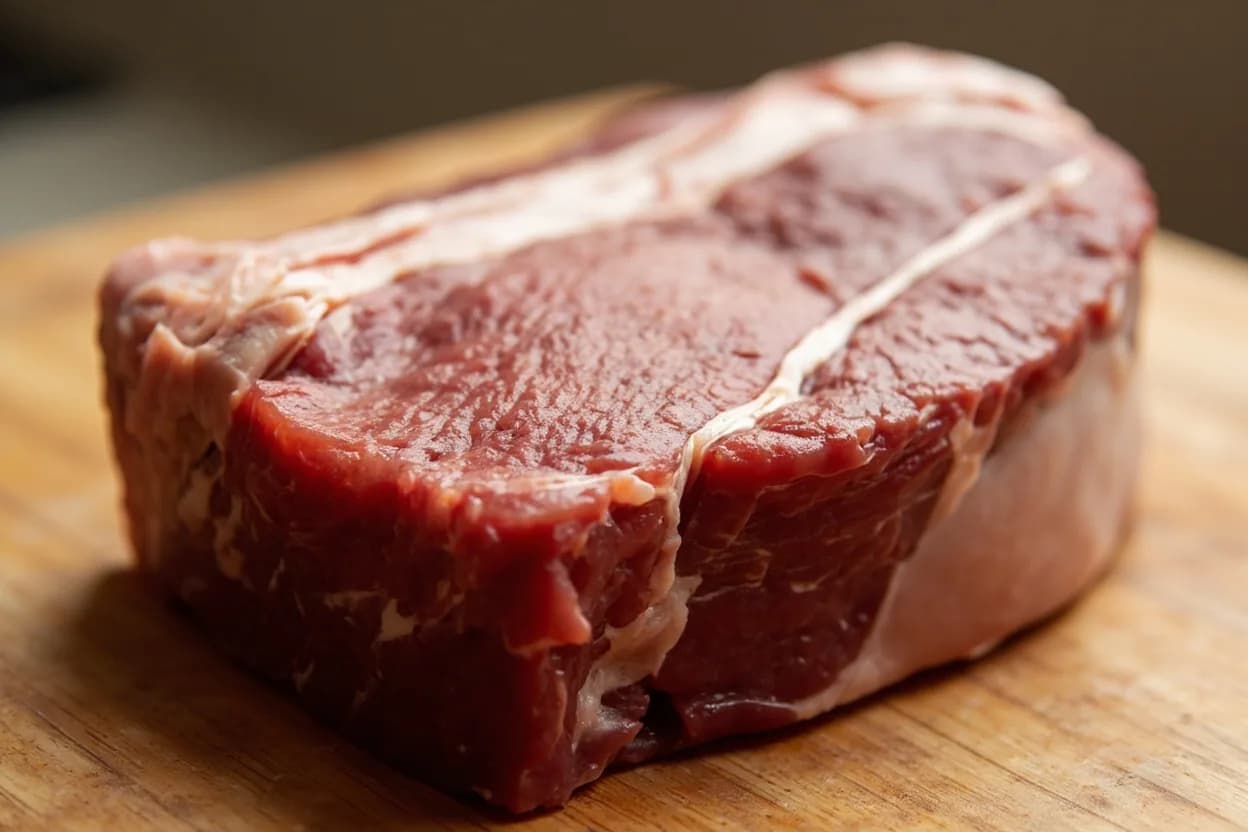
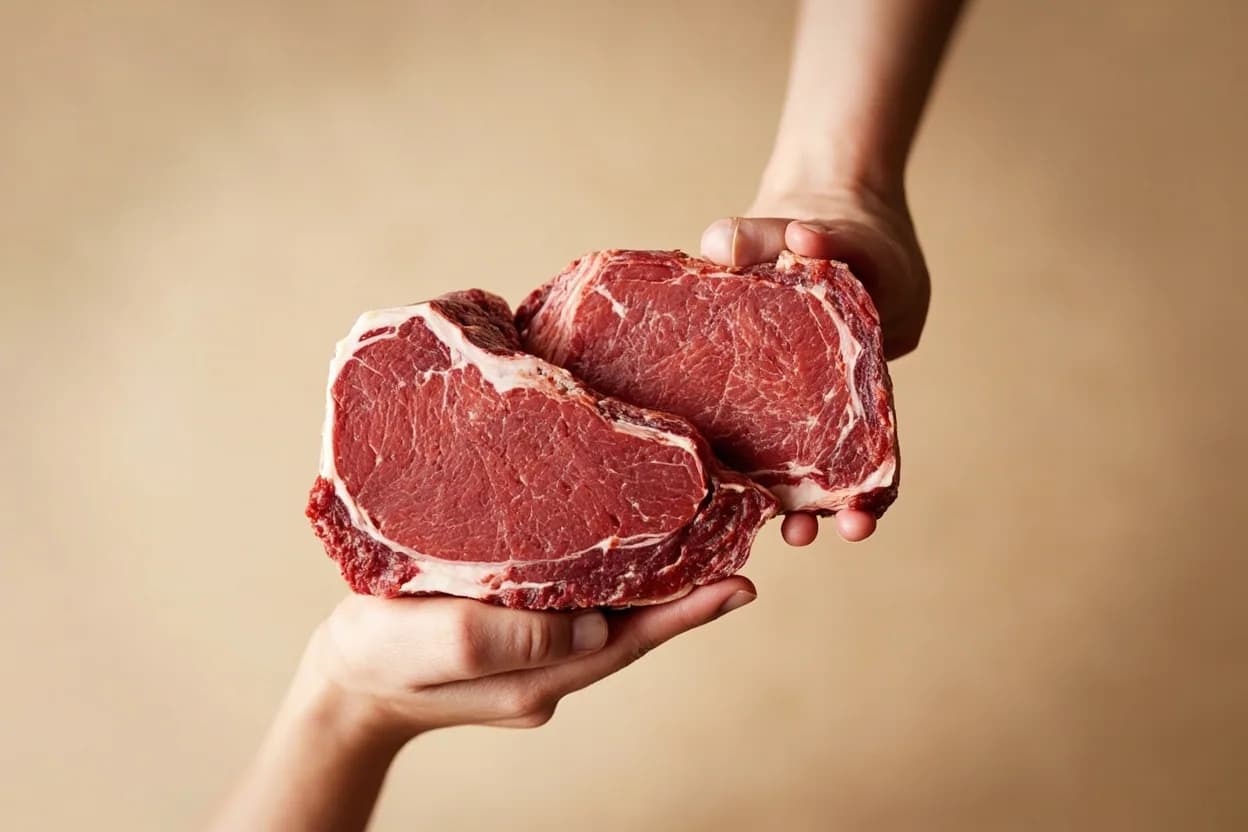
The round primal comprises the entire hindquarter below the sirloin and above the shank: essentially the large muscles of the hind leg. It is the largest single primal by weight and one of the leanest. The major subprimals are the top round (inside round, semimembranosus), bottom round (outside round, consisting of the biceps femoris and associated muscles), eye of round (semitendinosus), sirloin tip (knuckle / quadriceps group), and the rump (gluteal muscles). Because the hind leg muscles are heavily worked for locomotion, all round subprimals are tough and low in intramuscular fat, requiring careful handling to avoid dryness and toughness. The rump, while part of the gluteal region, is typically included with the round in USDA nomenclature.
In photos
Where it comes from
Hindquarter, from the hip joint posteriorly through the hind leg down to the hock. The femur (thigh bone) runs through the center; muscles surround it in distinct groups separated by natural seam fat. The top round lies medially (inside of the leg), the bottom round laterally (outside), the eye of round runs along the posterior surface, and the knuckle/sirloin tip covers the anterior femur.
Best for
How to cook it
- 1Top round roast beef: dry-brine 24–48 hours. Roast at 225°F (107°C) until internal temp reaches 125–130°F (52–54°C). Rest 20 minutes. Slice on a deli slicer or by hand as thinly as possible against the grain. Thick slices of round are unpleasant; thin slices are tender and juicy.
- 2Eye of round (oven-braised): sear all over, then braise in beef stock at 275°F (135°C) for 2.5–3 hours until probe-tender. A 'cheater' corned beef can be made by curing an eye of round in a brine of salt, curing salt, and pickling spices for 5–7 days then simmering gently.
- 3Bottom round pot roast: brown all sides, sauté aromatics, add wine and stock to come halfway up the roast, braise covered at 300°F (150°C) for 3–4 hours until fork-tender. The bottom round benefits from longer braising than top round.
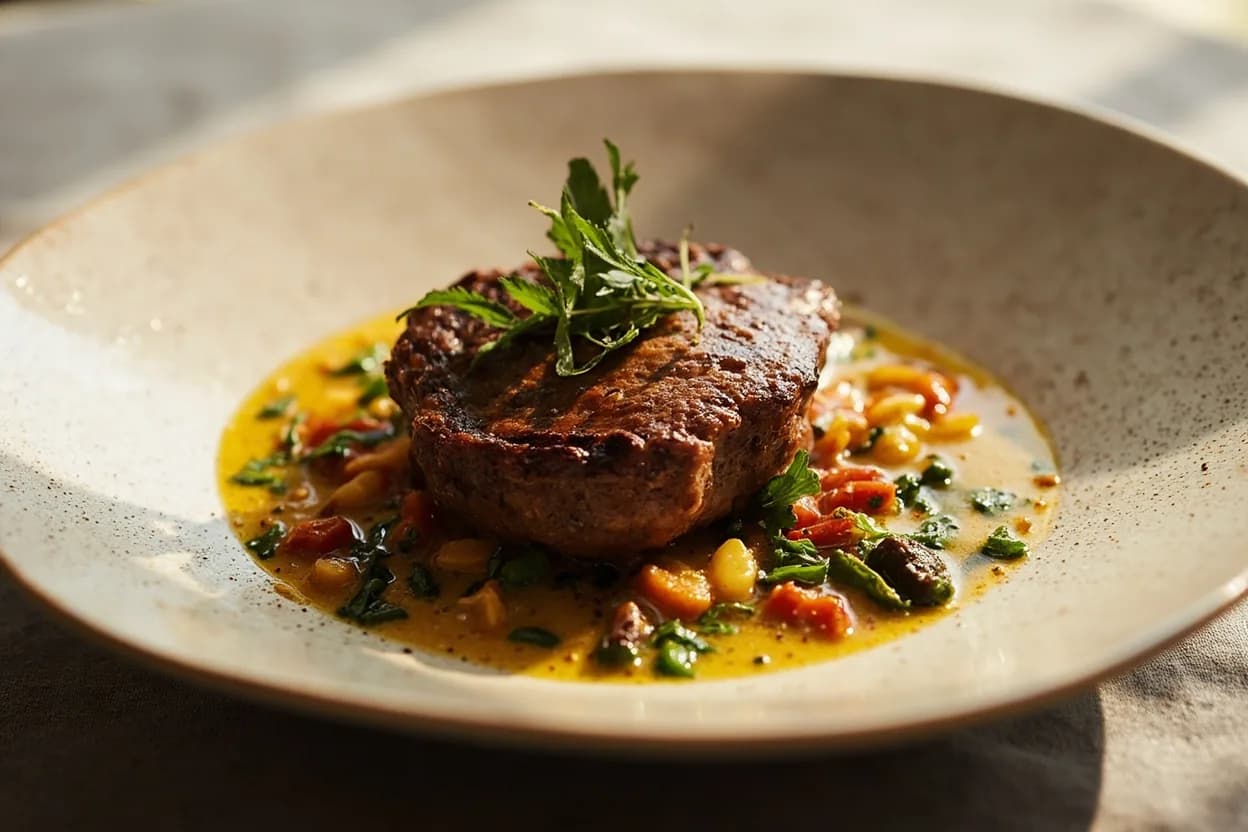
- 4Rump roast (Sunday roast): slow-roast at 325°F (163°C) to medium (145°F / 63°C internal), resting fully before carving. Higher internal temps cause the lean muscle to seize and dry out. Many cooks prefer braising the rump rather than dry-roasting to compensate for its leanness.
- 5Sirloin tip (grilling): marinate in an acid-based marinade for 4–8 hours, grill quickly to no more than medium-rare (135°F / 57°C), rest fully, and slice thinly. This cut toughens rapidly above medium.
Prep & butchery
- Identify the seam between top round (medial, inside) and bottom round (lateral, outside) — they are separated by a defined layer of intramuscular fat and connective tissue running vertically through the primal.
- The eye of round is easily identified as the small, oval, very lean muscle running along the posterior of the primal. It lifts free of the bottom round with minimal knife work.
- Remove the femur (thigh bone) and kneecap (patella) first: locate the femoral head, follow the bone with a boning knife, and pop out the knee joint. The sirloin tip group releases from the anterior face of the femur.
- Silverskin and surface silver fat should be trimmed before roasting — the leanness of round makes surface fat critical to retain for basting, but tough silver sheaths should be removed.
- For deli roasting: tie the top round or eye of round with butcher's twine at 1-inch intervals to maintain a uniform cylinder for even cooking and consistent slice thickness.
Substitutes
- Chuck Roast
Much higher collagen and fat — braises more richly and doesn't need thin-slicing. If the round is unavailable for pot roast, chuck is the superior substitute.
Bottom sirloin triangle; leaner than chuck but more tender than round. A good substitute for sirloin tip in grilling applications.
- Pork Leg (Fresh Ham)
Comparable lean, large-muscle structure; substitutes well in slow-roast and deli-slice applications where beef is unavailable.
Related cuts
Adjacent anterior primal; sirloin borders the round at the hip joint
- Beef Shank
Adjacent inferior primal; the hock and shank connect to the round at the hock joint
- Tri-Tip (Bottom Sirloin)
Sits at the sirloin/round interface; sometimes included with round in retail
- Beef Brisket
Both are lean, tough forequarter (brisket) and hindquarter (round) cuts requiring long cooking — often compared for cured preparations like corned beef
Appears in
References
- 1.USDA IMPS Series 100 — Fresh Beef, Items 160 (Round, Primal), 161 (Round, Bone-In), 167 (Knuckle), 168 (Top Round), 169 (Bottom Round), 171B (Bottom Round, Flat), 171C (Bottom Round, Heel)
- 2.The Complete Meat Cookbook — Bruce Aidells and Denis Kelly
- 3.Butchering Beef — Adam Danforth
- 4.On Food and Cooking: The Science and Lore of the Kitchen — Harold McGee
Confidence: high
Notes
The thin-slice imperative
Round subprimals are frequently miscooked because home cooks try to serve them in thick steaks or thick roast slices — the result is dry, chewy, and unpleasant. The key insight is that thinness compensates for both leanness and toughness: slicing an eye of round or top round at 1/8 inch (3mm) against the grain produces tender, juicy slices even at a higher internal temperature than you'd use for a strip steak. Restaurant deli operations roast round to medium (150°F / 66°C) then slice on a machine set to the thinnest setting — this is why deli roast beef tastes tender in a sandwich.
Round as curing substrate
The round's leanness, uniform muscle structure, and cylindrical shape make it the most practical substrate for curing. Eye of round cures evenly in 5–7 days (much faster than brisket's typical 7–10 days) due to its smaller diameter. Top round is the traditional cut for pastrami in many New York delicatessens that substitute it for the classic navel plate — the result is leaner than traditional pastrami but holds up well to long steaming. Bresaola (Italian air-dried beef) is almost exclusively made from the top or eye of round.