Bread Scoring
Cross-Hatch & Decorative Scoring
Also: decorative bread scoring, fougasse cuts, leaf scoring, wheat-stalk scoring, artistic bread scoring
Scoring patterns that prioritize visual design and deliberate hole-opening over ear formation — from fougasse windows to wheat-stalk motifs.
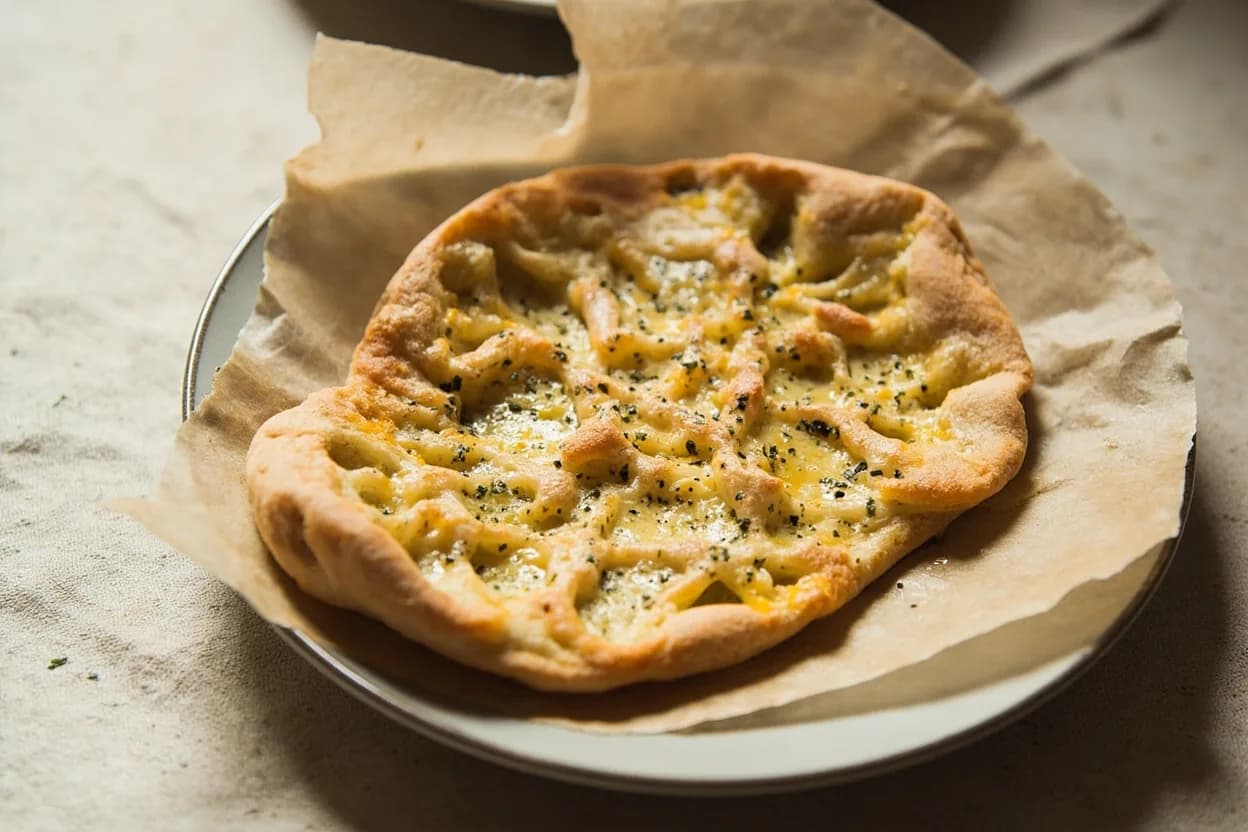
Cross-hatch and decorative scoring encompasses all bread-surface cutting patterns whose primary goal is visual expression or structural opening (as in fougasse) rather than the controlled oven spring of a single deep slash. These cuts are made with a lame, a standard razor blade, scissors, or a sharp paring knife, and they range from the purely functional crossed slashes on a focaccia or pan loaf to elaborately planned leaf veins, wheat stalks, and geometric mandalas on display sourdoughs. Unlike ear-forming cuts, decorative scoring typically uses a more vertical blade angle so both sides of each cut expand symmetrically, creating an even opening rather than a lifted flap.
In photos
Where it comes from
Surface of the proofed dough, generally the top face of a boule, batard, or flatbread. Fougasse cuts penetrate all the way through the loaf to form open leaf-window holes. Surface decorative cuts penetrate 4–6 mm and bloom open during oven spring.
Best for
How to cook it
- 1Use a fresh single-edge razor blade for intricate decorative work; lame handles introduce arc that complicates straight decorative lines
- 2Sketch the motif lightly with a toothpick on the floured surface before committing with the blade
- 3Hold the blade at 60–90° to the dough surface so cuts open symmetrically rather than lifting an ear flap
- 4For fougasse, cut all branches in one confident session, then use wet fingers or a bench scraper to gently open the cuts slightly before baking
- 5Transfer decorated loaves to the oven quickly — the cuts begin to dry and narrow within minutes at room temperature
- 6Bake with moderate steam; too much steam suppresses the bloom of decorative patterns and can cause intricate lines to fuse back together
Prep & butchery
- Cold-retard shaped loaves before decorative scoring — firm skin holds pattern edges cleanly and prevents the blade from dragging
- Dust the surface very lightly with rice flour or all-purpose flour to keep the blade from sticking mid-motif
- For fougasse, stretch the shaped dough to an oval on parchment before cutting; the leaf-hole pattern should be planned to leave structural ribs at least 2 cm wide
Substitutes
- Scissors
Essential for epi/wheat-stalk cuts; angled snips along a baguette form the stalks of the wheat-ear shape
- Sharp paring knife
Adequate for fougasse branch cuts where precision is less critical than for fine decorative motifs
- Stencil + cocoa dusting
For visual contrast without structural cuts; does not affect oven spring but creates dramatic surface patterns
Related cuts
Functional scoring family from which decorative scoring derives its blade toolkit
The opposite intent — decorative scoring avoids the angled undercut that produces an ear
- Epi baguette snip
Scissor-based decorative cut series that transforms a baguette into a detachable wheat-ear roll cluster
Appears in
References
- 1.Modernist Bread — Myhrvold & Migoya (The Cooking Lab, 2017)
- 2.Advanced Bread and Pastry — Michel Suas (Delmar Cengage, 2009)
- 3.The Rye Baker — Stanley Ginsberg (W.W. Norton, 2016)
- 4.Tartine Bread — Chad Robertson (Chronicle Books, 2010)
Confidence: high
Notes
Fougasse vs. decorative boule
Fougasse scoring is functional and structural: the through-cuts are designed to maximize crust-to-crumb ratio, shorten bake time, and produce an open, crunchy leaf-shaped bread. Decorative boule scoring is primarily aesthetic: the cuts bloom open during baking but the loaf retains its round, closed shape. The blade angle, depth, and intent differ fundamentally even though both fall under 'decorative scoring.'
The razor vs. lame debate
A lame on a curved handle is optimal for the long, continuous slash of a baguette or batard because the arc of the handle helps the blade track a straight or slightly curved line at a consistent low angle. For intricate decorative motifs — fine leaf veins, tight cross-hatching, delicate circles — the curve is a liability. Most display bakers grip a single-edge razor directly, using fingertips against the blade spine for control, treating it like a scalpel rather than a scoring tool.