Bread Scoring
Bread Scoring — Batard, Boule & Baguette Patterns
Also: lame scoring, slashing bread, bread slashing patterns, grigne patterns
The deliberate cuts made on shaped loaves before baking that control where the bread opens and how the crust forms.
Bread scoring is the act of making precise incisions through the surface of a shaped, proofed loaf immediately before it enters the oven. These cuts are not decorative afterthoughts — they are structural decisions that predetermine the loaf's expansion trajectory. Without scoring, bread tears unpredictably at its weakest seams; with it, the baker dictates where the crust splits, how dramatically the crumb opens, and what silhouette the finished loaf presents. Each shape — the elongated batard, the round boule, the long narrow baguette — demands its own pattern geometry derived from that shape's internal tension and mass distribution.
In photos
Where it comes from
Surface of the proofed dough; the tool is a baker's lame (curved razor blade on a handle) or a single-edge razor held at a deliberate angle. The cut penetrates 5–10 mm into the outer skin of the loaf.
Best for
How to cook it
- 1Chill the loaf if possible before scoring — 15–30 minutes uncovered in the refrigerator firms the skin and reduces drag
- 2Use a fresh, sharp blade on the lame; a dull blade compresses rather than cuts and causes the dough to deflate
- 3For an ear on a batard or baguette, hold the lame at 15–20° off vertical (blade nearly parallel to the dough surface) and draw with a single confident stroke
- 4For a boule cross or asterisk, a more vertical blade angle (closer to 45–60°) produces a wider, more symmetrical bloom rather than a raised ear
- 5Transfer to the baking vessel or stone quickly after scoring — delay allows the cuts to skin over and diminish oven spring
- 6Steam in the first 10–15 minutes of baking keeps the crust pliable so the score can open fully; remove steam source for the last phase to set and color the crust
Prep & butchery
- Dust the surface of the proofed loaf very lightly with flour to make the blade glide without sticking
- For intricate decorative patterns, use a toothpick or skewer to lightly sketch the design first before committing with the blade
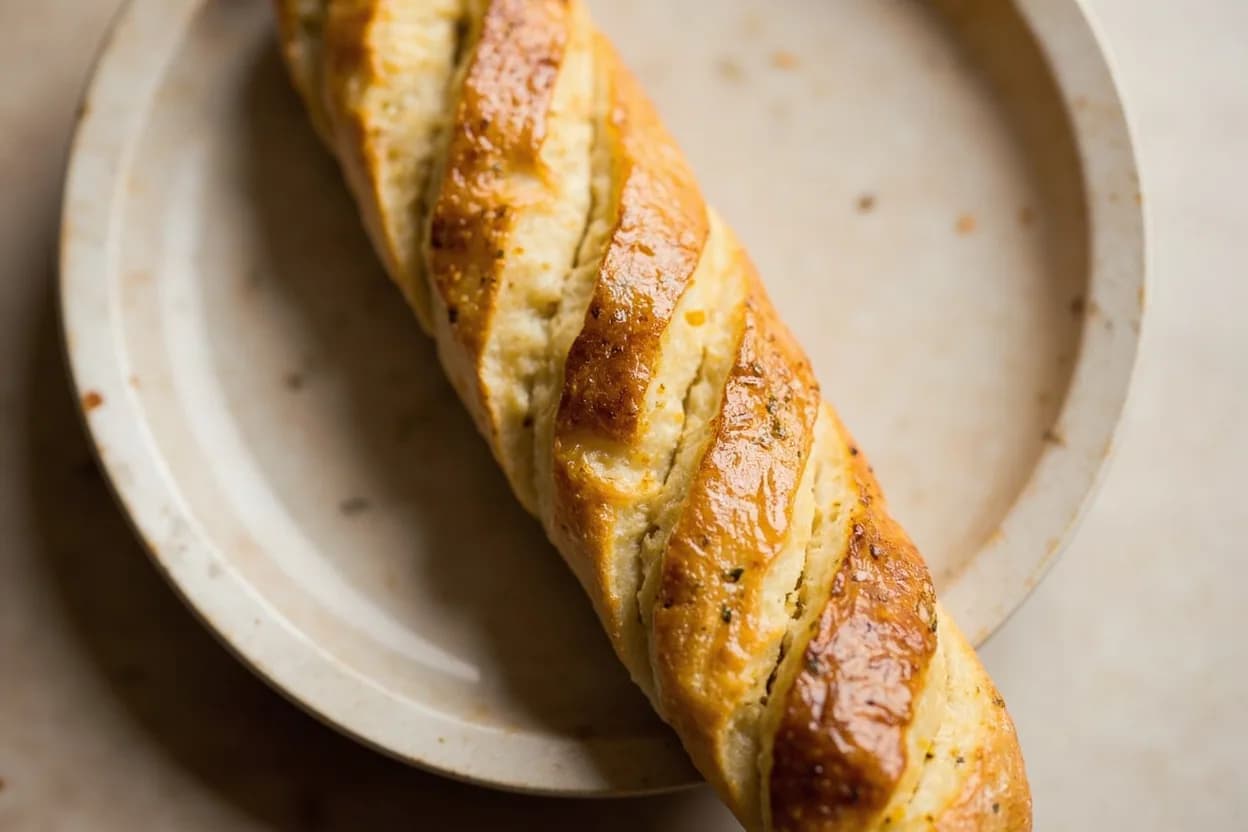
- Score baguettes from the heel (far end) toward the baker in a single pulling motion, overlapping each slash by roughly one-third of the previous cut's length
Substitutes
- Single-edge razor blade (unhandled)
Gripped at an angle; harder to control consistently than a lame but produces equally sharp cuts
- Scissors
Used for epi baguettes and decorative snips on dinner rolls; not a substitute for slash scoring on lean bread
- Sharp paring knife
Last resort; the slightly thicker blade drags and compresses dough edges — use only if a lame is unavailable
Related cuts
The raised flap that results from an angled shallow score — the defining visual and textural feature of well-scored sourdough
Extends scoring into purely visual territory; shares the same lame toolkit
- Epi (wheat-stalk) cut
Scissor-based cut series on a baguette to produce linked wheat-ear rolls; related but distinct technique
Appears in
References
- 1.Tartine Bread — Chad Robertson (Chronicle Books, 2010)
- 2.The Bread Baker's Apprentice — Peter Reinhart (Ten Speed Press, 2001)
- 3.Modernist Bread — Myhrvold & Migoya (The Cooking Lab, 2017)
- 4.Advanced Bread and Pastry — Michel Suas (Delmar Cengage, 2009)
Confidence: high
Notes
Why pattern matches shape
A baguette's long, narrow mass expands primarily lengthwise; overlapping diagonal slashes channel that spring into a continuous ridgeline. A boule has radially symmetric tension, so a cross or star allows even expansion in all directions. A batard is intermediate — its elongated oval responds best to a single courageous central slash that runs almost tip to tip. Applying a baguette slash pattern to a boule or vice versa produces uneven, asymmetric blooming.
The role of steam
Scoring and steam are co-dependent. Steam in the oven's first phase keeps the surface moist and extensible so the cuts remain open as the interior expands. Without steam, even perfectly executed scores seal shut within the first few minutes and the loaf tears at random weak points instead.