Poultry — Breakdown & Cuts
Spatchcock / Butterfly (Poultry)
Also: butterflied chicken, spatchcocked bird, poussin spatchcock, crapaudine
Remove the backbone, crack the keel, flatten the bird — and you've halved the roasting time while doubling the skin exposure.
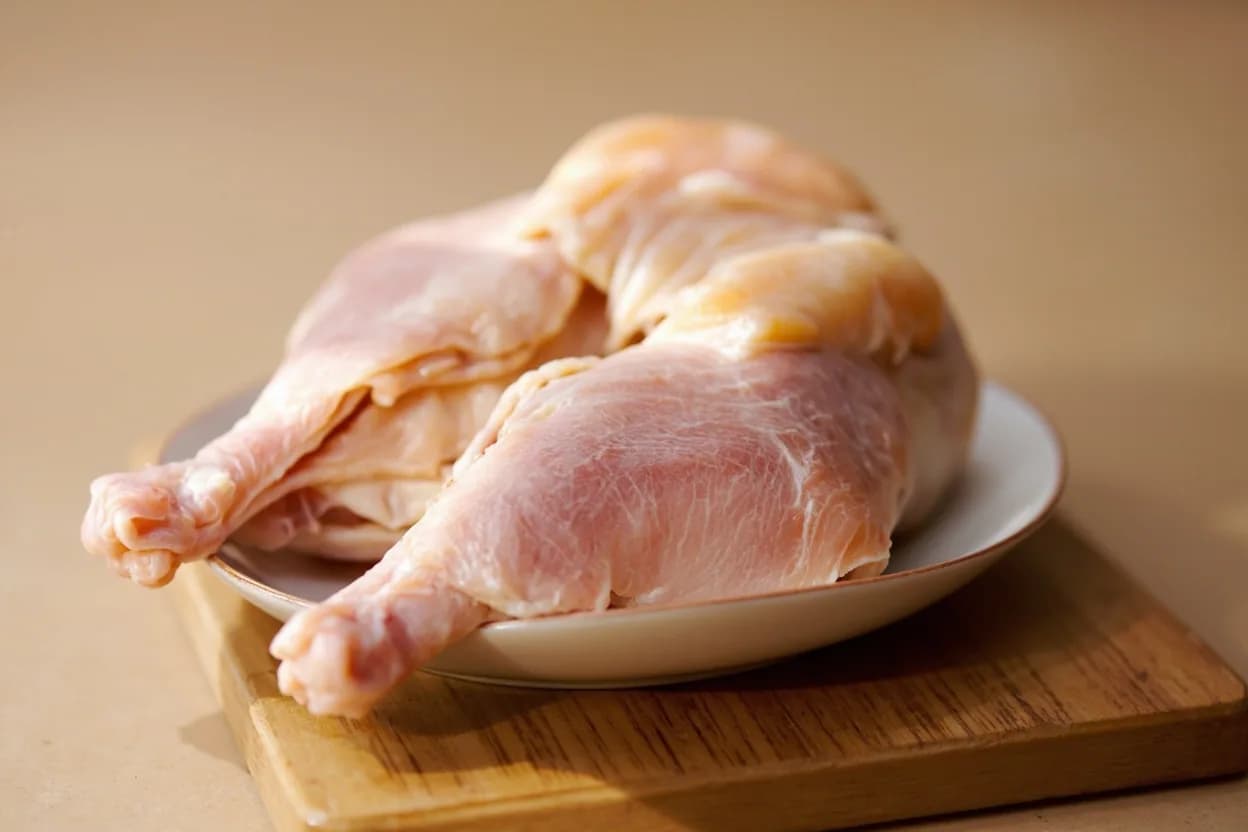
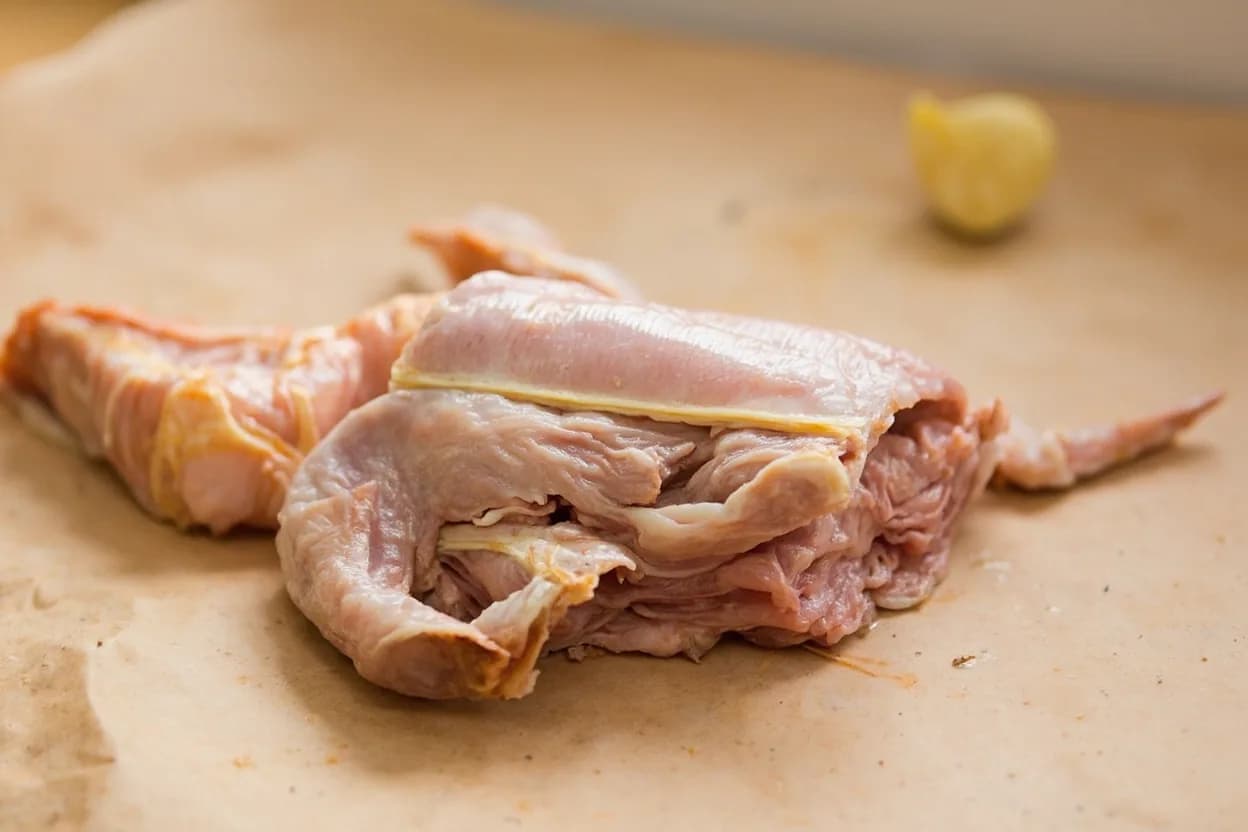
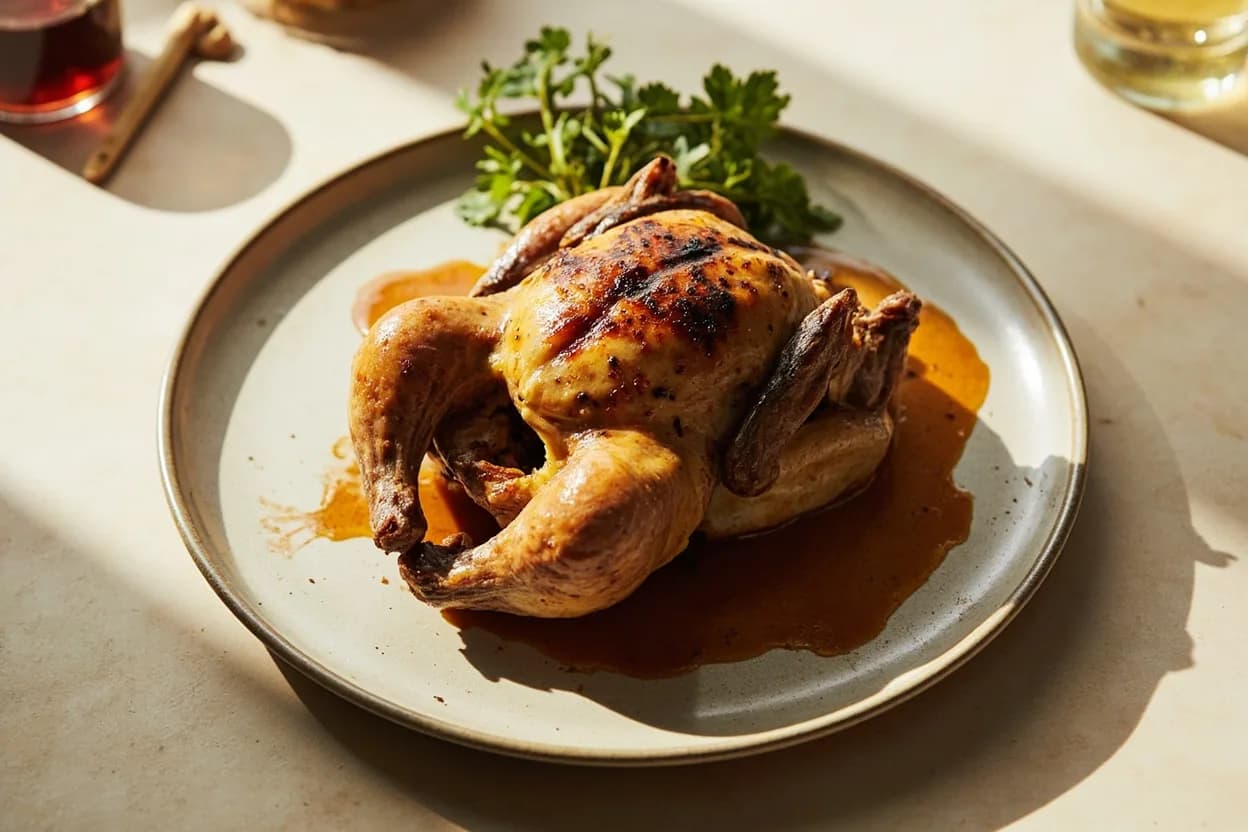
Spatchcocking (also called butterflying) is the technique of removing the entire backbone of a whole bird using kitchen shears or a heavy knife, then pressing the carcass flat by cracking or removing the keel bone (sternum), producing a uniform single-layer bird. The flattened form dramatically reduces oven, grill, or spit cooking time, exposes the maximum possible skin surface for crisping, and allows more even heat penetration across breast and thigh simultaneously.
In photos
Where it comes from
Applied to the whole bird — typically chicken (1–2 kg), Cornish hen (poussin), turkey (3–7 kg), or quail. The backbone runs the full dorsal length and is cut free on both sides with kitchen shears or a thin-bladed knife following the vertebral column. Once removed, the bird is turned breast-side up and pressed firmly at the breastplate until the keel bone cracks and the bird lies flat. For maximum flatness, the keel can be completely excised with a paring knife.
Best for
How to cook it
- 1STEP 1 — Remove the backbone: place bird breast-side down. Using sturdy kitchen shears, cut along both sides of the backbone from tail to neck. Remove the backbone and reserve for stock.
- 2STEP 2 — Score the keel: flip the bird breast-side up. Locate the keel bone (pinkish cartilage running down the center of the breast). Score both sides with a paring knife, or press firmly down on both breasts simultaneously with your palms until you hear and feel the breastplate crack flat.
- 3STEP 3 — For complete keel removal: use fingers to peel back the keel bone and cartilage wings for a fully flat bird — this produces the flattest possible result and is standard in restaurant prep.
- 4STEP 4 — Season: generously salt under the skin and on all surfaces. Dry-brine uncovered in the refrigerator at least 1 hour, ideally overnight, for crispest skin.
- 5STEP 5 — Roast at 230°C (450°F) on a wire rack over a sheet pan, or grill over a two-zone fire starting thigh-side down over direct heat before moving to indirect. A 1.5 kg chicken is done in 35–45 minutes vs. 60–75 minutes trussed. Target 74°C (165°F) at thigh.
Prep & butchery
- Chill the bird thoroughly before spatchcocking — cold poultry holds its shape and the skin doesn't tear
- Use dedicated heavy-duty kitchen shears — chef's knives are less safe on backbone cartilage and can slip
- Pull up on the backbone with one hand while cutting with the other to create tension against the shears
- If the keel bone refuses to crack by pressing, score it more deeply with a paring knife along the centerline cartilage — don't force it blindly
Substitutes
- Whole bird (trussed)
The non-spatchcocked alternative; longer cook time, uneven skin exposure, harder to achieve crispy thighs and moist breast simultaneously
- Bone-in chicken pieces (8-piece cut-up)
Same even-cooking benefit via pieces rather than a single flat bird; better for braising applications
- Butterflied leg of lamb
Analogous de-bone-and-flatten technique applied to lamb leg for grill or oven; different protein, same geometry logic
Related cuts
The premium individual portion derived from the breast of the same bird after breakdown
Alternative to spatchcocking when individual pieces are the goal
- Pollo al Mattone (brick-pressed chicken)
Classic Italian application of the spatchcock technique cooked under a heavy weight
Appears in
References
- 1.Samin Nosrat — Salt, Fat, Acid, Heat
- 2.J. Kenji López-Alt — The Food Lab: Better Home Cooking Through Science
- 3.Jacques Pépin — La Technique
- 4.The Culinary Institute of America — The Professional Chef (9th ed.)
Confidence: high
Notes
Etymology
The origin of 'spatchcock' is disputed. One theory traces it to 18th-century Anglo-Irish culinary slang: 'dispatch cock' — a bird killed and quickly prepared (dispatched) for immediate cooking, usually by splitting. Another theory links it to the Irish 'spatch' (a dispatch). What is clear is that the technique predates the word: records of flattened grilled birds appear in Roman, Persian, and Indian texts centuries before the English term was coined. The French classical equivalent 'crapaudine' (toad-style) refers to the flattened bird's visual resemblance to a toad splayed on a rock.
Tandoor and shawarma applications
In South Asian tandoor cooking, a whole chicken is sometimes spatchcocked and marinated before being threaded directly onto the iron skewer rack inside the tandoor wall — the flat form gives even char and allows the extreme radiant heat (300–400°C) to cook the bird in under 15 minutes. For vertical spit shawarma, a whole marinated spatchcocked bird is stacked flat onto the spit as one layer among many, a common practice in Lebanese and Turkish shawarma stalls when using whole birds rather than deboned meat slabs.