Fish — Fabrication & Breakdown
Whole Fish Scoring for Steaming / Frying
Also: fish scoring, cross-hatch scoring, slashing the fish, diagonal score cuts
Shallow diagonal or cross-hatch cuts made through the skin and into the flesh of a whole fish to ensure uniform heat penetration and allow aromatics to reach deep into the meat.
Fish scoring is not a butchery cut in the portioning sense but a preparation cut — a series of knife incisions made into the exterior of a whole, unboned fish to solve the problem of uneven cooking. A whole round fish presents the cook with radically different thicknesses from shoulder to tail; without scoring, the thin tail is overcooked long before the shoulder joint is done, and the skin shrinks unevenly, cracking the flesh. Score cuts — parallel diagonals or a cross-hatch pattern — give the skin a controlled path to shrink along, open channels for steam and seasoning to penetrate, and dramatically reduce cooking time at the thickest part. The technique is ubiquitous across Chinese, Japanese, Thai, Vietnamese, Levantine, and Sichuan culinary traditions, each with characteristic geometry and depth.
In photos
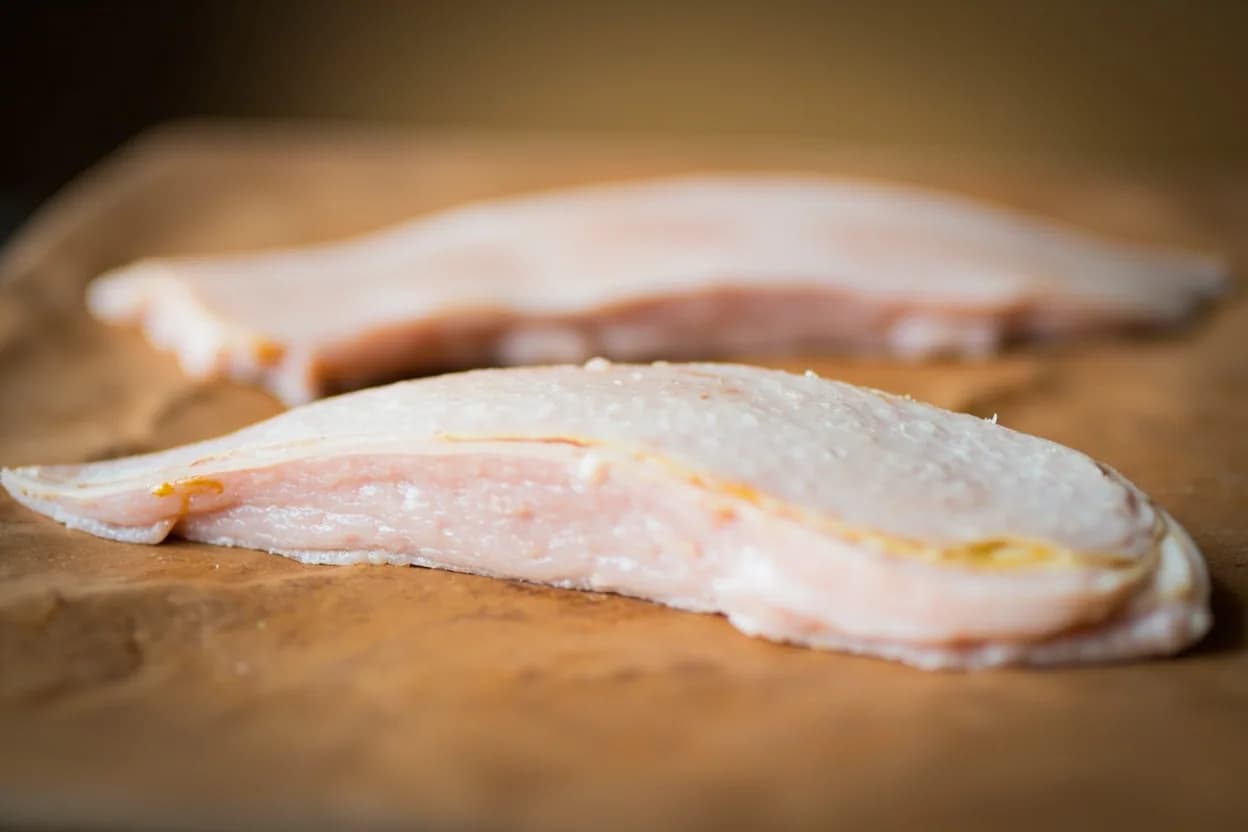
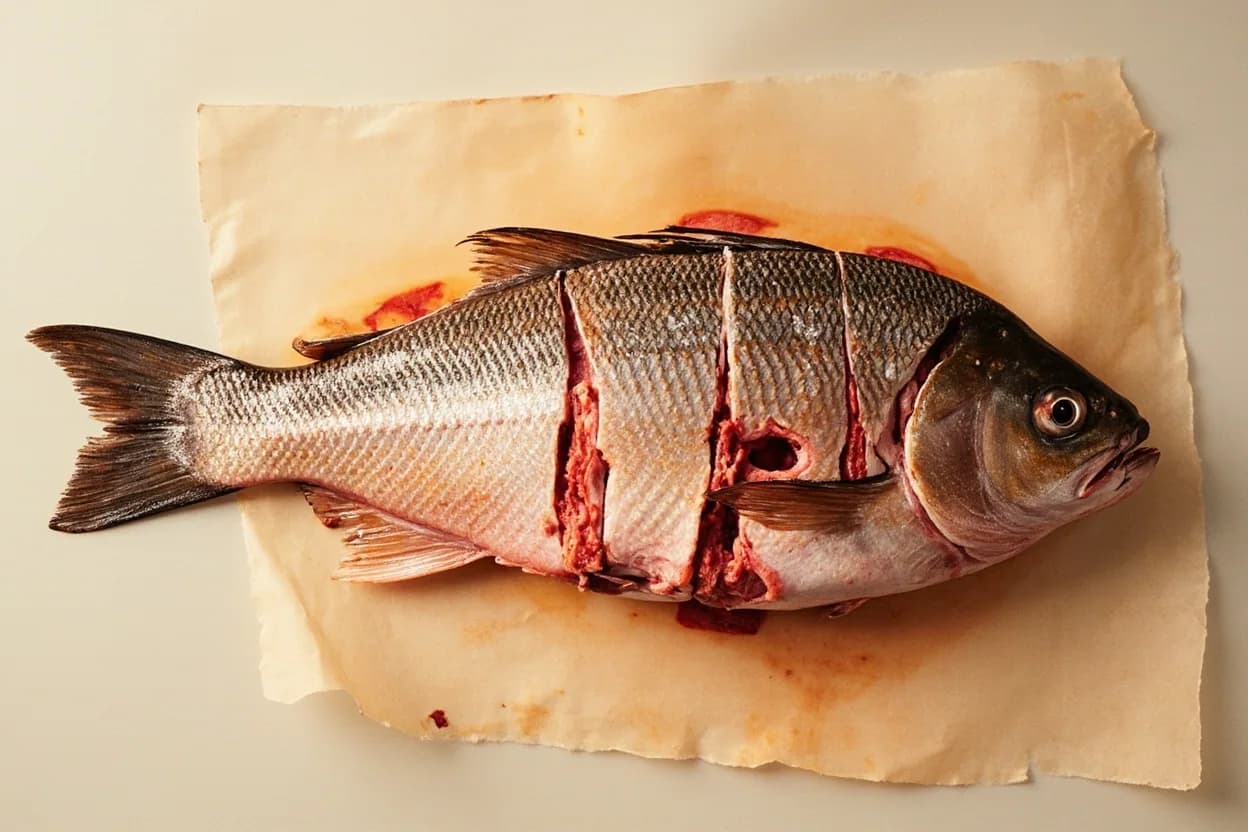
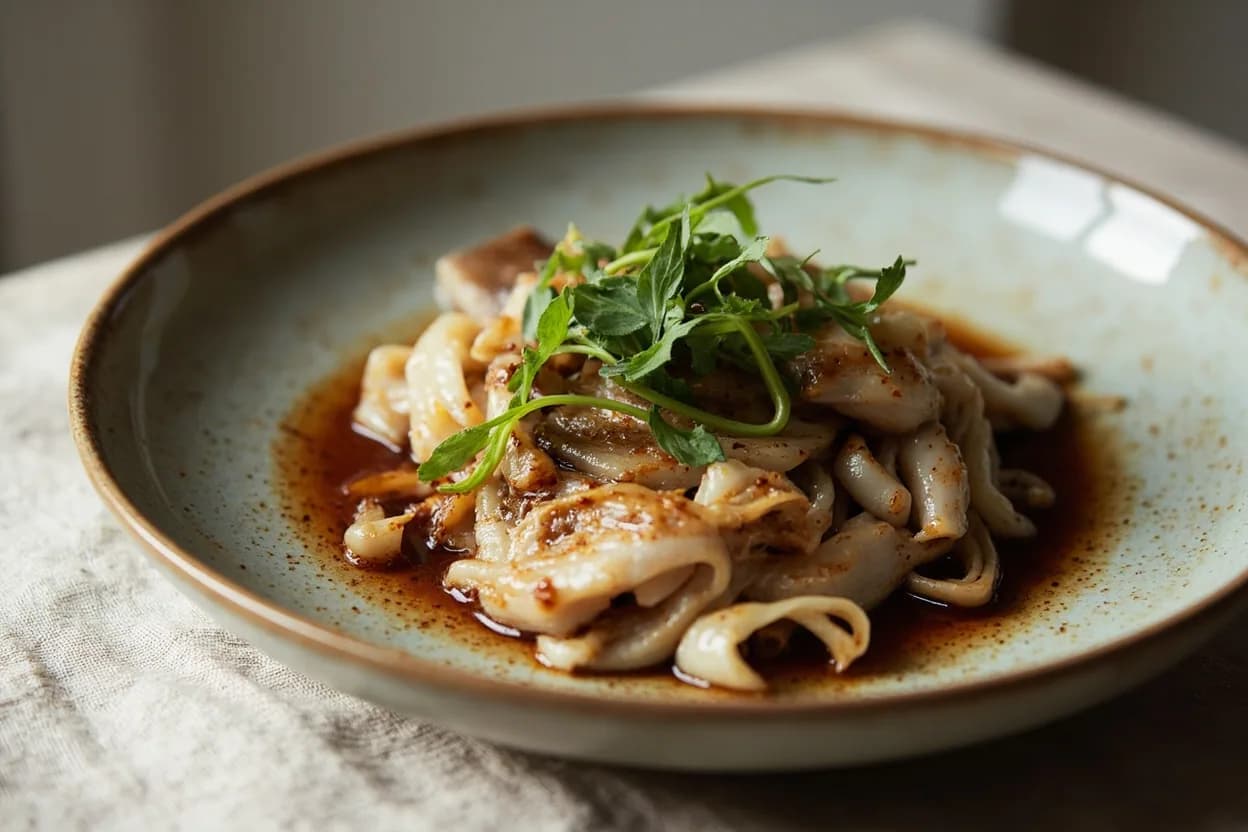
Where it comes from
Applied to medium whole round fish kept intact: sea bass, branzino, red snapper, tilapia, grouper, carp, and whole mackerel. Also applied to large flat fish grilled bone-in (turbot, flounder). The scores penetrate the lateral muscle — the main eating flesh — between the dorsal and ventral fin lines.
Best for
How to cook it
- 1Scale the fish and clean the cavity; remove gills if steaming (gills impart bitterness). Pat the skin completely dry — wet skin leads to oil spatter when frying and prevents clean cuts.
- 2FOR STEAMING (diagonal single cut, Cantonese method): Hold the fish on its side. Make 3–5 cuts at 45 degrees to the spine, beginning just behind the head and spaced 3 cm apart, cutting 1–1.5 cm deep. Do not cut all the way to the backbone. Repeat on the other side. Lay the fish on sliced ginger in the steaming dish; steam over high heat for 8–12 minutes (for a 600 g fish) until the flesh at the deepest score point pulls away from the bone with a chopstick.
- 3FOR DEEP-FRYING (cross-hatch, Cantonese 'squirrel fish' style): After diagonal scoring one direction, make a second set of cuts in the opposite direction (forming diamonds). This allows each diamond of flesh to fan open in the hot oil, creating the characteristic chrysanthemum texture. Dust with potato starch before frying at 180 °C.
- 4FOR SICHUAN BRAISING (fry then braise): Score diagonally, deep-fry the whole fish until golden, then transfer to a wok of doubanjiang-based braising sauce, spooning sauce over the scores repeatedly to penetrate.
- 5Rub the scored surfaces with the seasoning or marinade immediately before cooking — salt will draw moisture if applied early, softening the skin.
- 6At service for a steamed fish, pour boiling hot oil down the length of the scores after the soy-ginger dressing is added — the sizzle blooms aromatics deep into the cuts.
Prep & butchery
- Dry the skin meticulously before scoring — damp skin drags the blade and produces ragged, torn cuts rather than clean incisions.
- Use a thin, sharp boning or Chinese cleaver tip; a serrated knife is useless here.
- Score at 45 degrees — cuts perpendicular to the spine sever muscle fibre cleanly but may cause the fish to crack apart at the scores during cooking; angled cuts stay intact.
- Depth calibration: your knife should glide until you feel the lightest resistance of the rib bones or backbone — stop just before contact.
- For symmetrical presentation, score both sides with the same number and angle of cuts, starting from the same reference point.
Substitutes
- Scoring with a mandoline blade (butcher's tip)
A box cutter blade run along a ruler produces perfect-depth parallel scores on thin-skinned fish like sea bass
- Skewer holes (alternative for steaming)
For delicate fish that may break: insert bamboo skewers through the cavity to prop open and promote airflow instead of deep scoring
- Fillet sections instead of whole fish
When timing control is paramount, fabricating into fillets and steaming on a bed of aromatics eliminates the uneven-thickness problem entirely at the cost of presentation
Related cuts
An alternative approach: removes the problem of uneven thickness entirely by opening the fish flat
Full deboning of small fish — scoring is the lighter version for fish too large to butterfly conveniently
- Darne
Slicing the fish into bone-in steaks is another solution to the cooking-time-gradient problem
Appears in
References
- 1.Every Grain of Rice — Fuchsia Dunlop (2012)
- 2.The Food of Sichuan — Fuchsia Dunlop (2019)
- 3.Land of Fish and Rice: Recipes from the Culinary Heart of China — Fuchsia Dunlop (2016)
- 4.The Professional Chef, 9th ed. — The Culinary Institute of America (2011)
- 5.Fish & Shellfish — James Peterson (1996)
Confidence: high
Notes
The boiling oil finish (Cantonese steamed fish)
The defining moment of Cantonese zheng yu is the finish: after steaming and draining the liquid from the plate, the cook lays a tangle of fine-julienned ginger and scallion over the fish, pours premium light soy sauce along the score channels, then drizzles 2–3 tablespoons of smoking-hot (200 °C) peanut or vegetable oil directly down the fish. The oil blooms the aromatics, sizzles into the scores, and creates a perfumed cloud at the table. The scores are the delivery mechanism for this theatrical, flavour-concentrating technique.
Squirrel fish geometry
In Song shu gui yu the cross-hatch cuts are made especially close (1–1.5 cm spacing) and at a steep 60-degree angle to the spine, then the flesh panels are gently pried open before dusting with starch. In the deep-fryer at 190 °C, each diamond fans outward like a pine cone or a squirrel's tail — the source of the dish's name. The geometry requires a very thin, very sharp knife and a steady confident hand; hesitation produces ragged edges that don't fan cleanly.