Egg Doneness
Tamagoyaki Set Point
Also: Japanese rolled omelette doneness, dashimaki tamago set, tamagoyaki doneness
The layer-by-layer set of thin egg sheets in a Japanese rolled omelette, each cooked just to the verge of firm before rolling, leaving the finished log with a custardy, moist interior.
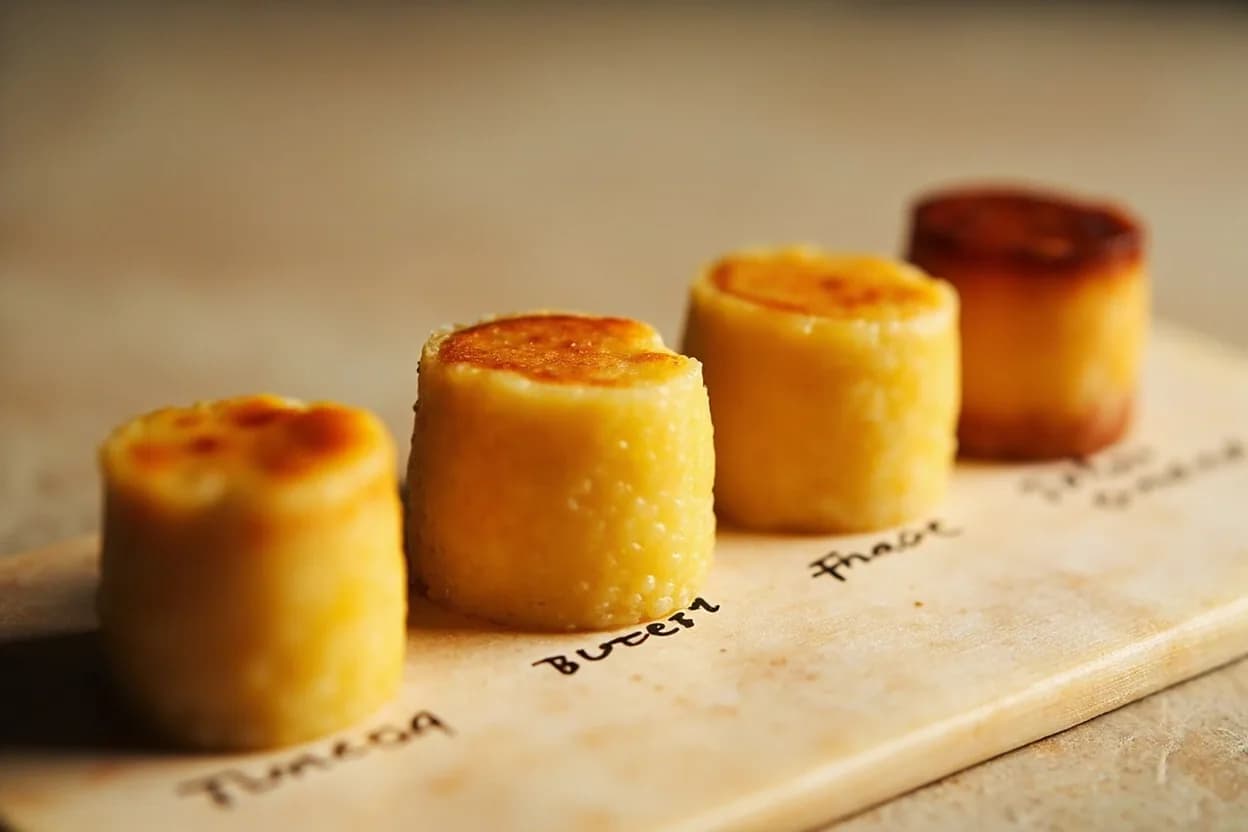
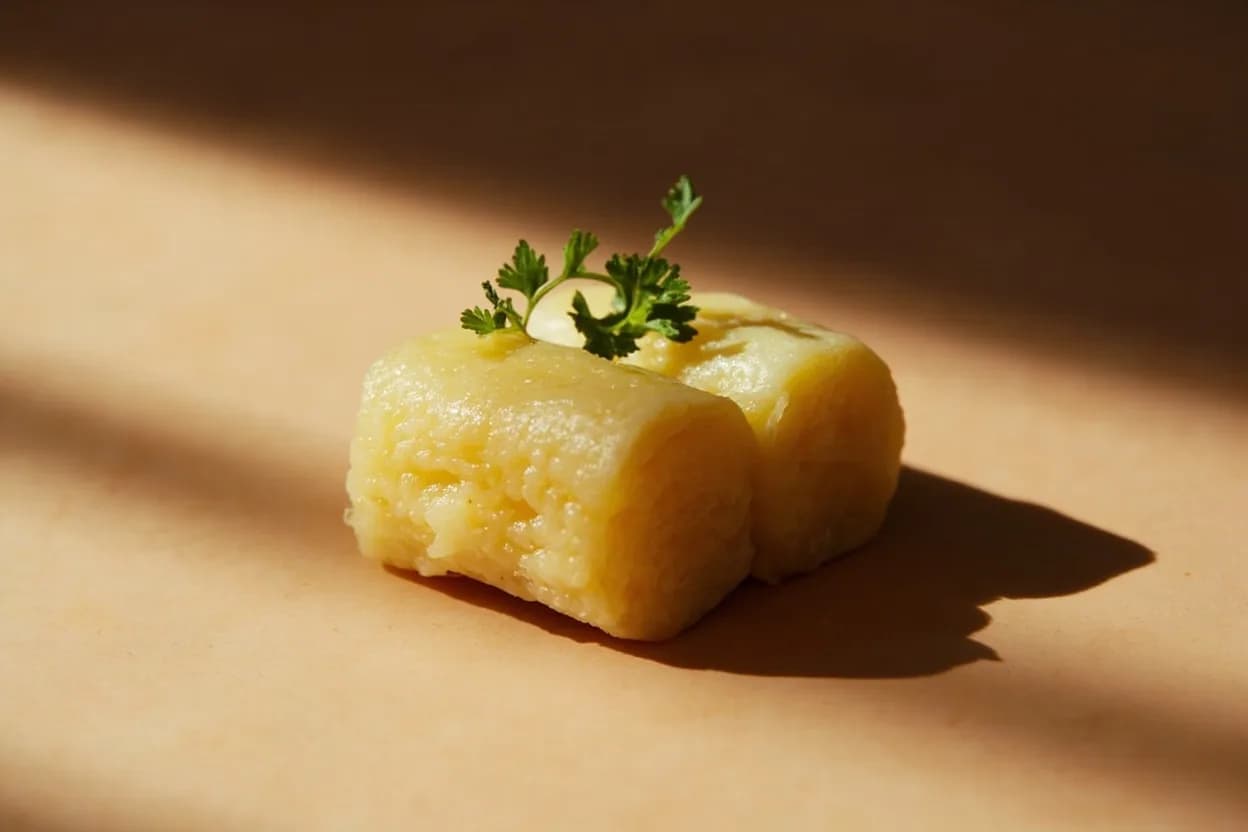
Tamagoyaki doneness is not a single temperature target but a per-layer process: each thin egg sheet poured into the rectangular tamagoyaki pan (makiyakinabe) must set enough on its surface and edges to be rolled without tearing, while retaining enough moisture that successive layers fuse and the finished roll has a silky, barely-custardy cross-section. The surface temperature of the pan is typically 160–180°C; the egg itself never exceeds roughly 75–80°C at the interior of the final roll, achieved by residual heat during the resting period.
In photos

What happens
Each egg pour (beaten egg thinned with dashi, mirin, and sugar) hits a lightly oiled, preheated pan. Within 20–40 seconds the bottom of the sheet sets via direct conduction while the top surface remains wet. At this critical point the egg white proteins (primarily ovalbumin, conalbumin) have coagulated on the underside, creating a self-releasing skin, while the top is still fluid enough to bond with the next pour. Rolling begins here: the partially set sheet folds onto itself without breaking because the interior is still plastic. Sugar in the recipe elevates the coagulation temperature slightly, extending the window for rolling. The finished roll rests, wrapped in a bamboo mat (makisu), where residual heat completes the set to a tender, just-firm gel.
What to look for
- Edges of the poured sheet turn from translucent to opaque and begin to contract from pan walls
- Surface appears wet but not liquid — it moves as one cohesive sheet when the pan is tilted
- Bubbles from the dashi/mirin mixture have fully settled; no active sizzling at the surface
- The sheet slides freely on the pan surface when shaken, indicating it has released
- Interior of the finished roll yields slightly under thumb pressure — soft but not liquid
How to check
- Edge opacity: watch for the egg to turn opaque around the perimeter (2–3 cm inward) while the center remains slightly glossy
- Pan tilt test: tilt the pan — a ready layer slides as a single skin, not as a wave
- Chopstick lift: gently slip a chopstick under one edge; if it lifts cleanly without tearing, the sheet is ready to roll
- Finger press on cooled final roll: should feel uniformly firm with slight give, not hard or rubbery
Food safety
Carryover & resting
The finished roll continues to cook significantly inside the bamboo mat during a 3–5 minute rest. This carryover is intentional and part of the technique — the roll is always removed from the pan when it still appears slightly underdone at center, relying on the mat's insulation to finish the set without drying the exterior.
The science behind it
Umami-rich stock used to thin the egg mixture, lowering protein density and producing a softer set
- Egg white coagulation temperature
Ovalbumin sets at ~80°C; sugar in the mix raises this slightly, giving more roll-time
- Makiyakinabe
The rectangular Japanese omelette pan essential for even heat distribution across the thin sheets
Sweet rice wine in the egg mix; its sugar content delays coagulation and adds gloss
- Dashimaki tamago
The Kansai (Osaka) style variant with a higher dashi ratio, producing an even softer, almost liquid center
Appears in
References
- 1.Japanese Farm Food — Nancy Singleton Hachisu
- 2.The Japanese Kitchen — Hiroko Shimbo
- 3.On Food and Cooking — Harold McGee
- 4.Japanese Soul Cooking — Tadashi Ono & Harris Salat
Confidence: high
Notes
Sugar and the rolling window
Traditional tamagoyaki recipes for sushi bars use relatively high sugar ratios (up to 1 tsp per two eggs), which is not purely about sweetness. Sugar competes with proteins for water molecules and interferes with protein-protein interactions, raising the effective coagulation temperature by several degrees. This gives the cook a longer window between 'bottom-set' and 'over-set' to execute the roll — critical when working with thin layers and a rectangular pan.
Regional variation in set
Tokyo-style tamagoyaki (Edo-mae) is firmer, drier, and sweeter — egg sheets are set more completely before rolling, producing a dense, sliceable log suitable for nigiri toppings. Osaka-style dashimaki tamago uses far more dashi and is rolled earlier, resulting in a soft, nearly custard-like interior that flows slightly when cut. Both are correct within their regional contexts; neither is underdone.