Teas & Beverages
Smoked Tea (Lapsang Souchong)
Also: lapsang souchong, zhengshan xiaozhong, tarry souchong, pine-smoked black tea, smoky tea
The world's most aggressively smoked tea, with a pine-and-tar aroma so pronounced it functions as a liquid smoke seasoning in cocktails, braises, and cured fish.
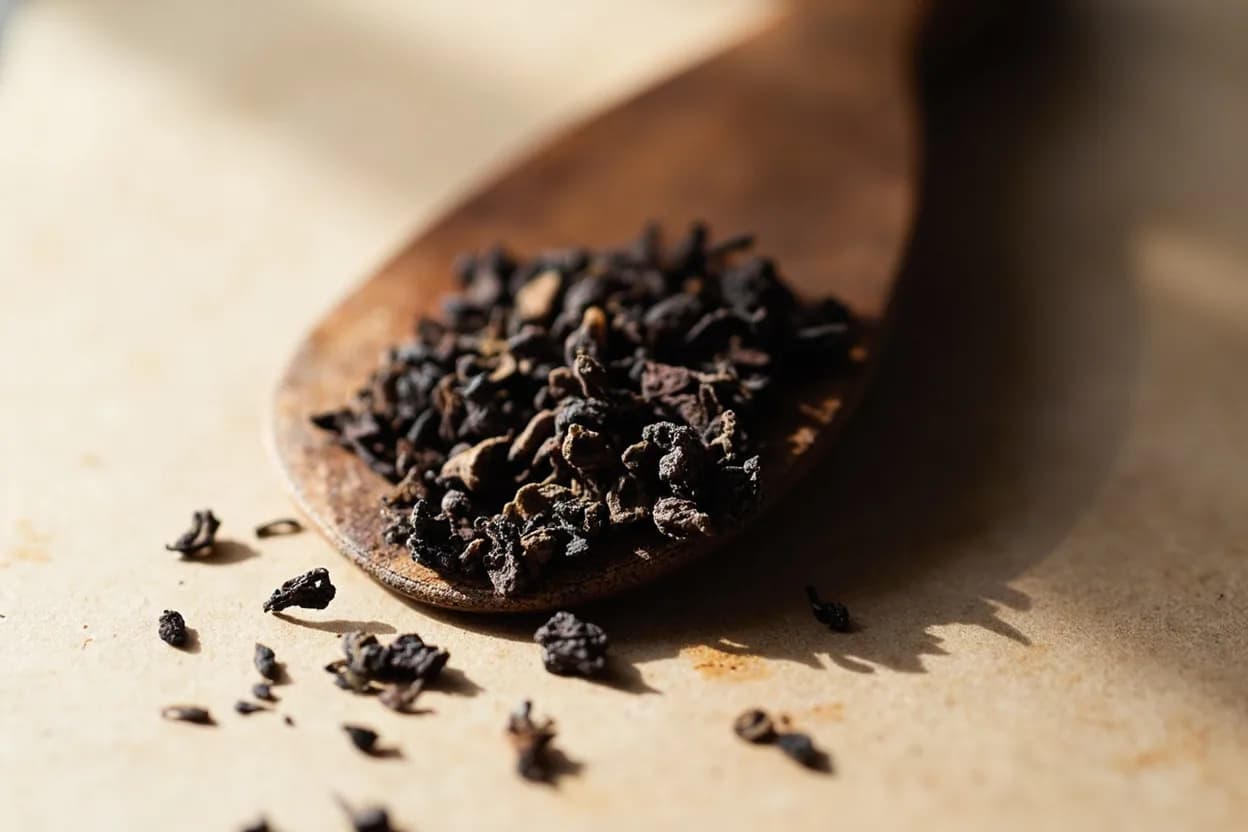
Lapsang souchong (Zhengshan Xiaozhong in Mandarin) is a black tea from the Wuyi Mountains of Fujian province, China, in which the leaves are dried and fully oxidized over burning pinewood — specifically Pinus massoniana (Masson's pine). The drying smoke penetrates the leaf completely, yielding a tea whose brew smells intensely of pine resin, tar, campfire, and dried fruit, with a long, warming finish. Original Zhengshan Xiaozhong is a nuanced smoked tea with dark-plum sweetness alongside the smoke; cheaper mass-market 'lapsang souchong' is often more aggressively smoky and tarry. The tea gained international fame in the 18th century when it reached European courts and was served as a prestige beverage; today it is equally prized by cooks who use it as a liquid flavoring — a vehicle for imparting smoke without a smoker.
In photos
Flavour profile
Classic pairings
- Smoked salmonBritish
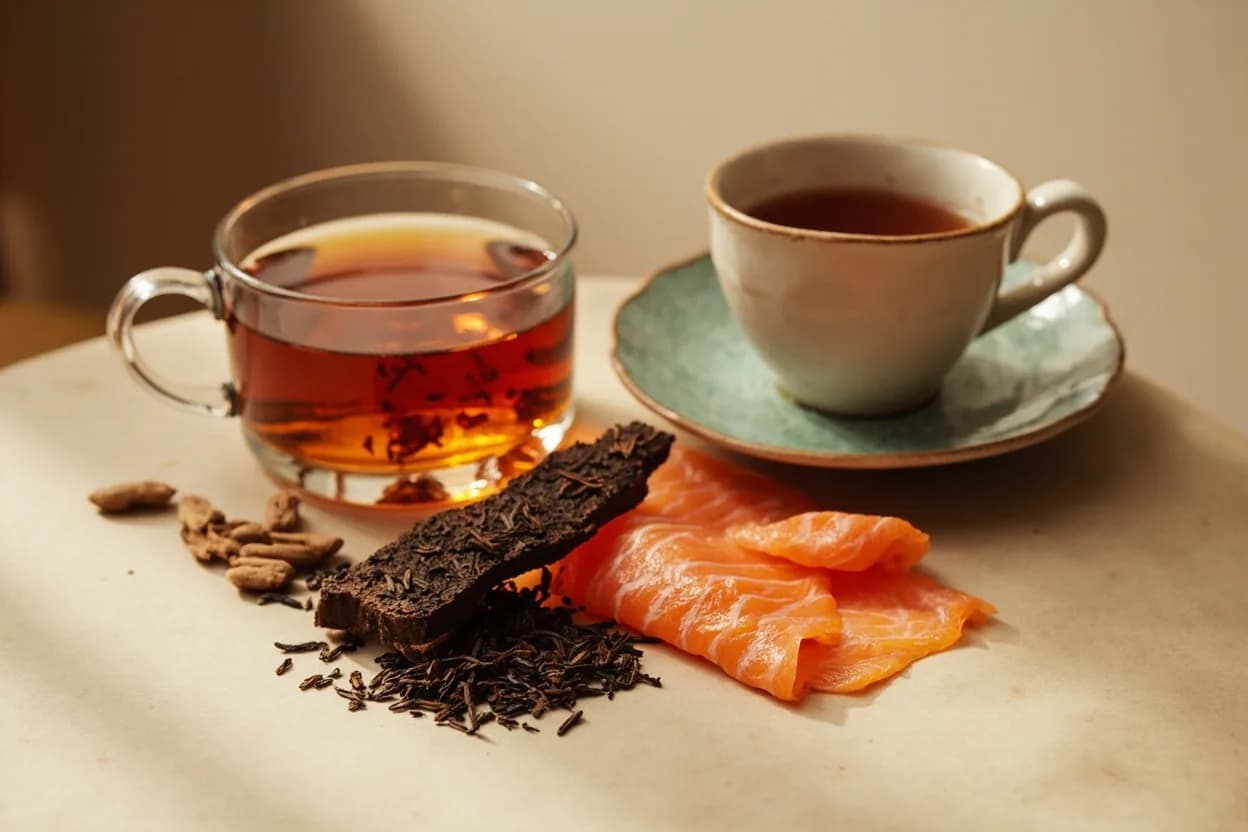
The tea's pine smoke mirrors and amplifies the salmon's own smoking; this classic British pairing (lapsang souchong with smoked salmon sandwiches at afternoon tea) works because both share the same sensory register, layering rather than competing.
- Dark chocolateConfectionery / French patisserie
High-cacao chocolate's bitterness and fruit notes pair naturally with the tea's dark-cherry smoke; lapsang is used to infuse ganaches and truffles in serious confectionery because it adds complexity without sweetness.
- Scotch whisky (peated)Cocktail
A canonical cocktail pairing: lapsang souchong–infused syrup or cold-brew concentrate in a highball with a peated Islay Scotch creates a double-smoke cocktail where peat and pine-smoke harmonize across two very different extraction methods.
- Slow-braised pork bellyChinese / Fusion
Substitute a strong-brewed lapsang souchong for part of the braising liquid (or all of the water) in hong shao rou (red-braised pork); the pine smoke bridges the tea's own role in Chinese red-braising traditions and adds a dimension that regular tea lacks.
- Hard cheeses (aged cheddar, comté)British / European
Aged cheeses with crystalline tyrosine notes and caramel undertones — comté, aged gouda, 24-month cheddar — are long-established accompaniments to smoked tea, the cheese's fat mellowing the tar while its salinity extends the tea's finish.
- Dried black cherries / prunesCocktail / European
The tea's own dried-fruit dimension is amplified rather than contradicted by pairing with prune or black cherry; used in cocktails (lapsang souchong syrup over a Manhattan riff) or in braising liquids for game birds.
Adventurous pairings
- Oysters
A lapsang souchong mignonette (cold brew steeped, strained, reduced, then mixed with rice wine vinegar and shallot) over raw oysters; the pine smoke works against the brine and mineral iodine in the same way a coastal campfire memory does — elemental and surprising.
- Vanilla ice cream
Freeze a lapsang souchong cold-brew as a granita or steep it into a cream base; the smoke against cold dairy fat is disorienting in the best way — the same principle as a smoked-salt caramel, but more complex.
- Lamb ribs (as a rub or marinade base)
Grind spent lapsang souchong leaves with salt, coriander, and black pepper; use as a dry rub on lamb ribs before slow roasting. The tea tannins tenderize, the pine smoke adds a layer that oven-roasting can't achieve on its own.
Use strong-brewed lapsang souchong as part of the cooking liquid for freekeh pilaf; two fire-roasted, smoke-forward ingredients create a grain that reads deeply savory with a campfire character — best finished with lamb fat and saffron.
- Mezcal
Lapsang souchong cold-brew in a mezcal cocktail (with honey syrup and lime) doubles down on agave smoke and pine smoke in a way that is polarizing and unforgettable; the tea's fruit softens mezcal's vegetal edge.
- Mascarpone
Infuse lapsang directly into warm mascarpone, strain and chill; the fat captures smoke aromatics efficiently. Use as a base for a tiramisu variation (espresso + lapsang, dark chocolate) or as a savory dip alongside cured meats.
Tread carefully
- Delicate floral teas (jasmine, chamomile)avoid
Lapsang obliterates subtle florals if used as part of a tea blend or in the same flavor context; the pine smoke is so dominant it reads as contamination rather than layering.
- Bright, high-acid saladsavoid
The tea's tannins combined with high vinegar acid create a metallic, astringent combination; its smoke and earthiness need fat or sweetness as a bridge, not a sharp vinaigrette.
- Fresh, herbaceous flavors (basil, tarragon)avoid
The pine-tar intensity overwhelms fresh herb aromatics entirely; pairings work only with dried or deeply cooked herbal notes, never fresh-raw.
- Seafood in delicate preparations (steamed halibut, sole)avoid
The tea's smoke and tannin overwhelm a delicate white fish; keep lapsang pairings with fatty, rich, or already-smoked fish only.
How to use it
- Cold-brew (8–12 hours in cold water, 10g per 500ml) for a smooth, smoke-forward concentrate without bitterness — the optimal form for cocktails and savory sauces
- Hot steep at 90°C (not boiling) for 3–4 minutes maximum to avoid extracting harsh tannins alongside the smoke
- Reduce a strong hot brew by half to create a 'lapsang syrup' for cocktail use (1:1 with sugar) or a braising glaze
- Grind dried spent leaves in a spice grinder with salt, pepper, and coriander for a smoked-tea rub
- Infuse warm cream, butter, or mascarpone directly with leaves (15 min at 60°C, strain) to capture lipophilic smoke aromatics
- Use as the liquid in smoking-gun–free charcuterie brines alongside pink salt and maple syrup
Appears in
Related flavours
- Mezcal
Shares the pine/earth smokiness from agave roasting; pairing the two creates a double-smoke cocktail that is intense but harmonious.
- Peat-smoked whisky (Islay Scotch)
Different smoke source (peat vs. pine) but the same flavor axis; together in a cocktail they layer smoke types in a manner appreciated by aficionados.
Another fire-roasted cereal with smoke and earth as primary flavor notes; using lapsang as the cooking liquid is an advanced cross-category pairing.
References
- 1.The Tea Enthusiast's Handbook — Mary Lou Heiss & Robert Heiss (2010)
- 2.World Atlas of Tea — Krisi Smith (2016)
- 3.Liquid Intelligence — Dave Arnold (2014) — cold-brew tea concentrates
- 4.Heston Blumenthal, The Fat Duck Cookbook (2008) — tea infusion in savory cooking
Confidence: high
Notes
Zhengshan Xiaozhong vs. 'lapsang souchong'
True Zhengshan Xiaozhong is produced from a small-leaf cultivar grown in the protected Tongmu Reserve in Fujian, at elevations above 1,000m, and pine-smoked only with locally sourced Masson's pine. It has a nuanced smoke — dark plum, longan fruit, and pine — alongside rather than instead of tea flavor. What is commercially sold in the West as 'lapsang souchong' is typically a lower-grade tea from outside the reserve that is smoked more aggressively to compensate for plainer base-leaf quality; it tastes tarrier and less fruity. For culinary use, the commercial version often works better because its smoke is more forward; for drinking, seek authentic Zhengshan Xiaozhong.
Cold-brew is the key culinary tool
Hot-steeping lapsang for culinary use risks over-extracting tannins, which are bitter and astringent in sauces. Cold-brewing extracts the volatile smoke aromatics and dried-fruit esters with minimal tannin, producing a concentrate that is smooth, sweet, and intensely smoky — a far more versatile culinary ingredient. At 10g of loose leaf per 500ml water steeped for 10–12 hours in the refrigerator, the result is a dark, viscous liquid that can be used straight, reduced to a glaze, or diluted into braising liquids.