Sweeteners
Caster Sugar (Superfine)
Ultra-fine white sugar that dissolves almost instantly, giving lighter meringues, smoother creamed batters, and grit-free custards.
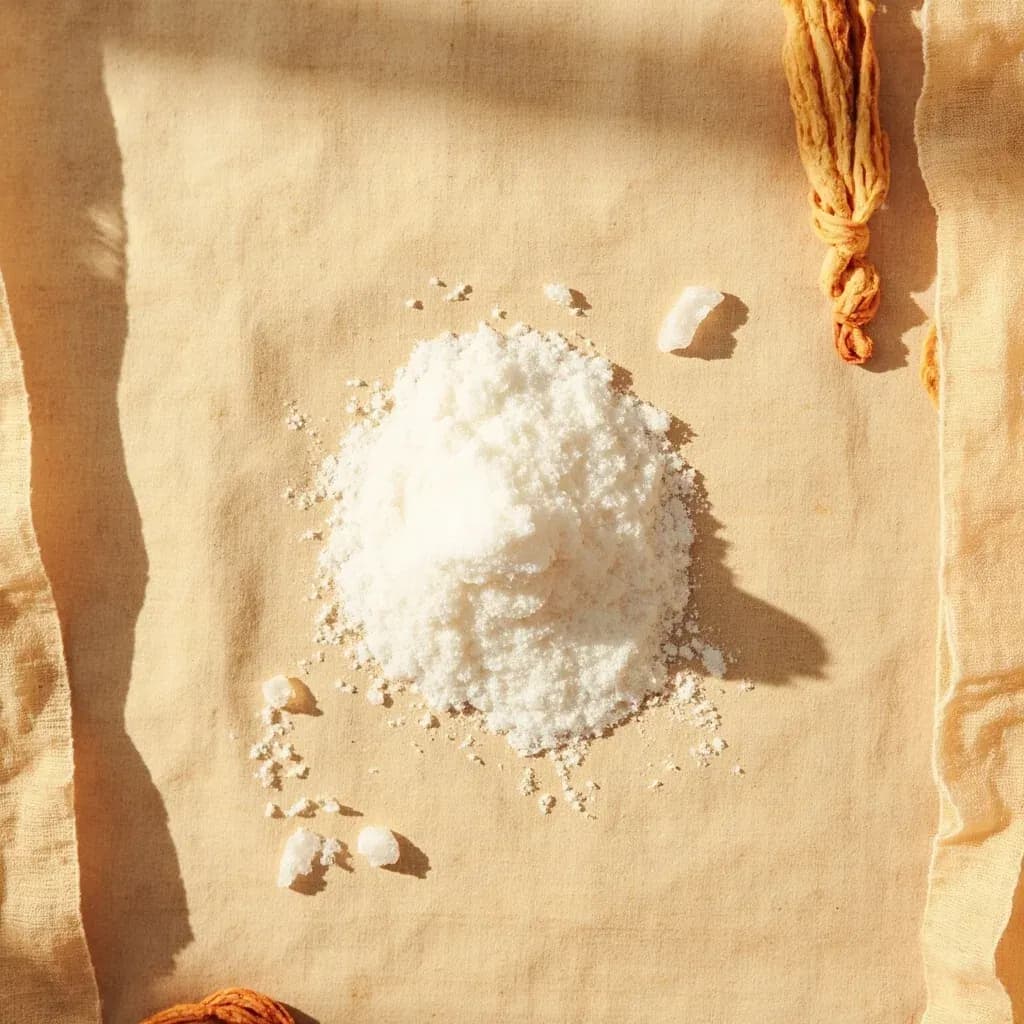
Caster sugar — sold as superfine sugar in the United States — is plain refined sucrose milled to a grain finer than ordinary granulated. Each crystal sits roughly 0.35 mm across, between granulated (~0.5 mm) and powdered/icing sugar (~0.06 mm). Chemically it is identical to the bag of sugar most cooks keep on the shelf: the same sweetness, the same ~387 kcal per 100 g, the same browning power in the oven. What changes is kinetic. Smaller crystals expose more surface area per gram, so they dissolve faster in cold and room-temperature liquids, integrate more evenly into creamed mixtures, and leave no perceptible grain in custards and whipped cream.
That faster dissolution is the entire reason caster exists. In a meringue, any undissolved sugar crystals left suspended in the foam act as nucleation points for the syrup that beads up on the surface (bakers call it weeping). Finer crystals dissolve fully during whipping, giving a glossier, more stable foam. The same logic applies to a custard that will not be strained, cold lemon juice for a curd, a shaker full of ice and bitters, or macerated strawberries destined for Eton mess — anywhere the granular texture of ordinary sugar would be a real problem, caster is the clean answer.
Where crystal size is invisible after the bake, however, granulated is a perfectly fine substitute, and most recipes that call for caster work just as well with regular sugar swapped in 1:1 by volume. American 'superfine' and British 'caster' are direct equivalents; the only US watch-out is 'bar sugar', which is similar in grain but usually contains a small amount of cornstarch or dextrose as an anti-caking agent and is best reserved for cocktails rather than delicate baking.
- Measured in
- g
- Storage
- Pantry
Find it in
Suits
Types & varieties
The UK/Ireland/AU/NZ standard; crystal size around 0.35 mm, designed to dissolve quickly in cold liquids and meringues
The direct US equivalent, sold under the 'Superfine' label by C&H and Domino; safe 1:1 swap for British caster
American trade name, sometimes even slightly finer than British caster; popular with commercial bakers for sponges and meringues
Bartending-grade superfine sugar; often has a small amount of cornstarch or dextrose added to discourage caking — useful for muddling and shaken cocktails, not ideal for delicate baking
Caster stored with a split vanilla pod (or a dab of vanilla paste) until fragrant; used as a flavored sweetener for dusting, biscuit doughs, and shortbread
Regular granulated sugar pulsed briefly in a clean, dry food processor or blender — a common kitchen workaround, not an industrial variety
Choosing a substitute when caster isn't on hand
Most baking can absorb granulated sugar 1:1 by volume with no detectable difference, so the substitution is worth thinking through only in a few situations. The right answer depends on what role the sugar is playing in the recipe.
- For cold liquids — cocktails, fruit purées, lemon juice for curd — make a quick 1:1 simple syrup from granulated sugar, or pulse the dry sugar briefly in a clean dry grinder before adding
- For meringue and pavlova, pulse granulated to caster texture; with straight granulated expect slightly slower whipping and a marginally less glossy result, but no real failure
- For batters that will be fully baked (sponge, cookies, quick breads, muffins), straight granulated is fine — the crystals disappear into the crumb
- Never substitute powdered/icing sugar 1:1; it is far finer and contains cornstarch, which can throw off structure, tenderness, and flavor
- Fine sanding sugar is the right grain for decorating but its coating keeps it from dissolving into a surface; it is not a baking substitute
Common uses
Tips & pitfalls
- To make a DIY substitute at home, pulse granulated sugar in a clean, dry food processor for 10–15 seconds only; over-processing turns it into powdered/icing sugar, which behaves very differently and contains cornstarch in commercial form
- Caster and granulated can be swapped 1:1 by volume in most baking — the small difference in weight is rarely meaningful
- When substituting granulated for caster, expect slightly slower dissolution in cold liquids (cocktails, cold syrups) and a marginally grainier finish in unbaked custards; both are minor rather than deal-breaking
- In the US, look for the word 'superfine' on the bag; 'caster' is rarely labeled in American supermarkets
- Keep caster bone-dry — because the crystals are small and porous, it clumps faster than granulated when exposed to humidity; sift before measuring if it has set
- In meringue, caster reduces weeping because any undissolved sugar crystals left in the finished foam attract moisture and release it as beads of syrup on the surface; finer crystals fully dissolve during whipping
- Do not substitute caster where a recipe calls for granulated for deliberate texture — shortbread that should be slightly sandy, crumble toppings, or cookies that need a coarser crunch all depend on the larger crystal
- For cocktails, if you only have granulated on hand, stir a quick 1:1 simple syrup and use that in place of bar sugar; it dissolves instantly and integrates cleanly into the drink
Nutrition
Energy
1619 kJ · per 100 g
Where the calories come from
Protein
0g
0% DV
Carbs
100g
36% DV
Fat
0g
0% DV
Fiber
0g
0% DV
Sugars
99.8g
of which
Sodium
1mg
0% DV
Source · USDA FoodData Central · Sugars, granulated
View on FDC →In the shops
Matched grocery products
No matched grocery products for Caster Sugar (Superfine) yet.
Good to know
- Crystal size
- Approximately 0.35 mm — finer than granulated (~0.5 mm), coarser than powdered/icing sugar (~0.06 mm)
- Composition
- Essentially pure sucrose (>99.9%); produced by milling standard refined cane or beet sugar to a finer grain
- Regional naming
- Caster or castor sugar in the UK, Ireland, Australia, and New Zealand; superfine, baker's, or bar sugar in the US and Canada
- Origin of the name
- British 'caster' refers to the small perforated castor shakers it was designed to flow through; American 'superfine' describes the grain
- Clumping behavior
- Bone-dry crystals with high surface area absorb ambient humidity quickly and clump faster than granulated; sift before measuring if lumpy
- Shelf life
- Indefinite if kept dry and sealed in an airtight container
- Cost
- Typically 10–25% more per kilo than standard granulated sugar
- Calories
- ~387 kcal per 100 g — identical to granulated and other white sugars
Substitutes
- Granulated white sugar (1:1 by volume) — The most accessible substitute; identical sucrose content, but larger crystals dissolve more slowly in cold liquids and give a slightly grainier texture in unbaked custards and meringues
- DIY caster (pulsed granulated) — Pulse granulated sugar briefly in a clean, dry food processor; stop the moment the crystals look finer — do not over-process or it becomes icing sugar
- American superfine or baker's sugar — Direct commercial equivalent to British caster; safe 1:1 swap in any application
- Fine sanding sugar — Fine enough in grain, but the coating prevents full dissolution into a batter; acceptable for decorating, not for baking into mixtures
- Demerara or turbinado sugar — Not a true substitute — different color, flavor, and much larger crystals; only appropriate where those changes are wanted (coffee, oatmeal, some rustic cookies)
- Coconut sugar — Texture and flavor diverge sharply; do not substitute 1:1 in delicate baking or anywhere the recipe assumes a neutral, fine white sugar
- Liquid sweeteners (honey, maple, agave, golden syrup) — Not a structural substitute — will change moisture balance, browning, and flavor; reduce other liquids and adjust acidity if using
Pairs with
Also called
castor sugar · superfine sugar · baker's sugar · azúcar extrafino · fine sugar