Sweeteners
Confectioners' Sugar
Sugar milled to powder with a little starch, so it dissolves instantly into glazes, royal icing, and buttercream and dusts cleanly without graininess.
Confectioners' sugar is refined sucrose pulverized to a fine powder and blended with a small amount of anti-caking starch — usually 3 to 5 percent cornstarch, though tapioca starch or tricalcium phosphate appear in some brands. The starch is not filler: it keeps the powder free-flowing in the bag and slows the clumping that begins the moment the sugar meets ambient humidity. Without it, a freshly opened box hardens quickly into a heavy lump.
The fine grind does far more than make the sugar dissolve instantly in cold liquid. Those microscopic crystals carry air when creamed into butter, which is part of why American buttercream is lighter than its reputation suggests. They stabilize egg-white foams and whipped cream, give royal icing the body it needs to hold a piped line, and help prevent recrystallization in cooked syrups — which is why the sugar appears in everything from Italian meringue to pâte à bombe. In fondant, the fine particles are what let the mass come together without going grainy on the tongue.
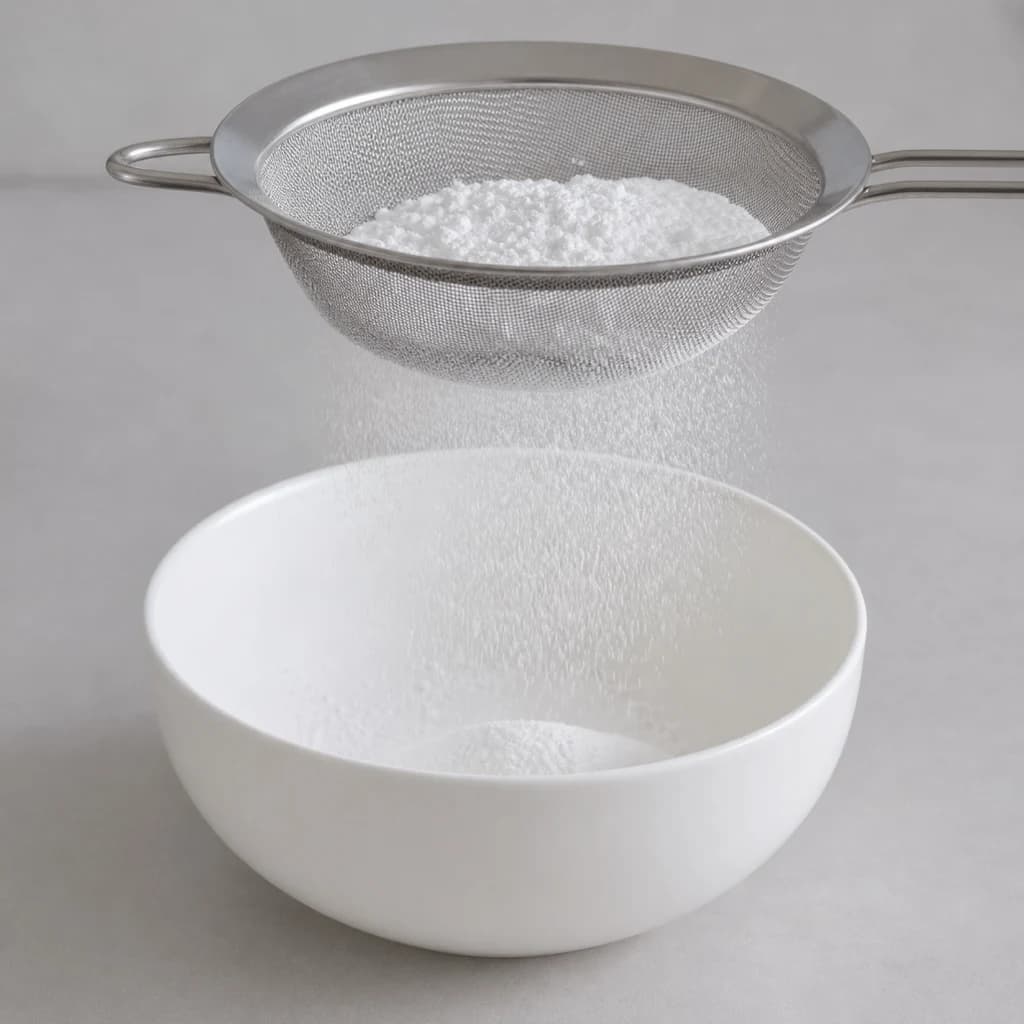
Powdered sugar is also one of the few baking ingredients where handling matters as much as the recipe. It compacts under its own weight in the bag, picks up moisture within minutes of being exposed, and weighs dramatically differently depending on whether it is sifted, spooned, or packed. Cooks who measure by the cup, or who skip sifting, will find that the same recipe yields two different icings on two different days.
- Measured in
- g
- Storage
- Sealed Airtight In A Cool, Dry Pantry Away From Humidity
Find it in
Suits
Types & varieties
The everyday confectioners' sugar; the finest grade commonly sold in supermarkets and used for icings, glazes, buttercream, and dusting.
Slightly coarser; shows up in older recipes for doughnut sugar and confections where a touch of grain is acceptable.
Coarsest commercial grade; rarely sold retail, used industrially where granular texture is desired.
Ultra-fine professional grade for pulled-sugar work, fondant, and decorative piping.
Made with tapioca starch instead of cornstarch; preferred by corn-allergic cooks and slightly more heat-tolerant in warm mixtures.
Made from organically grown cane sugar with an organic anti-caking agent, usually organic tapioca starch.
Increasingly common in US supermarkets; functionally nearly identical to cane-based for everyday baking.
Erythritol- or monk-fruit-based 'powdered' sweeteners sold in 1:1 cup-for-cup form for diabetic and low-carb baking.
What the powder actually does in baking
Beyond sweetness, confectioners' sugar performs several structural jobs that granulated sugar handles poorly or not at all. Understanding these roles explains why the ingredient appears in recipes that don't taste especially sweet — and why swapping in granulated sugar rarely works.
- In royal icing, the fine particles pack tightly as the icing dries, forming a hard, smooth shell that holds piped detail and resists smudging.
- When creamed with butter, the tiny crystals help incorporate and trap air, which underpins the lightness of American buttercream and many pound cakes.
- In whipped cream and meringue, a small amount stabilizes the foam by interfering with bubble coalescence, slowing weeping and keeping the structure intact for hours.
- In cooked syrups for Italian meringue, fondant, and fudge, the powder dissolves so quickly that it helps prevent the late-stage crystallization that would otherwise turn the syrup grainy.
- In fondant, the fine grind is the difference between a satiny mass and one that feels sandy on the tongue.
Common uses
Tips & pitfalls
- Always sift before measuring or mixing — the sugar compacts in the bag and clumps the moment it meets humid air, throwing off ratios and leaving visible lumps in icing.
- Measure by weight whenever precision matters; royal icing, macarons, and meringue all change character with a few extra grams of sugar.
- Spoon lightly into dry measuring cups and level with a straight edge; never pack, as a packed cup can hold 30% more sugar than a sifted one.
- Revive clumped sugar by spreading it on a sheet pan and drying in a 250°F (120°C) oven for about 10 minutes, then sifting once cool.
- Make a quick substitute at home: pulse 1 cup (200 g) granulated sugar with 1 tablespoon cornstarch in a clean blender or food processor for 30–60 seconds, working in short bursts so friction doesn't melt the sugar.
- Sift powdered sugar together with cocoa when making chocolate glaze or frosting — the cocoa is just as lumpy and just as stubborn.
- Do not substitute cup-for-cup for granulated sugar in baking; the cornstarch content and fine grind change texture, spread, and liquid absorption in cookies and cakes.
- Keep the bag tightly closed, or decant into a glass jar with a rubber-gasket lid; humidity is the single biggest enemy of powdered sugar, and a small food-safe desiccant helps in damp climates.
Nutrition
Energy
1628 kJ · per 100 g
Where the calories come from
Protein
0g
0% DV
Carbs
99.8g
36% DV
Fat
0g
0% DV
Fiber
0g
0% DV
Sugars
97.8g
of which
Sodium
2mg
0% DV
Source · USDA FoodData Central · Sugars, powdered
View on FDC →In the shops
Matched grocery products
No matched grocery products for Confectioners' Sugar yet.
Good to know
- Composition
- Finely milled sucrose (about 93–97%) blended with 3–5% anti-caking starch, most commonly cornstarch; tapioca starch and tricalcium phosphate are also used
- Granulation grades
- Commercial grades 4X, 6X, 10X, and 12X; the X refers to the fineness of the silk mesh the sugar is sifted through, not the number of times it is milled
- Standard retail grade
- 10X, the everyday baking and supermarket standard; 12X is reserved for pulled-sugar work and decorative piping
- Source
- Refined cane or beet sugar, pulverized in hammer or pin mills and then air-classified for fineness
- Approximate weight
- 1 US cup sifted weighs about 120 g (4¼ oz); 1 lb is roughly 3½–3¾ cups unsifted; sifted and packed volumes can differ by 30% or more
- Shelf life
- Indefinite if kept dry and airtight; clumping or hardening is a sign of moisture exposure, not spoilage
- Storage
- Airtight container in a cool, dry cupboard; never refrigerate, as condensation causes immediate clumping
- Solubility
- Dissolves nearly instantly in cold liquid because particles are roughly an order of magnitude smaller than granulated sugar
- Freezing
- Freezes well if sealed airtight but absorbs off-flavors from the freezer; best used within 2–3 months if frozen
Substitutes
- Homemade powdered sugar — Pulse 1 cup (200 g) granulated sugar with 1 tablespoon cornstarch in a clean blender or food processor for about 30 seconds, until powdery; yields roughly 1 cup of confectioners' sugar.
- Powdered erythritol or monk-fruit blend — Commercial 1:1 cup-for-cup replacements for low-carb and diabetic baking; some lack anti-caking agents and clump more readily, so sift aggressively.
- Caster (superfine) sugar — Works in a pinch for dusting or for cooked syrups where the crystals will dissolve, but will not blend smoothly into cold buttercream or royal icing.
- Powdered dextrose — Used in some commercial baking; slightly sweeter and less stable than sucrose, but functionally similar in frostings.
Pairs with
Also called
powdered sugar · icing sugar · 10x sugar