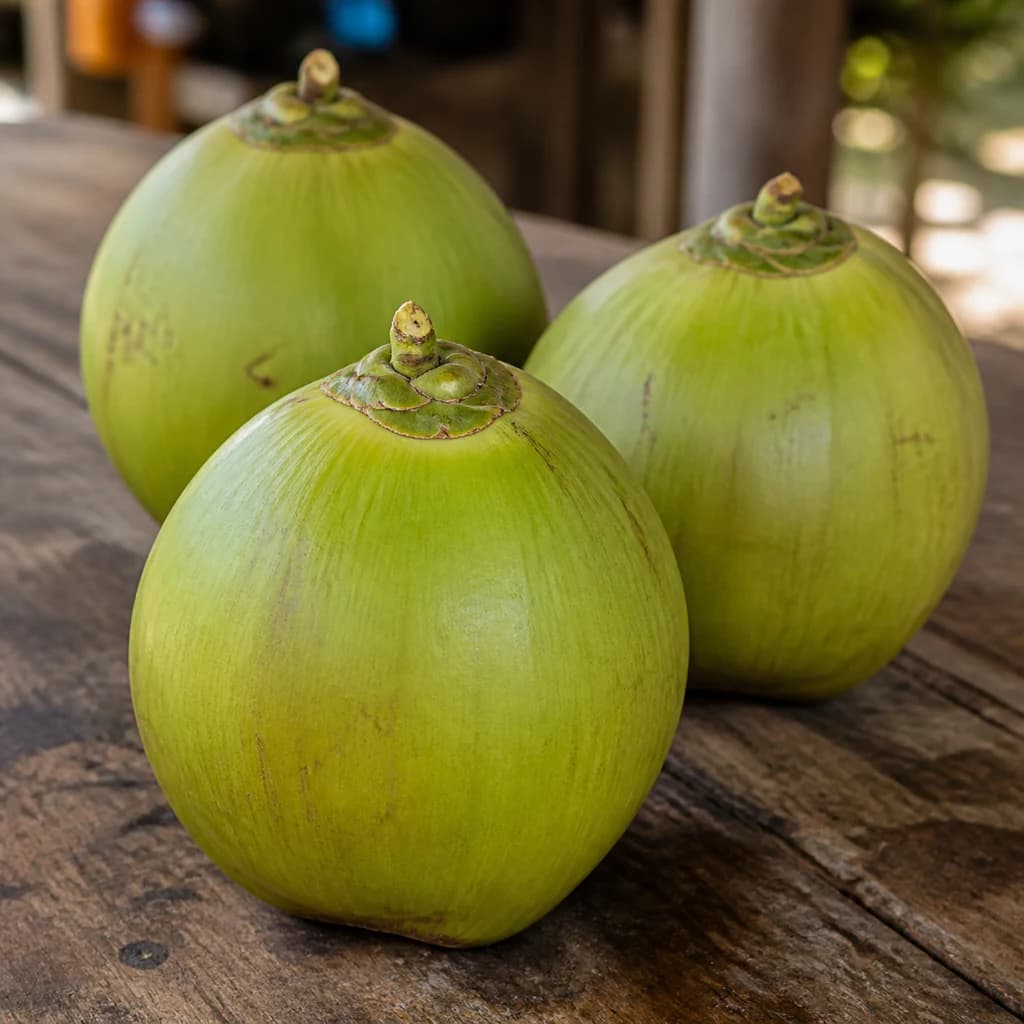
Natural form
Whole young coconuts, green-husked and intact, as sold at markets across Southeast Asia.
Shows the defining visual — the full green husk and rounded teardrop shape readers will encounter in the wild or at a market stand.
Produce
Young Coconut
Green immature coconut with sweet drinking water and soft, jelly-like flesh.
A young coconut is harvested before maturity, with a soft green or trimmed white husk, sweet refreshing coconut water, and tender, jelly-like flesh. The water is drunk straight, and the soft meat is spooned out for desserts, smoothies, and Thai dishes. It is sweeter and softer than the firm flesh of a mature brown coconut.
Young coconut (Cocos nucifera in its immature stage) is harvested at 6–9 months, distinguished by its green or pale yellow-green husk and abundance of clear, mildly sweet water. Unlike its mature counterpart, which develops thick, firm flesh, the young coconut prioritizes liquid content—the interior holds 8–14 fluid ounces of naturally sterile water alongside a thin layer of soft, jelly-like white flesh that scrapes easily with a spoon. Native to Southeast Asia and the Pacific Islands, it has become a global ingredient prized for its clean, electrolyte-rich water and its subtle coconut flavor that doesn't overwhelm other ingredients. The jelly-like texture of young coconut flesh is unique among coconut products, making it essential for certain Thai, Filipino, and Indonesian preparations where a yielding, delicate mouthfeel is paramount. The variety known as kopyor (or klentik) deserves special attention: this Javanese and Filipino variety has flesh that separates naturally from the inner shell, making it especially prized for traditional desserts where whole pockets of tender flesh are served intact.
- Measured in
- piece
- Storage
- Fridge
Allergens
Types & varieties
Most common variety in US markets; medium size with thin husk and very sweet water
Typically larger with thicker flesh; slightly more subtle, less sweet flavor
Often smaller; very popular for traditional desserts; slightly denser flesh
Hybrid variety with golden-tinted water; sweeter and higher in beta-carotene
Southeast Asian variety with loose, extra-tender flesh that separates easily from the shell; primarily used for traditional desserts
Opening a Young Coconut Safely
The technique for opening a young coconut differs from a mature one because the husk is fibrous and the shell is thinner. The goal is to drain the water first, then access the flesh cleanly without shattering the entire fruit. Work on a stable surface with good drainage, and keep a screwdriver and heavy cleaver separate to avoid confusion during the strike.
- Pierce the three eyes with a screwdriver or metal spike, starting with the softest eye (it will give slightly under pressure)
- Drain the water completely into a bowl or glass—tilt and rotate the coconut to extract every drop
- Set the drained coconut on its side and position the cleaver at the midpoint of the circumference
- Strike firmly 2–3 times with the cleaver, rotating slightly between strikes until the husk splits
- Pry the shell open with your hands or the cleaver edge; the flesh inside should be exposed in clean sections
- Run warm water over the interior or let rest 5 minutes if flesh sticks to the shell
Water versus Flesh: When to Use Each
Young coconut water and flesh serve different culinary purposes and behave differently under heat and processing. Understanding when each component shines will improve your results.
- Water is best used raw: smoothies, beverages, cold soups, and cocktail mixers where its delicate sweetness and mineral content shine
- Water can be frozen directly into ice pops or blended into frozen desserts, but avoid cooking it—heat diminishes the fresh flavor and alters the electrolyte balance
- Flesh is ideal for desserts requiring a soft, yielding texture: halo-halo, panna cotta, mousses, and tropical fruit salads
- Blend flesh with 1–2 parts water to make a lighter coconut cream (thinner than mature-coconut milk)
- Scraped flesh oxidizes within hours—use it immediately or press it into a dessert within 24 hours
Common uses
Tips & pitfalls
- Select by weight: heavier coconuts contain more liquid; avoid any with visible cracks or dry-looking eyes
- Test freshness by shaking: you should hear distinct sloshing; silent coconuts have dried out
- Pierce the softest eye first when opening—pressing each eye to find the most yielding spot saves effort and prevents dry spillage
- After draining, chop through the husk with 2–3 firm cleaver strikes, then pry open; never attempt to crack it like a mature coconut
- If flesh sticks to the shell, run warm water over the interior briefly or let the drained coconut sit 5 minutes before scraping
- Use a serrated spoon or melon baller for the most efficient flesh extraction
- Work quickly with opened coconut—the flesh oxidizes and loses texture within hours
- Do not substitute packaged coconut water for fresh in recipes requiring texture or fresh flesh—convenience versions lack the delicate sweetness and mineral complexity
- Young and mature coconut water are not interchangeable—they differ significantly in sweetness, mineral content, and textural role
- To make coconut cream from young coconut: blend 1 part flesh with 1–2 parts water; the result is lighter than mature-coconut cream
- For frozen applications: scoop flesh into balls or strips, freeze on a parchment-lined tray, then transfer to airtight bags
- If the water tastes sour or fermented, discard—the coconut has turned and the flesh will be compromised
Nutrition
Energy
1481 kJ · per 100 g
Where the calories come from
Protein
3.3g
7% DV
Carbs
15.2g
6% DV
Fat
33.5g
43% DV
Fiber
9g
32% DV
Sugars
6.2g
of which
Sodium
20mg
1% DV
Source · USDA FoodData Central · approx. Nuts, coconut meat, raw
View on FDC →In the shops
Matched grocery products
No matched grocery products for Young Coconut yet.
Good to know
- Botanical name
- Cocos nucifera (immature stage)
- Origin
- Southeast Asia and Pacific Islands; Thailand, Indonesia, Philippines, and Malaysia are major producers
- Harvest age
- 6–9 months (mature coconuts are harvested at 12+ months)
- Shell color
- Green or pale yellow-green outer husk; white/cream inner shell when husked
- Typical weight
- 1–2 lbs (450–900g) whole; yields 8–14 fl oz (235–415ml) water and 1–3 tablespoons flesh
- Water composition
- 94% water; naturally sterile when sealed; contains electrolytes including potassium, magnesium, and sodium
- Flesh texture
- Soft, jelly-like, 1–3mm thick; easily scraped with a spoon or melon baller
- Flavor
- Water is mildly sweet, clean, and slightly nutty; flesh has a subtle coconut flavor and tender texture
- Peak season
- Year-round in tropical regions; imported to US and Europe year-round but best April–November
- Storage (unopened)
- Room temperature 2–4 weeks; refrigeration extends to 2–3 months
- Storage (opened)
- Refrigerate water in sealed container up to 48 hours; use flesh immediately or within 24 hours
- Equipment
- Cleaver or heavy knife for husking; screwdriver or metal spike to pierce eyes; spoon for flesh
- Yield
- Approximately 50–60% liquid recovery by weight
- Difficulty
- Low (opening requires care but flesh requires no preparation)
- Commercial availability
- Whole coconuts at Asian/Thai markets, specialty grocers, some chain supermarkets; bottled/canned water widely available but not the same as fresh
- Cost
- $1.50–$4.00 per whole coconut in US retail; significantly cheaper at Asian markets
Substitutes
- Mature coconut water — Thinner texture, less sweet; acceptable for hydration but not for desserts or beverages where fresh flavor is key
- Packaged young coconut water — Convenient but lacks fresh flesh; acceptable for drinking, not for recipes requiring texture or the actual flesh
- Almond milk or oat milk — Completely different flavor and nutritional profile; acceptable only as a liquid substitute in smoothies, not for direct consumption or desserts
- Coconut water kefir — Fermented and tangy; not a direct substitute but works in different contexts where a cultured product is desired
- Simple saline solution with coconut extract — Last resort only; does not replicate the mineral content, subtle sweetness, or textural qualities
Pairs with
Also called
Drinking Coconut · Coconut (Young)
Appears in these dishes

Related
Tomato
Juicy, sun-sweet fruit for sauces, salads, and slow-cooked depth
Yellow Onion
The aromatic backbone of soups, sofritos, and braises
Garlic
Pungent cloves that perfume nearly every savory dish
Lemon
Bright, acidic citrus that wakes up almost any dish
Potato
Humble, hearty staple — roast, mash, fry, or boil
Carrot
Sweet, crunchy root — raw, roasted, or the base of a sofrito
Cucumber
Cool, crisp, and watery — for salads, pickles, and tzatziki

Lettuce
Crisp leaves for salads, wraps, and a fresh crunch