Appliances & Heat
Charcoal Brazier
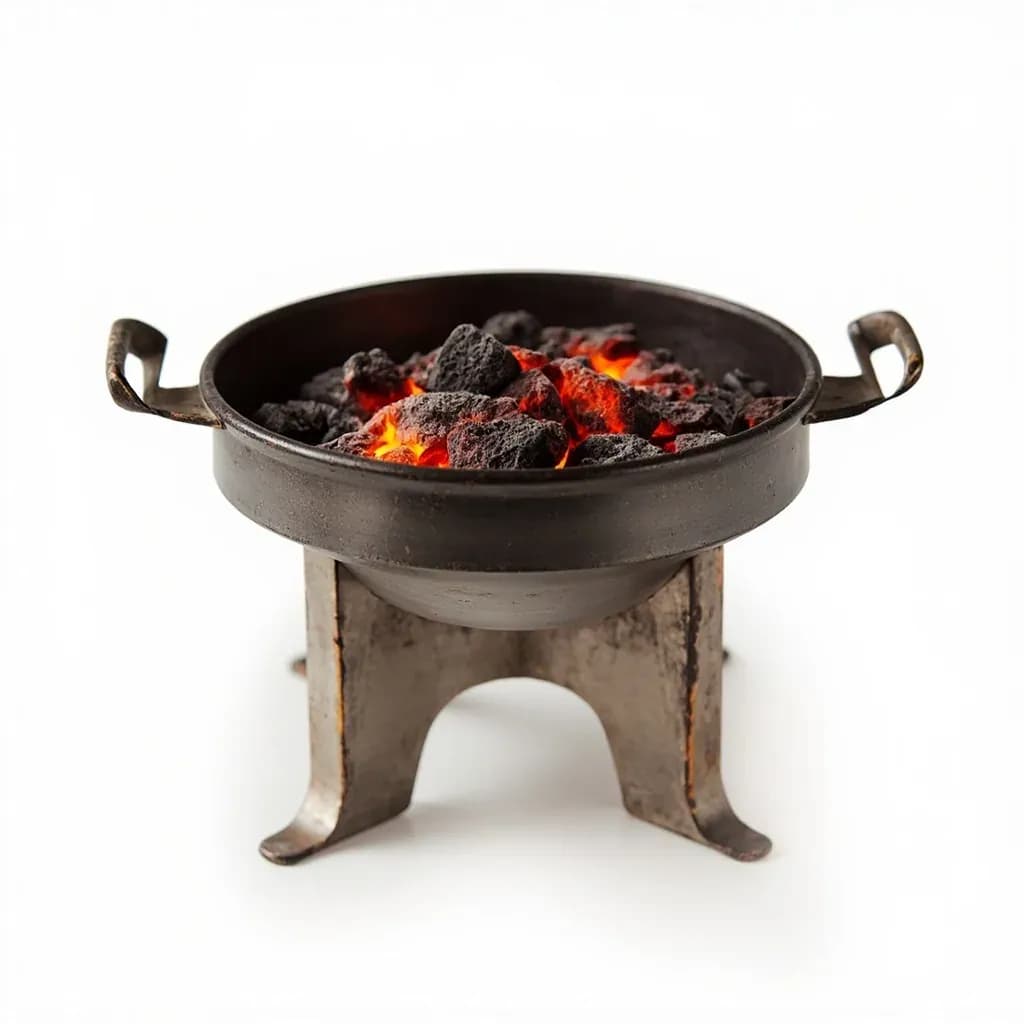
Portable charcoal-burning stove that supports a pot for cooking over glowing coals.
A charcoal brazier is a compact, often clay or metal stove that holds burning charcoal beneath a grate or pot rest. Used across Africa, the Caribbean, Asia and beyond, it provides steady radiant heat for simmering stews, boiling, and slow cooking where gas or electricity is scarce. Energy-saving versions like the ceramic-lined Kenyan jiko retain heat to use less fuel.
A charcoal brazier is a portable, open-topped vessel that holds a bed of burning charcoal and supports a pot, pan, or grill grate directly over the radiant heat of the coals. Unlike a gas burner or closed oven, it delivers intense, dry, flame-free heat to whatever sits on or above the grate, which is why cuisines built on seared crusts and smoky flavor — Japanese robatayaki, Korean barbecue, Turkish and Levantine kebabs, Indian tandoori-style cooking — have always relied on one. The defining trait is direct radiant contact: glowing coals transfer heat to the food or vessel surface without the buffering of an intervening burner head, producing surface temperatures in the 500–1000°F (260–540°C) range once the fuel is fully ignited.
Because the fuel is solid carbon rather than a gas flame, a brazier rewards a different kind of attention than a stove. Airflow governs everything: bottom intake vents feed oxygen to the coals, and a top damper or chimney exhausts combustion gases. Opening the vents stokes the fire; closing them smothers it. Lump charcoal burns hotter and cleaner than briquettes, while binchotan — a dense Japanese oak charcoal — burns long and almost smokeless, the standard for professional robatayaki. Braziers range from palm-sized clay dishes for tabletop grilling to waist-high metal stands for street kebab stalls, but the underlying principle is the same: a controlled bed of glowing coals beneath whatever you intend to cook.
Alternatives
Types & varieties
Small round Japanese brazier of refractory clay with a removable grate; the standard for yakiniku and tabletop yakitori.
Long, narrow rectangular Japanese ceramic brazier with end vents for a strong draft; designed for binchotan and robatayaki.
Small portable metal box, usually cast iron or sheet steel, with an open top and side vents; the term adopted in U.S. English for tabletop grilling.
Raised Middle Eastern and Turkish brazier, often on a stand, used for skewered kebabs over long-burning lump charcoal.
Indian clay or sheet-metal charcoal brazier used for tandoor-style cooking, rotis, and warmth; traditionally small and portable.
Hokkaido-style domed brazier shaped like a battle helmet, built for grilling lamb and vegetables around a central well.
Korean under-table or floor-level clay brazier used historically for heating and slow cooking.
Heavy cast-iron bowl with grate used in professional kitchens for finishing and browning with overhead radiant heat.
Choosing and managing fuel
The fuel you load shapes everything about how a brazier cooks. Lump charcoal — pieces of real wood carbonized into irregular chunks — lights quickly, burns hot, and leaves very little ash, which is why restaurants and serious home cooks prefer it. Charcoal briquettes are uniform, cheaper, and slower-burning, but they contain binders that produce more smoke and a faintly chemical aroma on the food. Binchotan, a dense Japanese oak charcoal (traditionally made from ubame oak), is the gold standard for robatayaki and yakitori: it snaps cleanly when struck, radiates intense infrared heat, and burns for hours with almost no flame or visible smoke, which lets the natural flavor of the food come through. Hardwood, particularly oak, mesquite, or fruitwoods, can be burned in larger braziers but requires more attention and a deeper bed to maintain even heat.
- Aim for a 1–2 inch (2.5–5 cm) bed of fully ignited coals before cooking — they should be covered in a thin gray-white ash and glowing uniformly, with no visible flame licking the grate.
- Use a chimney starter rather than lighter fluid; chemical-soaked coals leave a kerosene note on food and can flare unpredictably.
- Replenish coals in small amounts rather than dumping fresh fuel onto a hot fire, which will spike flames and deposit soot on the food.
- Smothering the vents will extinguish a brazier in 10–15 minutes — useful for ending a cook without leaving open flame unattended.
Common uses
Tips & pitfalls
- Use outdoors or on a covered patio only — never in an enclosed room, even with a window open, because carbon monoxide can accumulate well before occupants notice symptoms.
- Wait until coals are fully ignited and ashed over before placing food; visible flames produce acrid, soot-laden heat that ruins crust and flavor.
- Control temperature with the bottom intake vents, not by lifting the food off the grate — repeated lifting cools the food and slows the sear.
- Lump charcoal burns hotter and cleaner than briquettes; binchotan is the standard for any Japanese-style application.
- Place the brazier on stone, brick, or a metal stand; never directly on a wood deck, plastic surface, or untreated tabletop.
- Let ashes cool for several hours — ideally overnight — before disposal; hot ash in a household bin is a leading cause of balcony and garage fires.
- Avoid thermal shock with clay or ceramic models: do not light them on a cold, wet surface, and never rinse a hot ceramic brazier with water.
- Season a new cast-iron brazier with a thin coat of oil after each use to prevent rust, and store it dry.
Good to know
- Also called
- Hibachi (American English), shichirin, konro, mangal, angithi, jingisukan-dai, komfo
- Etymology
- From French brasier (pan of hot coals), from Old French braise, from Frankish *brâsa (live coal)
- Fuel
- Lump charcoal, charcoal briquettes, hardwood, or binchotan; sometimes coconut shell or vine cuttings in traditional settings
- Heat at grate
- Approximately 500–1000°F (260–540°C) depending on fuel, airflow, and draft
- Common materials
- Refractory clay, terracotta, cast iron, sheet steel, stainless steel, brass, copper
- Ventilation
- Bottom intake vents and typically a top exhaust or damper to control combustion
- Ash management
- Bottom ash pan or tray; should be emptied only when fully cold
- Indoor use
- Not safe indoors without dedicated, chimney-grade ventilation; produces carbon monoxide and particulates
Also called
Fogareiro · Coal Pot · Charcoal Jiko · Jiko · clay brazier · charcoal stove · coal stove
Related

Stovetop
The everyday burners where most cooking actually happens

Oven
Enclosed dry heat for roasting, baking, and braising

Grill
Live-fire or gas grates for char, smoke, and high heat

Smoker
Low, slow heat and wood smoke for barbecue and brisket

Air Fryer
Countertop convection that crisps with little or no oil

Slow Cooker
Set-and-forget low heat for stews, beans, and braises

Pressure Cooker
Sealed steam pressure that cooks tough food in a fraction of the time

Rice Cooker
Foolproof, perfectly steamed rice every single time