Appliances & Heat
Charcoal Grill
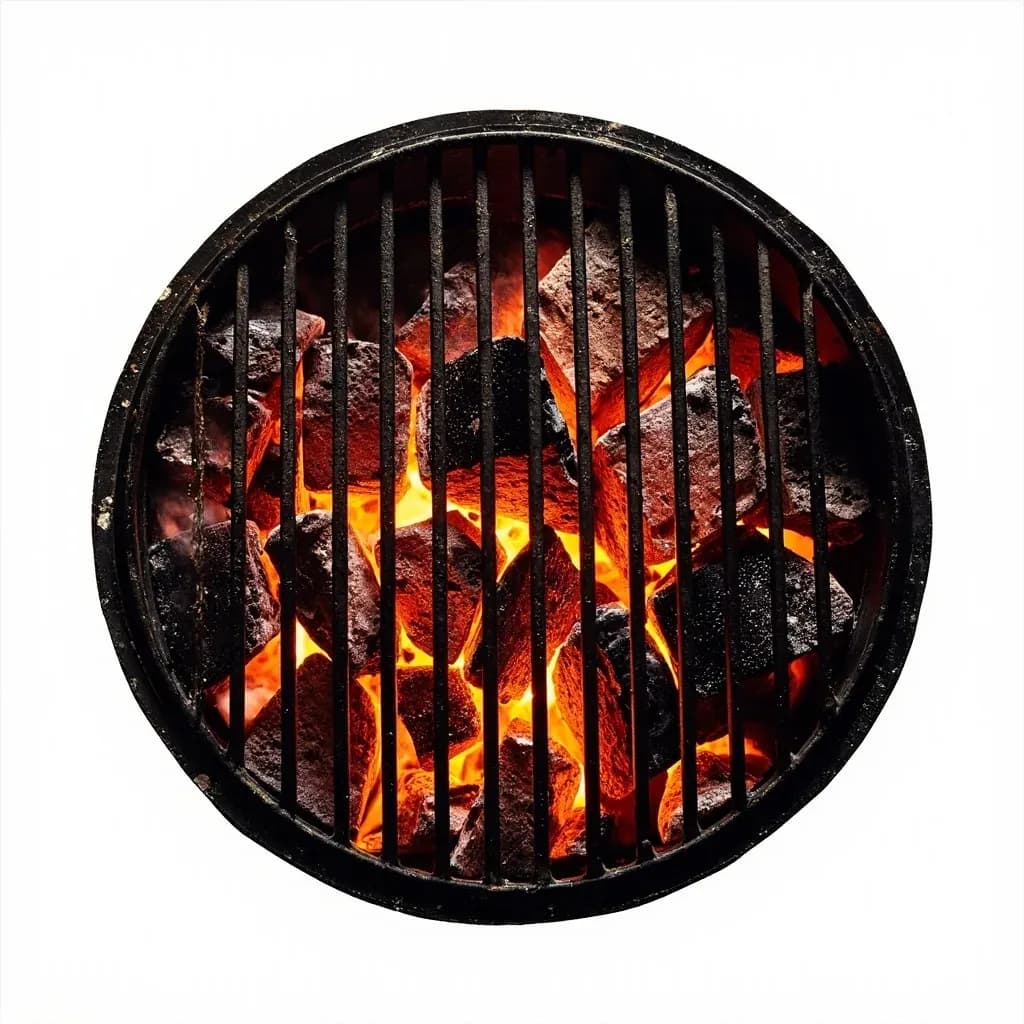
Open grate over burning charcoal for grilling food with smoky, high radiant heat.
A charcoal grill cooks food on a grate set over a bed of burning charcoal or wood embers, imparting a distinctive smoky char that gas cannot match. It is used worldwide for grilling meats, skewers, vegetables and seafood, from the Brazilian churrasqueira to the Turkish and Middle Eastern mangal. Coal placement and vents let the cook manage heat zones and temperature.
The charcoal grill is the original outdoor cooker, and the one that gives grilled food its most distinctive character. Where gas grills heat food with concealed burners, a charcoal grill radiates heat directly from glowing coals that sit just below the grate, so every burger, chop, or vegetable picks up both intense radiant heat and the flavor of burning carbonized wood. Most modern designs add a lid, and that lid turns the cooker into a convection oven that traps smoke and stabilizes temperature, which is what makes the charcoal grill equally capable of a two-minute sear and a ten-hour brisket smoke.
The single most consequential decision a charcoal cook makes is the choice of fuel. Lump charcoal is simply hardwood burned into irregular chunks; it lights quickly, burns very hot, leaves almost no ash, and contributes a clean smoke flavor. Charcoal briquettes are uniform compressed pillows of charcoal dust held together with starch binders and ash-producing additives such as limestone; they are slow-burning and forgiving at lower temperatures, which is why competition barbecuers and casual weekenders alike still reach for them. The two are not interchangeable, and matching the fuel to the cook is half the skill of charcoal grilling.
Temperature is controlled by airflow rather than a knob. Bottom intake vents feed oxygen to the coals, and a top exhaust vent releases combustion gases; opening them raises the fire, closing them starves it. Bank all the coals to one side and you have a two-zone fire with a hot direct-heat side for searing and a cool indirect side for finishing thicker cuts or for long, low smoking. Wood chunks laid on the coals release smoke for hours. With that handful of variables, a charcoal grill covers an unusually wide range of cooking — hot-and-fast steaks, slow-and-low ribs, smoked salmon, wood-fired pizza, and charred vegetables all come from the same basic fire.
Alternatives
Types & varieties
Round bowl with dome lid and tripod legs, the iconic Weber design. Excellent for direct grilling and two-zone indirect cooking, with top and bottom vents.
Vertical cylinder, often repurposed 55-gallon drums or purpose-built. Larger grate area, frequently used for low-and-slow smoking with an offset firebox or bottom heat deflector.
Egg-shaped refractory ceramic cooker; heavy walls retain heat and make it unusually fuel-efficient for long smokes as well as high-heat grilling.
Small, open, cast-iron or steel Japanese-style grill traditionally fueled by binchotan. Compact, very hot, with little smoke capture; standard for yakitori.
Charcoal cooker mounted on a wheeled cart with side shelves, ash catcher, and storage. Weber Performer and Master-Touch are common examples.
Permanent outdoor island or brick-built hearth with heavy thermal mass for very long, steady burns; includes Mediterranean styles such as the Greek and Levantine mangal and Egyptian masonry grills.
Folding legs and a small grate; charcoal-only, designed for picnics, camping, and small households.
Charcoal loaded into a hopper and fed by gravity or a fan into a firebox; pairs charcoal flavor with set-and-forget temperature control.
Lump vs. Briquette: Choosing the Right Fuel
The fuel you light determines the fire you cook over, and lump and briquette are built for different jobs. Lump is hardwood that has been carbonized and broken into irregular chunks of varying size. It lights in about 10–15 minutes in a chimney, hits its peak temperature quickly, and burns out in 45–90 minutes depending on how much you load. Because there are no binders or additives, lump produces very little ash, which keeps the grate airflow open and the fire clean. The downside is irregularity: a bag of lump can mix thumb-sized pieces with fist-sized pieces, and that variation makes temperature harder to predict.
Briquettes are manufactured for consistency. Charcoal dust is compressed with a starch binder into uniform pillows, and a small percentage of limestone or other minerals is added so the briquettes hold their shape and produce a predictable bed of ash. They take a little longer to light (15–25 minutes to reach full ash coating), but once they are ready they hold a steady 225–275 °F for hours when spread out for indirect cooking. For long, low barbecue where temperature stability matters more than searing power, briquettes are the standard choice.
- Use lump for high-heat searing, fast grilling, and any cook under an hour.
- Use briquettes for low-and-slow smoking, roasting, and any cook over an hour.
- Mix the two when you want both: briquettes as a base for steady heat, lump added later for a finishing sear.
- If a recipe gives charcoal by weight, assume briquettes unless told otherwise; lump contains more combustible carbon per pound (briquettes include ash-producing additives and binders), so the same weight burns hotter and shorter.
The Two-Zone Fire
The single most useful skill in charcoal grilling is building a two-zone fire, a hot side for searing and a cool side for finishing. Once you have it, you can grill a steak, roast a chicken, or smoke a pork shoulder on the same cooker without ever moving food to the oven.
To build one, light a full chimney of charcoal and pour the coals onto one side of the firebox, mounding them up to maximize airflow and heat. The grate directly above the coals is the direct-heat zone; the empty side is the indirect-heat zone, where food cooks by convection with the lid closed. Most foods start on the hot side to develop color and grill marks, then move to the cool side to finish gently without burning or flare-ups. Thicker cuts can go on the cool side from the start, or smoke there for hours.
For low-and-slow cooks, spread the coals across one third of the firebox, place a drip pan on the empty two thirds, and set the food over the pan. Adjust the bottom and top vents to settle grate temperature at 225–275 °F; a quarter-turn of a vent typically changes temperature by 25–50 °F, so adjust gradually. Add a few wood chunks to the coal bed at the start, not to the food, and let the closed lid do the rest.
- Sear over direct heat, finish over indirect — the standard pattern for thick steaks, chops, and bone-in chicken.
- For long smokes, bank coals to one side, set a water pan on the other, and track temperature at the grate, not the lid.
- A water pan beneath the food stabilizes temperature, catches drips, and adds humidity so meat does not dry out.
Common uses
Tips & pitfalls
- Start charcoal in a chimney starter with newspaper or a paraffin cube; never use lighter fluid, which leaves a petroleum taste on the food.
- Wait until the coals are evenly coated with a thin layer of white ash (about 15–25 minutes) before cooking — cooking over black, flame-licked coals gives acrid flavor and soot on the food.
- Build a two-zone fire by banking hot coals to one side: direct-heat side for searing, cool side for finishing thicker cuts and avoiding flare-ups.
- Choose lump for hotter, cleaner, shorter burns and briquettes for steadier, longer cooks; mixing both is a legitimate way to get a steady base and a finishing sear.
- Add wood chunks directly to the coals rather than chips alone — chunks smolder for hours, chips burn out in minutes. Soak wood only when the grill has no lid to hold the smoke.
- Keep the lid closed between turns; lifting it every minute can drop grate temperature by 50–100 °F and stall long cooks.
- Oil and preheat the grate until the oil just starts to smoke — food sticks to a cold, dry grate, not to a hot, seasoned one.
- Gauge temperature by holding your hand 4 inches above the grate: 1–2 seconds for very hot, 3–4 seconds for hot, 5–6 seconds for medium, 7+ seconds for low.
- Clean while still hot: after cooking, close the lid with vents wide open to let remaining coals burn down to ash, then brush the grates with a stiff wire brush.
Good to know
- Fuel
- Lump charcoal (carbonized hardwood chunks) or charcoal briquettes (compressed charcoal dust with starch binders and ash-producing additives such as limestone).
- Heat output
- Direct grilling zone typically reaches 500–700 °F (260–370 °C) on fully ignited coals; can exceed 750 °F with a chimney of fresh lump charcoal in a kettle.
- Materials
- Body is typically porcelain-enameled steel (Weber-style), bare steel, cast iron, or refractory ceramic (kamado). Grates are chrome-plated steel, stainless steel, or cast iron.
- Origin
- Charcoal briquettes were developed in the early 1920s by Henry Ford and chemist Orin Stafford and mass-produced by the Kingsford Company. The iconic kettle grill was designed by George Stephen Sr. at Weber Brothers Industries, Chicago, in 1952.
- Lid function
- A closed lid converts the grill into a convection/conduction oven, stabilizing temperature, capturing smoke, and enabling indirect roasts and long smokes.
- Ventilation
- Heat is governed by intake (bottom) and exhaust (top) dampers — open them to raise the fire, close them to cool it.
- Wood pairing
- Hickory, mesquite, oak, apple, cherry, pecan, and alder chunks or chips are added to the coals for smoke flavor.
- Fuel consumption
- Roughly 1–1.5 lb of charcoal per hour of direct grilling; 6–10 lb for a 4–6 hour low-and-slow smoke.
- Typical sizes
- Portable/folding grills: 150–200 sq in. 22-inch kettle: ~363 sq in. 26-inch kettle: ~508 sq in. Standard cart/barrel grills: 500–800+ sq in.
- Cook time
- Direct grilling: 3–8 minutes per side for steaks, burgers, chops. Indirect low-and-slow: 1–8 hours for ribs, brisket, pulled pork at 225–275 °F.
Also called
Churrasqueira · Mangal · mangali · charcoal fire · outdoor charcoal grill · souvlaki charcoal grill
Related

Stovetop
The everyday burners where most cooking actually happens

Oven
Enclosed dry heat for roasting, baking, and braising

Grill
Live-fire or gas grates for char, smoke, and high heat

Smoker
Low, slow heat and wood smoke for barbecue and brisket

Air Fryer
Countertop convection that crisps with little or no oil

Slow Cooker
Set-and-forget low heat for stews, beans, and braises

Pressure Cooker
Sealed steam pressure that cooks tough food in a fraction of the time

Rice Cooker
Foolproof, perfectly steamed rice every single time