Appliances & Heat
Blender (Countertop / Liquidificador)
A motorized jar with whirling blades that purees, liquefies, and emulsifies ingredients.
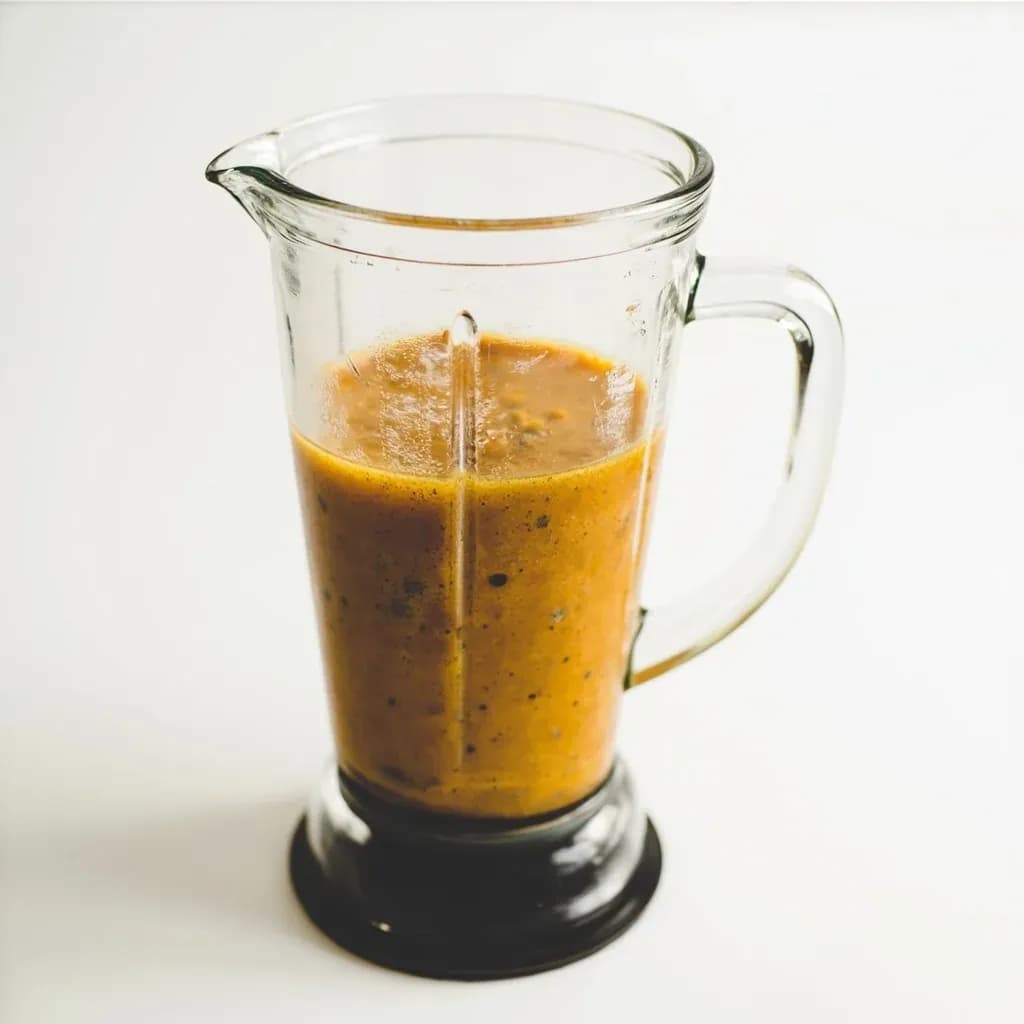
A countertop blender is an electric appliance with a tall jar and bladed base that spins fast enough to puree, liquefy, and emulsify. It makes smoothies, soups, sauces, batters, and crushed-ice drinks, and powerful models can grind grains or make nut butters. The tapered jar creates a vortex that pulls ingredients down into the blades for an even blend.
The countertop blender is a high-speed liquidizer: a tall, narrow jar with a fast-spinning blade at the bottom, designed to draw food into a continuous vortex and break it into a smooth, pourable mass. It is the primary kitchen tool for anything that needs to move from solid to liquid or from coarse to fine — smoothies, puréed soups, emulsified sauces, frozen drinks, and, on the strongest machines, nut butters and friction-heated soup. Where a food processor uses a wide bowl and a slower blade to chop solids without liquefying them, a blender is built to sustain turbulence, which is why jar shape and blade speed matter as much as motor wattage.
The mechanism is the vortex. The blade at the base, spinning at roughly 15,000 to 28,000 RPM, flings ingredients outward against the slightly tapered walls; they climb, fall back toward the center, and are pulled through the blades again. Liquids — or at least moisture-rich ingredients — must be present to keep the circulation alive, which is why the standard loading order is liquids first, soft ingredients next, then ice and hard items on top. A blender is fundamentally a wet-prep tool; the moment you load it with only dry, hard items, the motor stalls and the blades spin in air.
The category ranges from a 300 W personal cup to a 1,500–2,000 W commercial bar blender, and the difference shows up in what each can actually finish. A standard 500–900 W model will reliably handle smoothies, vinaigrettes, and puréed soup, but only a 1,000+ W high-performance machine will turn fibrous kale into a grit-free green drink, almonds into nut butter, or raw vegetables into a velvety hot soup heated by friction in five to seven minutes. Choosing the right tool is less about brand than about matching motor strength to the resistance of what you are blending.
Alternatives
Types & varieties
The everyday 40–64 oz jar with 500–900 W motor; suitable for smoothies, dressings, puréed soups, and crushed ice
1,000–1,500+ W with aircraft-grade blades and a heavier drive; the only class reliable for nut butters, fibrous greens, frozen-fruit sorbets, and fine purées
Smaller 16–24 oz cups that screw onto the blade base; designed for one portion, lower power, quick clean-up
Compact personal blenders meant for short bursts on small quantities
Stick-shaped, used directly in a pot; the most common alternative for puréed soups and pan sauces
Heavy-duty 1,500–2,000 W with a 48–80 oz jar; built to run hard for ice-heavy drinks and batched service
Variable-speed models offer a continuous dial and pulse; preset models have one-touch cycles for smoothie, ice cream, soup, and the like
Blender vs. Food Processor
The two machines look similar but solve different problems, and substituting one for the other is a common source of frustration. A food processor has a wide, shallow bowl and a slower horizontal blade designed to chop, slice, and shred solids without liquefying them. A blender has a narrow, tall jar and a fast vertical blade designed to maintain a vortex that pulls solids into a liquid mass. Reach for the food processor when you are making pastry dough, slicing or shredding vegetables, grating cheese, chopping large volumes of nuts, or doing any dry prep. Reach for the blender for anything that should end up pourable — purées, sauces, smoothies, soups, emulsions, frozen drinks, and (on a high-performance machine) nut butters and friction-heated soup. At the very top end the line blurs: a 1,500 W blender can knead a small dough and grind grain, but a separate food processor is still the better tool for most dry prep and slicing work.
Choosing the Right Blender
Match the machine to what you actually cook. If your blender life is mostly smoothies, salad dressings, puréed soup, and the occasional frozen margarita, a 600–900 W standard model with a glass or copolyester 48–64 oz jar will serve you well and cost far less. If you make green smoothies with kale or chard, blend frozen fruit into sorbet, or want to grind nuts into butter without stalling, step up to a high-performance model — the stronger motor, heavier blade, and tighter jar geometry are what make the difference, not marketing claims. If you blend for one or two people and clean up immediately, a personal-cup blender is convenient. For a bar or batch-cooking context, a commercial unit is worth the cost: quieter, cooler-running, and built for sustained use.
Common uses
Tips & pitfalls
- Add liquids first, then soft ingredients, then ice and hard items on top so the vortex can pull solids down into the blade.
- For hot liquids, stop before they boil, vent the lid by removing the center cap, and cover the opening loosely with a folded kitchen towel to prevent splatter.
- Do not fill past the max line — foaming, hot, or carbonated liquids need even more headspace than the line suggests.
- Use the tamper only when the lid is locked and the machine is running; never reach a spatula or spoon through the lid opening while the blades are moving.
- If the motor stalls, unplug the machine before scraping anything down — never reach into the blade assembly while it is still plugged in.
- For nut butters, run on high and pause to scrape the jar; the mix will go from crumbs to a ball to a smooth paste as the oils release, which can take 1–3 minutes on a high-power machine.
- To crush ice cleanly, use small, even cubes with a splash of water; large chunks will jam the blade and strain the motor.
- Do not run the blender empty or with only dry items — the motor needs load or liquid to keep cool and stable, and dry running burns out the bearings.
- For emulsions like mayonnaise, drizzle the oil slowly through the lid opening while running on low to build a stable emulsion.
- Clean immediately after use — a quick soap-and-water blend followed by a clean water rinse prevents residue from drying on the blade.
- Glass jars are heavier and resist staining but can shatter if dropped; copolyester jars are lighter and shatterproof but eventually cloud from blade wear.
- Do not use a blender where a food processor is called for: pastry dough, uniform slicing, shredding, and chopping large volumes of dry ingredients are not its job.
Good to know
- Inventor
- Stephen Poplawski, 1922, Racine, Wisconsin (patented the spinning-blade drink mixer)
- First commercial brand
- Waring Blender, introduced 1933–34; bandleader Fred Waring funded Fred Osius to develop it
- Typical jar sizes
- 32 oz (personal), 48–64 oz (standard household), 80 oz (commercial)
- Common jar materials
- Glass, Tritan copolyester, polycarbonate, stainless steel
- Motor power (household)
- Roughly 300–1,500 W; high-performance models 1,000–1,800 W
- Blade speed
- Approximately 15,000–28,000 RPM at full speed
- Capacity rule
- Leave headspace — never fill above the max line, especially with warm or foaming liquids
- Cleaning
- Run a small amount of warm water with a drop of dish soap on high for 15–30 seconds, then rinse
Also called
manual-blender · licuadora · liquidificador · jug blender
Related

Stovetop
The everyday burners where most cooking actually happens

Oven
Enclosed dry heat for roasting, baking, and braising

Grill
Live-fire or gas grates for char, smoke, and high heat

Smoker
Low, slow heat and wood smoke for barbecue and brisket

Air Fryer
Countertop convection that crisps with little or no oil

Slow Cooker
Set-and-forget low heat for stews, beans, and braises

Pressure Cooker
Sealed steam pressure that cooks tough food in a fraction of the time

Rice Cooker
Foolproof, perfectly steamed rice every single time