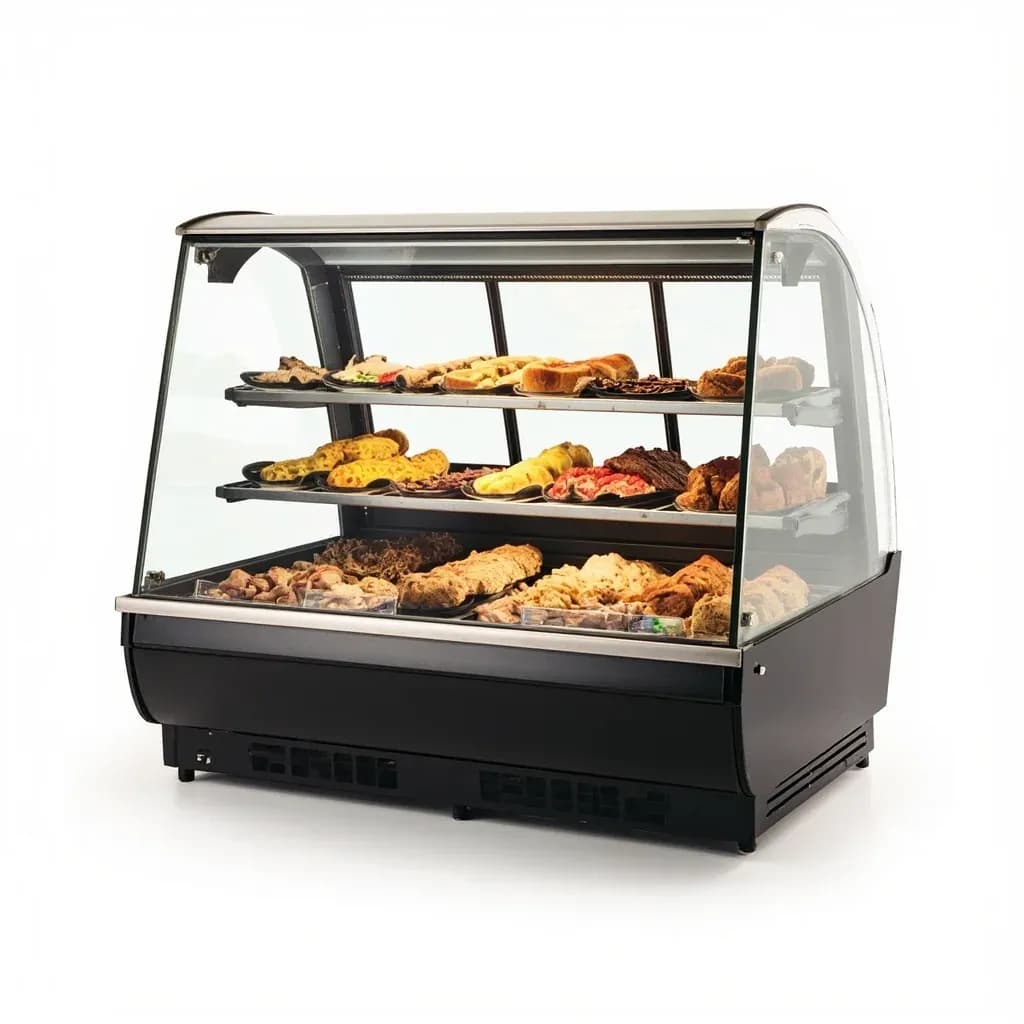
Appliances & Heat
Refrigerated Display Case
A glass-fronted chilled cabinet that holds and shows cold foods at safe temperature for service.
A refrigerated display case is a glass-fronted cooled cabinet that keeps prepared foods, cheeses, pastries, and drinks cold while letting customers see them. Used in delis, bakeries, and cafes, it maintains safe holding temperatures during service and is often lit and tiered for presentation. Open-front grab-and-go and closed-door versions trade easy access against energy efficiency.
A refrigerated display case is the working compromise between a commercial refrigerator and a piece of merchandising furniture. The glass — single, double, or triple-pane tempered — keeps cold air in and gives the customer a clear view of the product, while a rear-mounted evaporator and either forced-air or, in some pastry cases, cold-wall cooling hold the interior at roughly 33–41°F (1–5°C) for full refrigeration, or 41–48°F (5–8°C) for the gentler "chilled" zone favored by cakes, pastries, and produce. Unlike a back-of-house reach-in, a display case is built to be seen: LED interior lighting keeps heat output low, and the airflow is tuned to hold a uniform temperature across the shelf without drying exposed surfaces.
For a cook or chef, the practical reality is that a display case is a temperature-and-humidity tool first, and a presentation tool second. The same airflow that recovers temperature quickly after a door opening will desiccate a buttercream-iced cake within a few hours; a sushi case that runs too dry will toughen the rice and dull the fish. Specialized units — sushi cases in particular — address this with water reservoirs and sometimes misting, and dual-temperature cases offer separate chilled and full-refrigeration zones in one cabinet. Even so, the operator has to match the case type to the product. Energy Star-rated models cut electricity 20–40% over older units, which matters because these cases run 24 hours a day, 7 days a week.
Beyond the food, a display case is a regulatory object. Most health departments require NSF/ANSI 7 certification, separation of raw and ready-to-eat products, and a calibrated thermometer to verify actual product temperature, which routinely runs 2–4°F warmer than the case's air reading. A cook who treats the case as just a "fancy fridge" ends up with dried-out pastries, fogged glass, compressor failures, and failed inspections; a cook who treats it as a tuned piece of equipment gets crisp displays, safe food, and a lower power bill.
Alternatives
Types & varieties
Compact 1–3 shelf unit sized for a coffee shop or cafe pass; holds grab-and-go items, pastries, or sliced cake.
Tall upright unit with a hinged glass door, single or double; used at front-of-house for merchandising or back-of-house for prep holding.
Sweeping curved glass front, typically static-cooled, designed to showcase whole cakes, tarts, and tortes at 41–48°F without drying frostings.
Vertical flat glass with a service counter behind it; holds prepared salads, sandwiches, sliced meats, and cheeses at the service line.
Includes a water tray or reservoir for humidity control and an integrated drain; runs slightly warmer (41–45°F) to keep rice moist and fish glistening.
Multi-shelf open-front case for packaged sandwiches, salads, yogurt cups, and bottled drinks in c-stores, airports, and hotel lobbies.
Built into a counter or millwork so the chilled well sits flush with the serving surface; used for plated crudo, oysters, or chilled desserts at the pass.
Tall supermarket-style unit with no doors, relying on a continuous cold air curtain; used in high-impulse retail where customers self-serve.
Two separate zones in one cabinet — a chilled section for dairy or produce and a full-refrigeration section for prepared foods.
Fan-Forced vs. Static-Cooled: Choosing the Right Case for the Product
The single most important decision when buying or specifying a display case is whether the cooling is fan-forced or static (cold-wall). They are tuned for different jobs, and using the wrong one will damage the product.
- Fan-forced (forced-air) cases move cold air across the interior with an evaporator fan. They recover temperature quickly after the door opens and hold a tighter, more uniform temperature across the shelf. The trade-off is that the moving air pulls moisture from exposed surfaces — fine for packaged sandwiches and bottled drinks, ruinous for a frosted layer cake or a tray of cream puffs, which will skin over and crack within hours.
- Static-cooled (cold-wall) cases have the evaporator mounted against the interior walls, so cooling happens by natural convection with no fan. The air is calmer and more humid, and pastries stay photogenic. The trade-off is slower temperature recovery after loading and a narrower safe zone; they are not the right choice for raw fish or for a heavy load of warm product.
- Sushi cases are a hybrid: fan-assisted cooling plus a water reservoir (sometimes with a small mister) to keep relative humidity high enough that rice and fish do not dry out. The drain pan is non-negotiable — it catches condensate and allows the reservoir to be refilled daily.
- Open-front multi-deck cases rely entirely on a continuous "air curtain" of cold air spilling down the front opening. They work beautifully in a supermarket but are unforgiving if overloaded: once product rises above the marked load line, the curtain breaks, temperatures climb, and the case can no longer hold 41°F.
Temperature, Humidity, and the Calibrated Thermometer
A display case's built-in thermostat reads air temperature at the sensor, typically near the evaporator. The actual product temperature inside the case is almost always 2–4°F warmer — sometimes more on a heavily loaded or frequently opened unit. A cook who trusts the gauge alone is working blind.
- Place a calibrated probe thermometer (or, better, a temperature data logger) in a representative product — a vacuum-sealed bag of water or a slim probe tucked into a sandwich — and check it at opening, mid-service, and close. This is the temperature that matters for HACCP logs.
- Humidity is the other hidden variable. Sushi and seafood cases run at elevated relative humidity to keep flesh from oxidizing; pastry cases run at moderate humidity to keep fondant glossy without making chocolate bloom; deli cases sit in between. If the case has no humidity control, a small dish of water (for sushi) or a sheet pan of damp towels (briefly, for produce) is a workable field fix.
- Glass fogging on the inside of the door is a sign the case is fighting warm, humid air from outside — usually from a door that isn't sealing, a gasket that has hardened, or simply too-frequent openings. Fix the cause, don't just wipe the glass.
Installation and Maintenance Essentials
Display cases are heat-generating equipment on both sides: the refrigerant loop dumps heat out the back or bottom, and the compressor needs airflow to dissipate it. Treat the case like any other piece of refrigeration — clearances, ventilation, and coil cleaning are not optional.
- Allow at least 4 in. of clearance behind and above the unit, more for a multi-deck floor model. Zero-clearance installation is the most common cause of premature compressor failure.
- Clean the condenser coils every 60–90 days. Dust, kitchen grease, and flour act as insulation; a fouled coil is the most common cause of temperature loss and compressor failure.
- Check door gaskets weekly. A torn or hardened seal forces the compressor to run constantly, wastes energy, and pulls humid air into the case — a triple loss.
- Pre-chill the case for at least 2 hours before loading product. Putting warm food into a cold case spikes the interior temperature, ices the evaporator, and stresses the compressor for hours.
Common uses
Tips & pitfalls
- Pre-chill the case for at least 2 hours before loading — warm product in a cold case spikes interior temperature and ices the evaporator coil.
- Do not overload. Product must not block the rear air vents or rise above the marked load line in open-front cases; the cold air curtain depends on free flow.
- Verify actual product temperature with a calibrated probe thermometer; the built-in gauge reads air temperature, which runs 2–4°F cooler than the food itself.
- For pastry and cake cases, choose a static-cooled (cold-wall) model — fan-forced airflow dries out exposed buttercream, fondant, and meringue within a few hours.
- Keep glass doors closed as much as possible on reach-in cases; every door opening pulls warm, humid air in and forces the compressor to recover.
- Clean the condenser coils every 60–90 days. Dust and kitchen grease buildup is the most common cause of temperature loss and compressor failure.
- Never store raw meat or fish in the same case as ready-to-eat foods. NSF/ANSI 7 requires separation, and cross-contamination is a real food-safety failure, not a paperwork problem.
- Check door gaskets weekly for tears or hardening. A bad seal is invisible to the eye but will run the compressor constantly and waste energy.
Good to know
- Category
- Commercial refrigeration / food merchandising equipment
- Typical temperature range
- 33–41°F (1–5°C) for full refrigeration; 41–48°F (5–8°C) for chilled pastry and produce cases
- Display front
- Tempered glass, single to triple pane, in flat, curved, or angled configurations
- Refrigeration type
- Forced-air (fan-assisted) is standard; static-cooled (cold-wall) units are used for exposed pastries and cakes
- Common sizes
- Countertop: 24–60 in. wide; floor models: 36–96 in. wide, 30–80 in. tall
- Power
- 115V/60Hz single-phase for most small units; 208–230V for larger multi-deck floor models
- Standards
- NSF/ANSI 7 (food equipment) and UL 471 (commercial refrigerators); Energy Star on most new models
- Common refrigerants
- R-290 (propane) or R-448A/R-449A on newer eco-friendly models; older units often use R-404A
Also called
Display Case · Display Chiller · deli case · refrigerated showcase
Related

Stovetop
The everyday burners where most cooking actually happens

Oven
Enclosed dry heat for roasting, baking, and braising

Grill
Live-fire or gas grates for char, smoke, and high heat

Smoker
Low, slow heat and wood smoke for barbecue and brisket

Air Fryer
Countertop convection that crisps with little or no oil

Slow Cooker
Set-and-forget low heat for stews, beans, and braises

Pressure Cooker
Sealed steam pressure that cooks tough food in a fraction of the time

Rice Cooker
Foolproof, perfectly steamed rice every single time