Appliances & Heat
Fermentation Incubator
A temperature-controlled cabinet that holds the precise warmth needed to grow cultures.
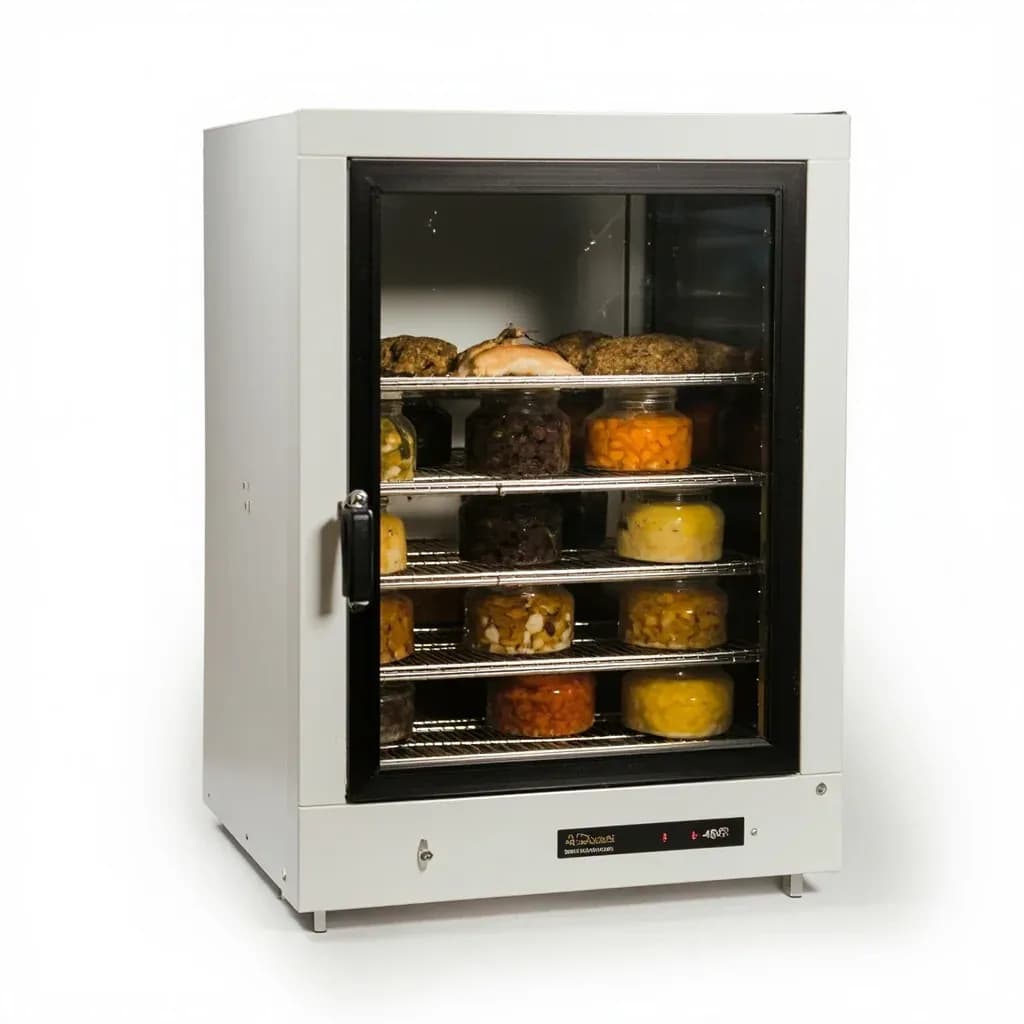
A fermentation incubator is an insulated, thermostatically controlled box that maintains an exact temperature for culturing food. It is used for koji, tempeh, yogurt, natto, and long ferments where a few degrees change the outcome. Holding steady warmth far more reliably than a kitchen counter, it gives consistent, repeatable fermentation.
A fermentation incubator is any enclosure that holds a culture at a steady, chosen temperature for hours or days. That sounds modest, but it is the single variable that most often separates a clean, predictable ferment from a stuck or contaminated one. Wild yeasts, lactic bacteria, SCOBYs, and molds such as Rhizopus each have a narrow window — within a few degrees of their sweet spot they thrive; outside it they slow, stall, or get outcompeted by something less welcome.
The category is broader than the word 'incubator' suggests. It spans a $40 plug-in yogurt jar, a collapsible proofing cabinet for bread, an egg hatcher borrowed from the poultry world, an Excalibur dehydrator dialed down, a sous-vide circulator clipped to a Cambro, and a chest freezer wired to a $30 STC-1000 controller. Most home cooks only ever need one of three configurations: a dough proofer for bread, a multi-temperature box for dairy and vegetable ferments, or a sous-vide-and-cooler rig for maximum flexibility.
Two design points matter more than the rest. First, stability beats precision — a unit that holds 78 °F flat will outperform one that drifts between 74 and 82, because cultures respond to consistency. Second, almost every consumer unit heats only and cannot cool, so it works best in a room cooler than your target. In summer, overshoot becomes the limiting problem, not undershoot, and a small fan or a propped door is often the fix.
Alternatives
Types & varieties
Small fixed-temp jars or single pot, usually pre-set around 110 °F; cheap but single-purpose.
Cabinet designed for bread; the Brod & Taylor Folding Proofer is the well-known collapsible model and doubles as a general fermentation chamber.
Brinsea Mini II and similar — built for poultry eggs but widely used for yogurt, tempeh, and natto because of stable, even heat.
Excalibur and similar 9-tray dehydrators with a thermostat below 100 °F; offers rack space and useful airflow for tempeh.
Immersion circulator clipped to a food-safe cooler or Cambro; flexible temperature, large capacity, very even heat.
STC-1000 or Inkbird ITC-308 wired to a small fridge; the only practical home route to true lager temperatures and cold aging.
Seedling/germination mat under a covered box; cheap and reliable for ambient-warm ferments like sourdough.
Multi-cooker with a 'Yogurt' or 'Keep Warm' cycle; popular low-cost option for small batches of yogurt and simple ferments.
Full-height stainless units with humidity control, used in bakeries and breweries.
Temperature Targets by Ferment
Most home ferments cluster in three bands. Knowing which band you live in immediately narrows the equipment choice and tells you whether a yogurt maker, a dough proofer, or a sous-vide-and-cooler rig will serve you best.
- 45–55 °F (7–13 °C): Lager fermentation. Requires a fridge or freezer build with a controller — no heating-only incubator can reach it in a warm room.
- 65–82 °F (18–28 °C): Sourdough, ale yeast, kombucha, water kefir, milk kefir with grains, sauerkraut, kimchi, curtido, hot sauces, garums, fish sauces, and mother-of-vinegar production. The most common home-ferment band, served well by a dough proofer, a yogurt box dialed down, or a sous-vide rig.
- 85–115 °F (29–46 °C): Tempeh and natto at the lower end (85–95 °F), koji work in the middle, and yogurt, skyr, plus thermophilic cheese ripening toward the top. Tempeh also wants airflow, so perforated or rack setups work better than sealed jars.
Common uses
Tips & pitfalls
- Verify the built-in thermostat with an independent probe thermometer at working height — many inexpensive units drift 3–5 °F, and heat stratifies so the top runs hotter than the bottom in still air.
- Stability beats precision: a constant 78 °F outperforms swings between 72 and 84 °F, which produce uneven flavor and stalled ferments.
- Match humidity to the ferment — a shallow pan of water inside helps sourdough bulk stay supple; for kombucha, yogurt, and most vegetable ferments, keep airflow higher and humidity lower.
- Stop opening the door every 30 minutes — each opening drops the internal temperature and lengthens the ferment. For long cultures, rely on time and smell rather than visual checks.
- Sanitize everything going in with a no-rinse sanitizer (Star San, dilute vinegar, or boiled water); warmth accelerates both wanted and unwanted microbes.
- Plan for summer overshoot — most basic incubators heat only. In a warm kitchen, add a small computer fan inside the cabinet or crack the door for the last few degrees.
- Give tempeh airflow: perforate the container or rest the beans on a wire rack. Stagnant CO₂ can suffocate the Rhizopus mycelium and invite Bacillus contamination.
- Lager requires a fridge build — no heating-only incubator will reach 48 °F in a warm room. Wire a small fridge or freezer to an STC-1000 or Inkbird controller instead.
- Label each batch with start date, target temperature, and target pH or time so you can replicate successful ferments.
Good to know
- Typical temperature range
- 60–120 °F (15–49 °C); most home units span 68–110 °F (20–43 °C)
- Common capacity
- 1.5–12 quarts for countertop boxes; full-size proofers hold 6–18 sheet pans
- Accuracy
- Quality units hold within ±1–2 °F of set point; verify with an independent probe thermometer, since heat stratifies and the top runs hotter than the bottom in still air
- Power draw
- Typically 30–200 W; most run continuously at low wattage
- Sourdough target
- 78–82 °F (25–28 °C) is the most-cited sweet spot for active starter and bulk fermentation
- Yogurt target
- 108–115 °F (42–46 °C) for thermophilic cultures; mesophilic styles like viili, matsoni, and filmjölk ferment at 70–78 °F
- Kombucha target
- 75–85 °F (24–29 °C); above 90 °F risks over-acidification and SCOBY kill-off
- Cost range
- Budget yogurt makers $30–60; dedicated proofers and incubators $100–400; pro-grade chambers $500+
Also called
fermentation chamber · proofing incubator · koji incubator
Related

Stovetop
The everyday burners where most cooking actually happens

Oven
Enclosed dry heat for roasting, baking, and braising

Grill
Live-fire or gas grates for char, smoke, and high heat

Smoker
Low, slow heat and wood smoke for barbecue and brisket

Air Fryer
Countertop convection that crisps with little or no oil

Slow Cooker
Set-and-forget low heat for stews, beans, and braises

Pressure Cooker
Sealed steam pressure that cooks tough food in a fraction of the time

Rice Cooker
Foolproof, perfectly steamed rice every single time