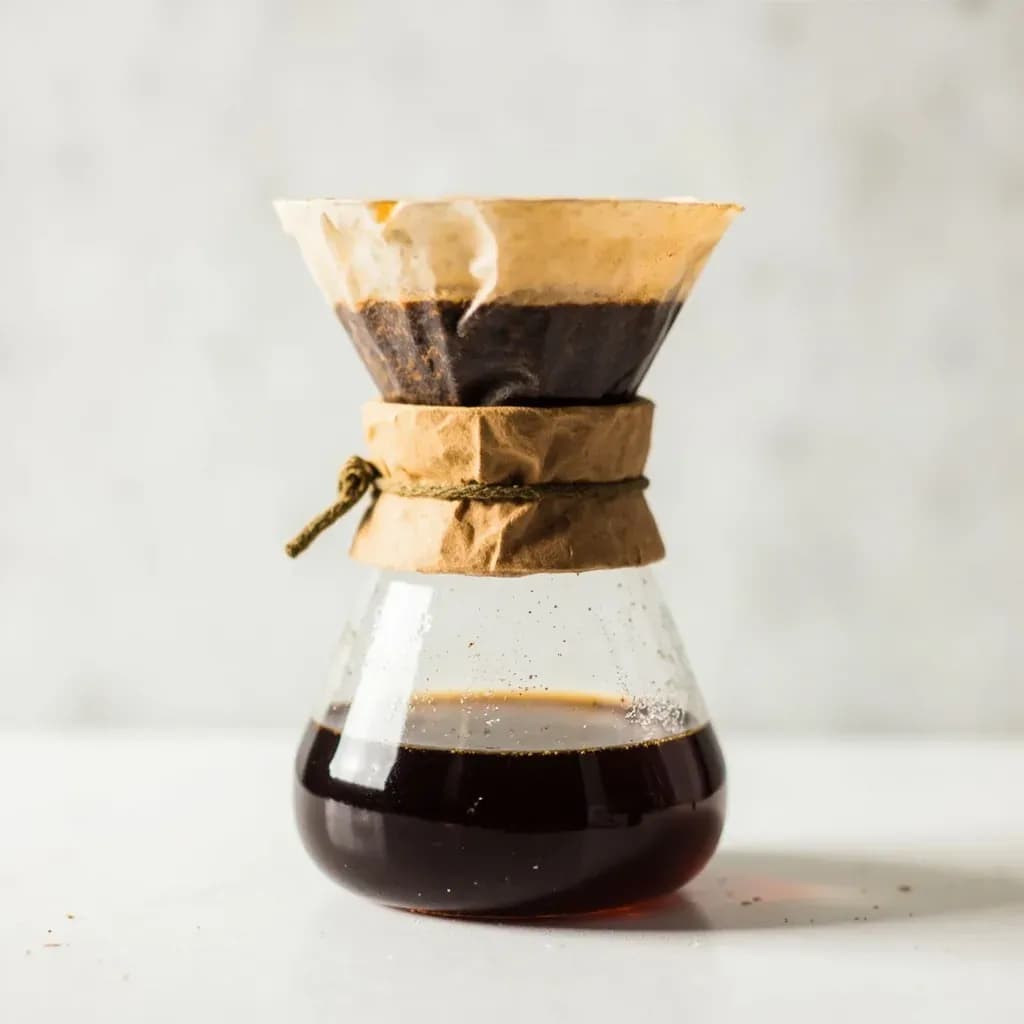
Appliances & Heat
Filter Coffee Maker
A brewer that drips hot water through ground coffee in a filter to make a pot of coffee.
A filter coffee maker brews coffee by passing hot water through a bed of grounds held in a paper or mesh filter, letting gravity drip the brew into a carafe below. It covers electric drip machines, pour-over cones, and plunger-style French presses, the everyday way most households make batch coffee. Drip and pour-over use a filter to catch grounds, while a French press steeps then presses them down.
A filter coffee maker — in most kitchens, an automatic drip brewer — is the workhorse of everyday coffee. Cold water sits in a reservoir; a heating element brings it to 195–205 °F and pushes it up through a tube to a spray head, which showers it evenly over a bed of ground coffee held in a paper, metal, or mesh filter. Gravity pulls the brewed liquid through into a carafe below, typically in 4 to 6 minutes. The format dominates home kitchens because it asks almost nothing of the user beyond filling the reservoir, dosing the grounds, and pressing a button.
The principle of pouring water through grounds is centuries old, but the modern electric machine dates to Germany's Wigomat in 1954 and reached American countertops with Mr. Coffee in 1972. Paper filters themselves were a 1908 invention by Melitta Bentz, who lined a tin pot with blotting paper from her son's schoolbook. Those filters are what give drip coffee its signature clarity, stripping out the fine sediment and emulsified oils that immersion brewers leave behind. The trade-off is body: an automatic drip cannot match the intensity of espresso (9 bar of pressure, 25–30 seconds) or the rich, foamy cup a moka pot (1–2 bar of stovetop steam) can deliver. What it offers instead is a clean, repeatable, hands-off cup.
In the kitchen, a drip brewer behaves predictably and forgives a great deal. Beyond brewing, the machine can double as a hot-water source for warming cups, jump-starting oatmeal, or preparing instant soups, since the heating element brings reservoir water to a near-boil. It will, however, punish neglect: a clogged basket, stale beans, hard water, or a pot left on the hot plate all produce a thin, bitter, or metallic cup. A small note on terminology: in South India, "filter coffee maker" usually refers to a brass or stainless two-chamber device with a perforated disc that brews a thick decoction for the traditional dabara-and-tumbler service — a different tool that shares only the name.
Alternatives
Types & varieties
Standard electric machine with reservoir, heating element, spray head, and carafe; the most common home format.
Manual cone held over a carafe or mug (e.g., Hario V60, Kalita Wave, Melitta, Chemex); same extraction principle, no electricity.
Café-grade machines with plumbed water, precise temperature control, and multiple brew heads; built to SCA standards.
Drip brewer with an insulated double-walled carafe in place of a glass pot and hot plate, keeping coffee hot without continued heat.
Brews one cup at a time through a sealed filter pod (e.g., Keurig, Nespresso); uses pressure or drip depending on system.
High-end home and commercial units that mimic barista pour-over timing with a computer-controlled water pulse.
Anatomy of an Automatic Drip Brewer
Most machines, from an inexpensive home unit to a high-end café brewer, share the same internal architecture. Understanding the parts helps diagnose bad brews and explains why certain maintenance steps matter.
- Cold-water reservoir: usually at the back of the machine, sometimes removable so it can be filled at the sink.
- Heating element and aluminum or copper hot-water tube: brings water up to brewing temperature; this is the first place mineral scale builds up in hard-water areas.
- Spray head or showerhead: distributes water in a wide, even pattern; a clogged or misaligned head is a leading cause of channeling and weak brews.
- Filter basket: holds the paper, metal, or mesh filter and the ground coffee; flat-bottom baskets drain more slowly than cones.
- Carafe: glass with a warming plate, or double-walled thermal stainless; the glass-and-plate model keeps coffee hot but continues to cook it after brewing.
- Control board: timer, auto-start, and sometimes a strength or temperature setting.
Filter and Grind Guide
The filter and grind size are the two variables a user controls most directly, and they have to be matched. A general rule: the faster the filter drains, the finer the grind can be.
- Paper (bleached or unbleached): cleanest, brightest cup; throws away fine sediment and most oils; rinse with hot water first to remove papery taste and preheat the basket.
- Gold-tone metal: reusable, no paper waste; a finer mesh than stainless mesh, so flow is slower and the cup is slightly more concentrated.
- Stainless mesh: fastest flow, lets through more fines, gives a slightly fuller body; rinse immediately after brewing to prevent clogging.
- Flat-bottom basket filter: even extraction, more forgiving of grind variations; pair with a medium grind.
- Cone filter: faster drain, tolerates a slightly finer grind, and often yields a more concentrated cup; common in pour-over drippers like the Hario V60, Kalita Wave, and Chemex.
Common uses
Tips & pitfalls
- Use a medium grind roughly the texture of coarse table salt; fine grounds clog flat-bottom filters, and very coarse grounds under-extract.
- Always brew with filtered or soft water — chlorine and hard minerals flatten flavor and scale the heating element.
- Weigh your coffee and water (about 60 g per liter) rather than measuring by spoonful; scoops vary wildly.
- Preheat the carafe with hot water so the first pour doesn't lose temperature to cold glass.
- Bloom the grounds with a small amount of water (2–3× the coffee weight) and wait 30–45 seconds before starting the full flow; this releases CO₂ and improves extraction.
- Decant any coffee that will sit more than 15–20 minutes into a thermal carafe — the hot plate scorches volatile aromatics and turns coffee bitter.
- Descale monthly with citric acid or a commercial descaler; mineral buildup is the leading cause of slow, cold brews.
- Rinse paper filters before brewing to remove paper taste and preheat the basket.
- Grind fresh for each brew if possible; pre-ground filter coffee loses volatile aromatics within a week of opening.
- Match grind to filter: cone filters tolerate slightly finer grinds than flat-bottom basket filters.
Good to know
- Earliest paper filter
- Melitta Bentz patented the first paper coffee filter in 1908 in Dresden, lining a tin pot with blotting paper from her son's schoolbook.
- First electric drip brewer
- Gottlob Widmann's Wigomat, produced in Germany from 1954, is widely credited as the first electric automatic drip coffee maker.
- Mr. Coffee
- Introduced in 1972 in the U.S. by North American Systems; it helped popularize home drip brewing in America.
- Standard brew temperature
- 195–205 °F (90–96 °C) per the Specialty Coffee Association brewing standard.
- Recommended ratio
- Approximately 1 g coffee to 15–18 g water (about 55–70 g per liter); a common shorthand is 2 tablespoons (≈10 g) per 6 oz cup.
- Typical contact time
- Roughly 4–6 minutes for a full batch, including a 30-second bloom.
- Materials
- Housing usually plastic or stainless steel; carafe either glass with a warming plate or double-walled thermal stainless; filters are paper (bleached or unbleached), gold-tone metal, or fine stainless mesh.
- Filter shapes
- Flat-bottom (basket) and cone; cone drains faster and tends to extract more.
- Capacity
- Home machines commonly brew 4–12 cups; a "cup" on most U.S. carafes is 5 fl oz, not a standard 8 oz measure.
Also called
plunger-coffee · french-press · kaffetrakter · Drip Coffee Maker · Pour-Over
Related

Stovetop
The everyday burners where most cooking actually happens

Oven
Enclosed dry heat for roasting, baking, and braising

Grill
Live-fire or gas grates for char, smoke, and high heat

Smoker
Low, slow heat and wood smoke for barbecue and brisket

Air Fryer
Countertop convection that crisps with little or no oil

Slow Cooker
Set-and-forget low heat for stews, beans, and braises

Pressure Cooker
Sealed steam pressure that cooks tough food in a fraction of the time

Rice Cooker
Foolproof, perfectly steamed rice every single time