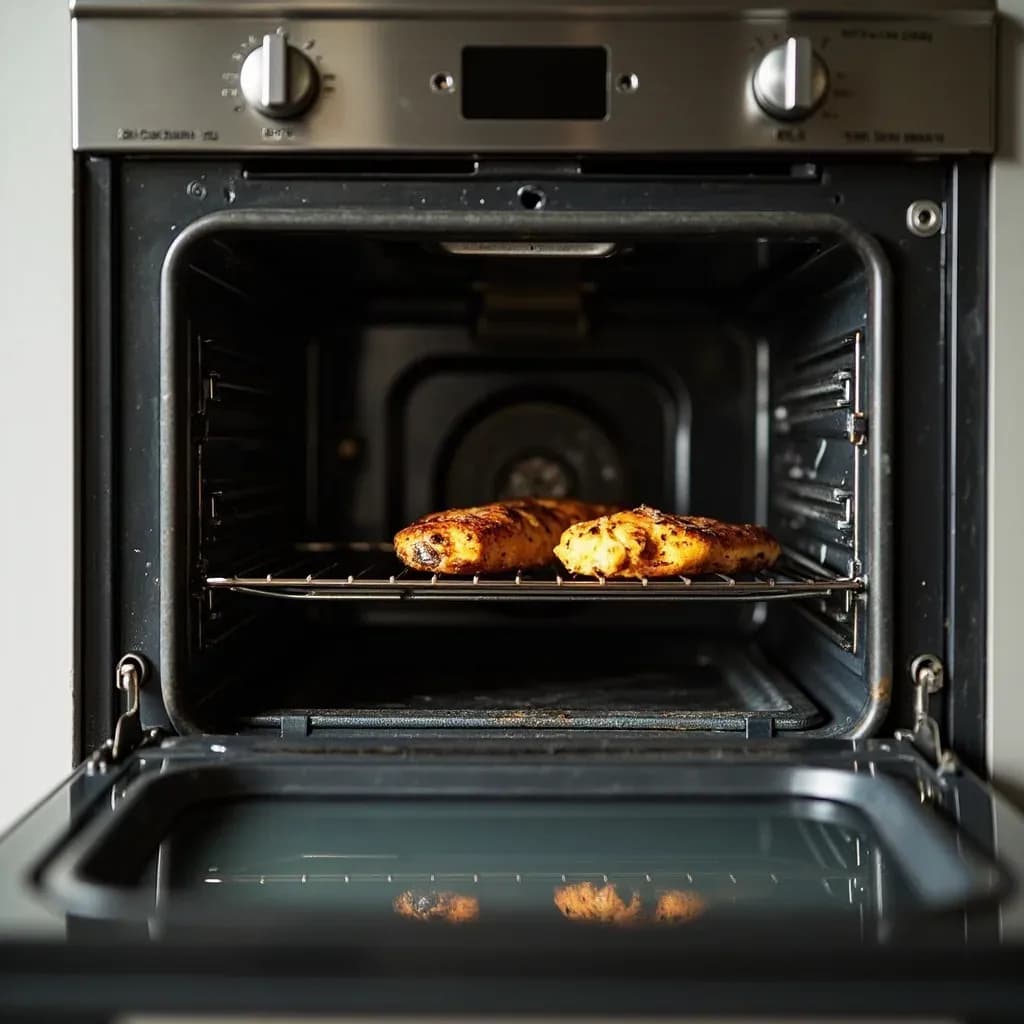
Appliances & Heat
Gas Oven
An enclosed gas-heated cavity for baking and roasting food at controlled temperatures.
A gas oven is an insulated box heated by a gas burner, used to bake, roast, and braise at a set temperature. Gas heat tends to be slightly moister than electric, which suits roasting, though it can give less even browning without a fan. It is the standard domestic baking oven in many homes, usually paired with a cooktop in a range.
A gas oven heats food with an open flame — most often a single burner set into the floor of the cavity, with a second, hotter burner mounted near the top for broiling. The flame warms the surrounding air and the steel it touches, and that hot air and metal do the cooking. Three practical consequences follow from the design. Combustion of natural gas or propane releases water vapor, so the oven's atmosphere is slightly more humid than an electric oven's. Preheat times are short, typically five to ten minutes to 350°F. And the heat is less even than in an electric cavity, with a clear hot zone above the burner and a noticeably cooler top.
For baking and roasting, that bottom-biased radiant heat is the gas oven's signature: it browns the underside of bread and pizza, renders fat on a standing rib roast, and crisps a tray of vegetables faster than most electric ovens. It is also the gas oven's main weakness for delicate baking — thin cookies, sponge cakes, and tall soufflés can over-brown on the bottom or rise unevenly, which is why many bakers favor electric or true convection. A baking stone or heavy steel plate set on a low rack absorbs the burner's radiant spike and evens the floor temperature.
When shopping or converting recipes, the word "convection" deserves a careful read. Some manufacturers add a fan to a gas oven and call it convection; others add a fan plus an electric heating element wrapped around it and call that "true" or "third-element" convection. The two behave differently: true convection cooks roughly 25% faster at a 25°F lower set point, while a fan-only gas oven moves air but adds no extra heat. Recipes tuned to one will not always succeed in the other.
Alternatives
Types & varieties
Single bottom burner, no fan; a hotter zone near the base and a cooler top.
Adds a fan to move hot air; evens temperatures and typically shortens cook times by about 25%.
Gas cooktop paired with an electric oven cavity; combines gas flame control with the evenness of electric baking.
Cooktop and oven in a single unit — the most common residential format in North America.
A separate oven installed at eye level or under the counter, paired with an independent cooktop.
Commercial bakery or pizzeria oven with stone or steel decks heated by a gas burner beneath each deck.
Large commercial rack oven in which the loaded rack rotates past a fixed heat source for even baking.
High-velocity hot-air jets impinge on the food from above and below on a moving belt; common in commercial baking and quick-cook chains.
Top-mounted, high-BTU gas burner for browning, gratinating, and finishing; often a separate piece of equipment.
Always-on gas-fired cast-iron ovens that cook by stored radiant heat at low, steady temperatures.
Convection, true convection, and dual-fuel
The labels in this corner of the market are not interchangeable, and confusing them is one of the most common reasons a familiar recipe misbehaves in a new oven. A standard gas oven has a single bottom burner and a top broiler. A "gas convection" oven adds a fan in the back wall that circulates hot air, which evens temperatures and shortens cook times. A "true convection" or "third-element convection" oven adds an electric heating element wrapped around that fan, which lets the fan move air that is hotter than the rest of the cavity — useful for roasting multiple trays at once and for baking pastry. True convection is the one that genuinely benefits from a 25°F drop in set temperature and a roughly 25% shorter cook time.
- Fan-only gas convection: evens temperatures, no extra heat — reduce cook time modestly, keep the same set temperature.
- True (third-element) gas convection: hotter moving air — drop set temperature 25°F and start checking 5–10 minutes early.
- Dual-fuel range: gas burners on top, electric element (often with true convection) in the oven — bake as you would an electric oven.
- If a recipe specifies "convection" without naming the type, assume true convection unless you know the oven's spec sheet.
Why the oven thermometer matters
Gas oven thermostats are mechanical, and they drift. A 10–25°F discrepancy between the dial and the actual cavity temperature is normal on a five-year-old range, and larger gaps are not unusual. Combined with the cavity's hot spot above the burner, that drift is the single biggest reason a recipe that worked in a friend's kitchen fails in yours. A separate oven thermometer — a dial type on a rack or a leave-in probe — tells you what the air around your food is really doing. Combined with rotating pans front-to-back and swapping rack positions at the halfway point, it solves most of the inconsistency people blame on the recipe.
Common uses
Tips & pitfalls
- Use an independent oven thermometer; gas thermostats commonly drift 10–25°F, and the cavity has clear hot spots.
- Rotate pans front-to-back and swap rack positions at the halfway mark — the back of the oven and the area directly above the burner run hottest.
- Set a baking stone or heavy steel plate on a low rack to absorb the bottom burner's radiant spike when baking bread, pizza, or pastry.
- When converting a recipe from an electric oven, drop the temperature by about 25°F or start checking 5–10 minutes early — gas runs slightly hotter and moister.
- Avoid lining the floor of the oven with foil: it blocks the bottom burner's heat and can overheat the porcelain enamel underneath.
- Keep the burner ports and igniter clean; clogged ports cause uneven flames, soot on dishes, and a faint gas smell at startup.
- For broiling, follow the manufacturer on door position and rack distance (commonly 4–6 inches from the flame) — gas broilers run hotter than electric and sear quickly.
- Check connections for gas leaks with soapy water and make sure the kitchen hood or flue is working; a gas oven consumes oxygen and produces combustion byproducts that should be vented.
Good to know
- Fuel
- Natural gas or propane (LPG)
- Heat source
- Gas burner at the base of the cavity, with a separate top-mounted broiler burner on most models
- Typical temperature range
- Roughly 150–500°F (65–260°C); broil runs higher
- Preheat to 350°F
- About 5–10 minutes, generally faster than a comparable electric oven
- Common residential burner output
- About 10,000–18,000 BTU for the oven burner; broil burners are usually higher
- Cavity material
- Cold-rolled steel finished with porcelain enamel or a continuous-clean coating
- Atmosphere
- Slightly more humid than electric because combustion releases water vapor
- First gas cooking patent
- 1826, James Sharp, Northampton, England
Also called
Home Oven · Domestic Baking Oven · Electric / Gas Home Oven
Related

Stovetop
The everyday burners where most cooking actually happens

Oven
Enclosed dry heat for roasting, baking, and braising

Grill
Live-fire or gas grates for char, smoke, and high heat

Smoker
Low, slow heat and wood smoke for barbecue and brisket

Air Fryer
Countertop convection that crisps with little or no oil

Slow Cooker
Set-and-forget low heat for stews, beans, and braises

Pressure Cooker
Sealed steam pressure that cooks tough food in a fraction of the time

Rice Cooker
Foolproof, perfectly steamed rice every single time