Appliances & Heat
Ice Cream Machine
A countertop or built-in machine that churns and freezes a base into ice cream.
An ice cream machine freezes a chilled custard or fruit base while a dasher stirs it, producing smooth ice cream, gelato, or sorbet. It is used at the dessert stage after the base has been cooked and cooled. Compressor models freeze on demand, while cheaper ones rely on a bowl frozen ahead of time.
An ice cream machine is, at heart, a temperature-controlled scraper. It pulls heat out of a sweet dairy (or dairy-free) base fast enough to nucleate ice crystals, while a rotating dasher scrapes those crystals off the cold wall and folds them back into the mix before they can grow. A freezer alone turns liquid into a solid icy block; a whisk alone aerates without freezing. The marriage of those two actions — refrigeration plus continuous agitation — is what produces the dense, creamy, scoopable texture that defines good ice cream.
Beyond simply freezing, the machine controls overrun, the percentage of air incorporated during churning. Premium ice cream and gelato sit at 20–35% overrun, meaning roughly a fifth to a third of the finished volume is whipped-in air; cheap supermarket pints can exceed 100%, which is why they feel light but taste muted. Dasher speed, refrigerant temperature, and residence time in the cylinder all steer this number, and a thoughtful cook can dial it in batch to batch.
The alternative — freezing a sweetened base in a loaf pan and scraping it every 30 minutes — works, but only within limits. A machine keeps ice crystals in the 20–25 micron range, well below the threshold the palate reads as "icy," helps emulsify fat into a stable network, and distributes stabilizers evenly. Used well, it is the single biggest upgrade a home cook can make to frozen desserts.
Alternatives
Types & varieties
Built-in refrigeration chills the bowl on demand, allowing back-to-back batches. Heavier and pricier, but the choice of serious home cooks.
A gel-filled canister stored in the freezer 8–24 hours before use. Affordable and reliable, but must refreeze fully between batches.
Bowl-and-dasher unit that bolts to a stand mixer (notably KitchenAid). Uses the mixer's motor; freezer-bowl style.
Traditional bucket with a dasher turned by hand, surrounded by crushed ice and rock salt. Inexpensive, slow, and great for nostalgia.
High-end residential unit integrated into cabinetry with a dedicated compressor and a clear cover so churning can be watched.
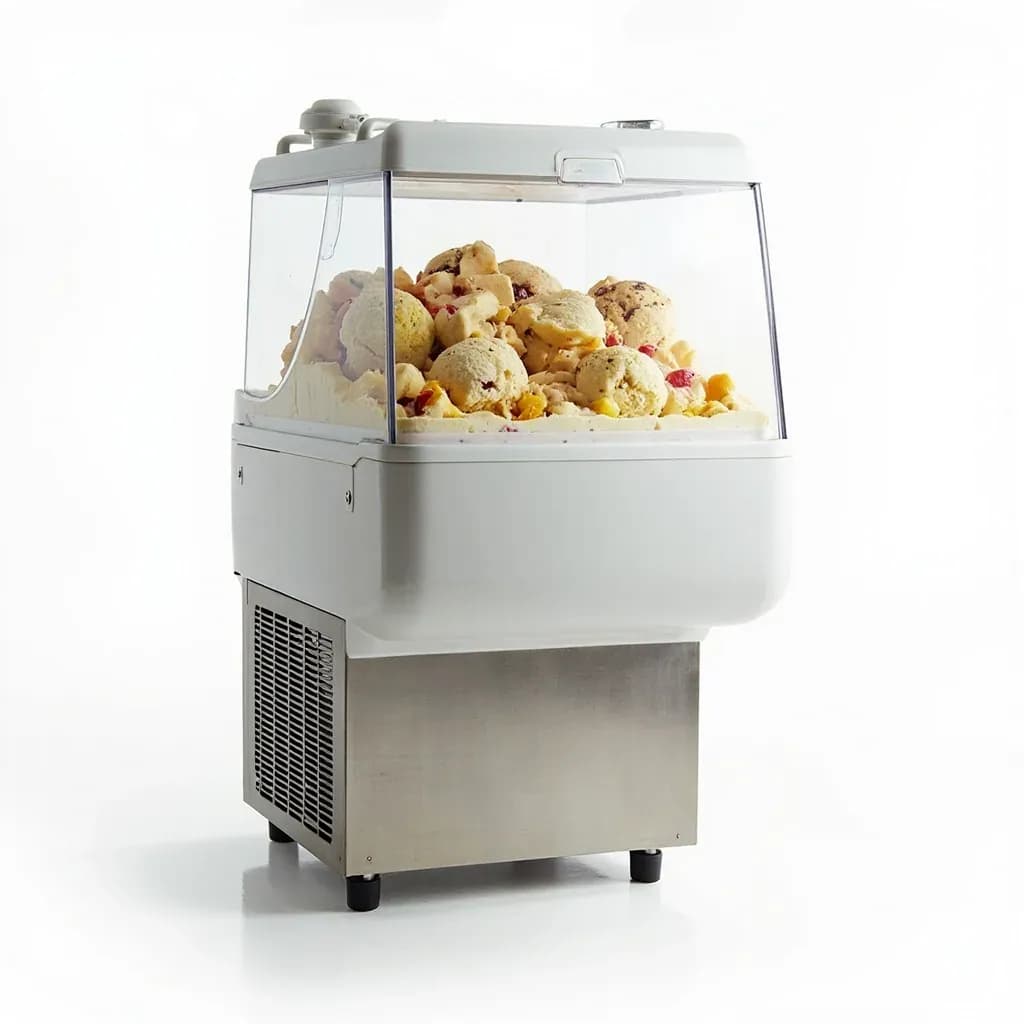
Pressurized countertop or floor unit that holds mix above freezing and dispenses on demand. Common in food service, rare at home.
Compact machines (e.g., the Ninja Creami class) that re-spin a pre-frozen block into a soft-serve texture rather than churning from liquid. Fast and convenient, but a different tool from a true churner.
Similar to a standard ice cream maker but with a slower dasher and a higher final serving temperature to keep overrun low and flavor dense.
How the machine actually works
Three things are happening at once inside the cylinder. The refrigerant pulls heat out through the wall, seeding ice crystals on the cold surface. The dasher scrapes them off the moment they form, breaking them up and dispersing them through the mix so no single crystal gets large enough to read as ice on the tongue. At the same time, the dasher whips air into the increasingly viscous base, which is overrun. By the time the mix reaches the 'mush' stage — soft-serve consistency, the dasher laboring visibly — the ice crystals are well under 25 microns and the air is evenly distributed. The cook's job is to stop the machine at that point and move the ice cream to a colder environment (the home freezer) to harden.
Fat and stabilizers do the rest. Milkfat globules, especially when stabilized by egg-yolk lecithin in a custard base, link into a partial network that traps air bubbles and slows the migration of water toward existing ice crystals. Added stabilizers (gelatin, cornstarch, xanthan, guar, locust bean) reinforce that network, which is why a properly stabilized base can survive weeks in the freezer without becoming an icy block.
Choosing a machine
The right pick depends on how often you plan to make ice cream and how much control you want over the process.
- Compressor machine: pick this if you want to make multiple batches in a session, want finer control over final texture, or hate planning ahead. Heavier and considerably more expensive than a pre-frozen bowl.
- Pre-frozen bowl: best for occasional use and small kitchens. The bowl must be flat-frozen for at least 8 hours (24 is safer) and must refreeze fully between batches, so plan accordingly.
- Stand-mixer attachment: a good middle ground if you already own a compatible mixer. Quality varies, and the mixer motor runs hot under prolonged load.
- Hand-crank canister: charming and inexpensive, but a workout; best for one nostalgic batch a summer, not a regular habit.
- Soft-serve and built-in drawer models: specialty purchases for very specific needs (parties, gelato shop at home).
- Standard home bowls run 1–2 quarts and produce roughly 1.5–2.5 quarts of finished ice cream; commercial batch freezers can handle 6 quarts or more.
Texture troubleshooting
Most ice cream failures trace back to one of three causes: a warm base, an overfilled bowl, or impatience. Below is what goes wrong and why.
- Icy texture: base went into the machine warm, churned too briefly, or lacked fat and stabilizer. Chill the base to 4°C (40°F) or colder before churning, and consider adding egg yolks or a small amount of cornstarch or xanthan.
- Greasy or yellow flecks: butter has broken out of the emulsion from over-churning. Stop the machine at the mush stage; once the dasher is fighting frozen mix, it is overworking the fat.
- Dense, heavy texture: churned too long, or the recipe has very little fat or air. Pull the batch earlier, increase the milk/cream ratio, or add a splash of alcohol to soften.
- Sorbet that freezes rock-hard: not enough sugar or no added stabilizer. A tablespoon of corn syrup, a small amount of glucose syrup, or a teaspoon of vodka will keep it scoopable.
- Soft-serve that never firms up in the freezer: too much alcohol, or the base was never chilled long enough. Move it to the coldest part of the freezer and wait 4+ hours.
Common uses
Tips & pitfalls
- Chill the cooked base to at least 4°C (40°F), ideally overnight in the refrigerator; a warm base slows the machine and yields visibly icier ice cream.
- Strain custards through a fine-mesh sieve to catch chalazae and any bits of cooked egg that would mar a smooth texture.
- Never exceed the machine's fill line. The base expands as air is whipped in, and an overfilled bowl stalls the dasher and produces an icy, under-aerated result.
- Stop the machine at the 'mush' stage, when the dasher starts to labor and the mix piles on top of itself. Over-churning breaks the butterfat emulsion and leaves greasy yellow flecks.
- Add mix-ins (chocolate chips, nuts, cookie crumbs, ribbons of caramel) in the final 1–2 minutes of churning so they distribute evenly without sinking or shattering.
- Transfer finished ice cream to a chilled container, press a sheet of plastic wrap directly onto the surface to exclude air, seal, and harden for at least 2–4 hours before serving.
- For freezer-bowl models, freeze the bowl flat at the back of the freezer for a full 24 hours before the first use; tilting or short freezes leave soft spots that prevent proper churning.
- Temper ice cream at room temperature for 5–10 minutes after pulling it from the freezer; properly made ice cream should scoop with light pressure, not require a hammer.
- Add 1–2 tablespoons of spirits (vodka, bourbon, cassis) per quart at the end of churning. The ethanol depresses the freezing point, so the ice cream stays softer straight from the churn and scoops easily without re-tempering.
- Rinse and dry the dasher and lid thoroughly after each batch; residual salt, detergent, or off-flavors will taint the next one.
Good to know
- Primary function
- Simultaneously freezes and agitates a liquid base, incorporating air while keeping ice crystals small (target 20–25 microns).
- Two mechanisms
- A refrigerant-cooled surface (compressor or pre-frozen gel bowl) plus a rotating dasher/paddle that scrapes the walls.
- Overrun
- The percentage of air whipped in during churning; premium gelato sits at 20–35%, supermarket pints can exceed 100%.
- Service temperature
- Ice cream is best at roughly -10°C to -15°C (14 to 5°F); gelato is served slightly warmer, around -8°C to -11°C (18 to 12°F).
- Hard-freeze storage
- -18°C to -29°C (0°F to -20°F) for fully hardened ice cream.
- Origin
- Nancy Johnson patented the first hand-cranked ice cream freezer with a rotating dasher in 1843 (U.S. Patent 3254).
- Common base styles
- Philadelphia-style uses only dairy, sugar, and flavorings; French-style (custard) is enriched with 4–6 egg yolks per quart.
- Typical home capacity
- 1 to 2 quarts (1–2 L) per batch; commercial batch freezers and countertop soft-serve units run 1.5 to 6+ quarts.
- Churn time
- 20–45 minutes for most home machines, depending on volume, base temperature, and refrigerant power.
Also called
ice cream maker · ice cream churner · gelato maker
Related

Stovetop
The everyday burners where most cooking actually happens

Oven
Enclosed dry heat for roasting, baking, and braising

Grill
Live-fire or gas grates for char, smoke, and high heat

Smoker
Low, slow heat and wood smoke for barbecue and brisket

Air Fryer
Countertop convection that crisps with little or no oil

Slow Cooker
Set-and-forget low heat for stews, beans, and braises

Pressure Cooker
Sealed steam pressure that cooks tough food in a fraction of the time

Rice Cooker
Foolproof, perfectly steamed rice every single time