Appliances & Heat
Stone Melanger (Wet Grinder)
A stone-roller grinder that refines chocolate or nut pastes smooth over many hours.
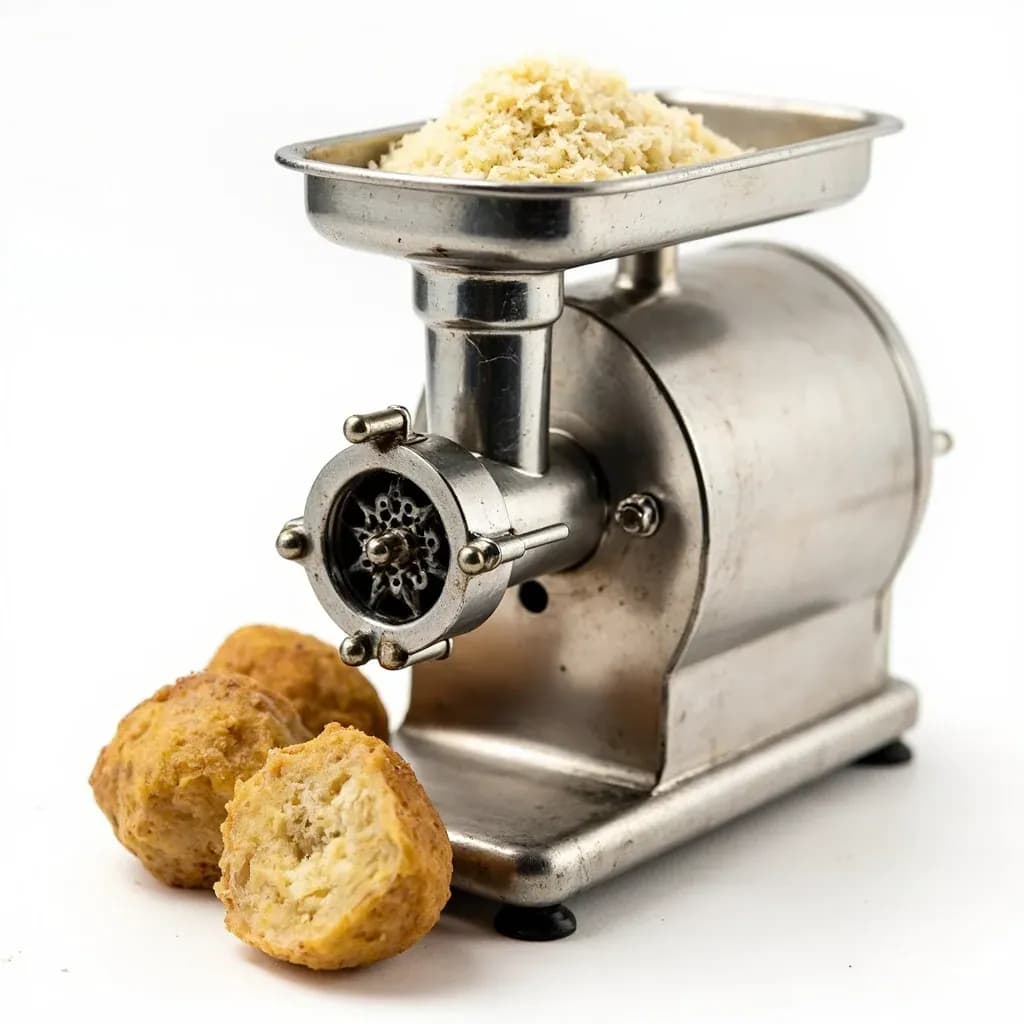
A stone melanger is a motorized grinder with heavy granite rollers turning over a granite base, used to refine and conche chocolate from cocoa nibs or to grind nut and seed pastes into silky butters. The continuous shearing over hours or days breaks particles down below the tongue's grit threshold. It doubles as a wet grinder for South Indian idli and dosa batters.
A stone melanger is a slow-turning wet grinder built around a heavy granite roller that revolves against a stationary granite bed. It originated in Tamil Nadu as a domestic wet grinder for rice and dal batters, where cooks prized its ability to produce a fine, airy grind without generating excessive heat. That same gentle, prolonged action turned out to be ideal for chocolate: the stones reduce cocoa nibs, sugar, and cocoa butter to particles in the 15–20 micron range, simultaneously incorporating fat and developing flavor through hours of agitation. For a serious bean-to-bar maker or a cook who wants velvety nut and seed pastes, the melanger is the single machine that does the work of a crusher, a refiner, and a conche at once. Home units are countertop-friendly and surprisingly affordable, while commercial melangers can process tens of kilograms per batch in craft chocolate shops.
Alternatives
Types & varieties
The classic Indian wet grinder, available from 1.5 L to 40 L; the workhorse of the bean-to-bar movement and still the most common chassis adapted for chocolate.
Indian-built stone grinder in 11, 22, and 40 kg sizes, marketed to small chocolate businesses; strong value for production capacity.
Compact 1.5 L countertop unit and the most common entry-level melanger for home cooks.
US-built tabletop melangers (C-Choc 70, C-Choc 130) sold specifically to craft chocolatiers, with US voltage and support.
Tabletop grinders from 3–15 kg with ergonomic housings and removable drum liners; popular with small-batch chocolate makers.
US-made two- and three-roller mills originally for grain, adapted for chocolate; technically a roll refiner, not a melanger, but often used in similar roles.
Italian large-format stone melangers built for industrial chocolate production, often 100 kg and up.
How a melanger actually works
The machine consists of a heavy cylindrical granite stone mounted on a vertical shaft, turning inside a granite trough. As the stone rolls, material caught between the roller and the bed is sheared and crushed. Because the rotation is slow, heat builds gradually and the fat in the charge melts and coats each newly exposed particle, preventing them from clumping. Over many hours the particle size falls from coarse grit to a smooth, flowing paste. In chocolate, the same hours of agitation drive off moisture, acetic acid, and unwanted volatiles while oxidizing the mass slightly — the combined process chocolate makers call conching. That is why a melanger is a true three-in-one machine, and why a roll refiner followed by a separate conche, or a ball mill plus a conche, is needed to replicate its output.
- The roller does not spin fast; its weight does the pressing, and the bed holds the charge.
- Particle size drops by attrition rather than impact, which is why well-maintained granite stones can last decades.
- Chocolate is ready when a finger-rub between thumb and forefinger feels silky, with no detectable grit.
Melanger versus roll refiner versus ball mill
These three machines are often confused because they all refine chocolate, but they do it differently. Understanding the trade-offs matters if you are scaling up a recipe or troubleshooting texture.
- Melanger: batch process, granite stones, slow (24–72 h), refines and conches at the same time. Best for small craft production and for cooks who want a single machine.
- Roll refiner: continuous, typically five steel rolls turning at progressively higher speeds, very fast (minutes per pass), but only refines. Conching must be done separately.
- Ball mill: rotating drum filled with steel balls, very fast refining, no conching action, noisy, and harder to clean for small batches.
Common uses
Tips & pitfalls
- Pre-crack or chop cocoa nibs and sugar before loading; a melanger is a refiner, not a crusher, and oversize pieces stall the stones.
- Add cocoa butter gradually in two or three additions to keep the mass flowing and prevent seizing into a dry lump.
- Resist the urge to speed up the process — heat from friction above ~50 °C (122 °F) scorches chocolate and drives off the volatile flavors you worked to develop during roasting.
- Leave the lid off or use a splatter guard for the first 6–12 hours; trapped steam will condense back into the mass and lengthen drying time considerably.
- Stop and scrape the sides, the corners of the trough, and the central hub every 8–12 hours to redistribute the mass and expose unrefined material to the stones — a missed scrape is the most common cause of a gritty batch.
- For nut butters, add neutral oil only if the nuts release too little of their own fat; over-oiling prevents a firm set in the jar.
- Clean the stones by running dry, hardened rice or coarse salt through them to absorb residual fat, then rinse and air-dry the granite thoroughly — never store the stones wet, as trapped moisture can crack the granite.
- If the chocolate becomes too thick near the end of refining, a small addition of cocoa butter (50–100 g per 3 kg batch) restores flow without disrupting the final temper.
Good to know
- Origin
- Tamil Nadu (South India) for rice and dal batters; adopted by artisan chocolate makers in the late 20th century.
- Operating speed
- 30–50 RPM; slower is better, as friction above roughly 50 °C (122 °F) scorches chocolate and drives off volatiles.
- Refining time
- 18–72 hours for chocolate, depending on recipe and target particle size.
- Target particle size
- ~15–20 microns for smooth chocolate; under 30 microns is generally accepted as non-gritty.
- Batch size
- 1.5–3 kg (home), 8–15 kg (small commercial), 20–40+ kg (commercial).
- Materials
- Natural granite roller and bed; some commercial machines use engineered stone or metal.
- Power
- 110 V or 220 V single phase for tabletop models (1–2 HP motors); 3-phase power with 3–5 HP motors for commercial units.
- Weight
- 30–60 lb tabletop; 200–600 lb commercial.
- Approximate output per batch
- 2.5–3 kg finished chocolate from a 3 kg home unit; 12–14 kg from a small commercial melanger.
- Cost range
- ~$400–$900 home; $1,500–$3,500 small chocolate; $5,000–$15,000+ commercial.
- Also called
- Wet grinder, stone grinder, stone melangeur, chocolate grinder.
Also called
wet grinder · chocolate melanger
Related

Stovetop
The everyday burners where most cooking actually happens

Oven
Enclosed dry heat for roasting, baking, and braising

Grill
Live-fire or gas grates for char, smoke, and high heat

Smoker
Low, slow heat and wood smoke for barbecue and brisket

Air Fryer
Countertop convection that crisps with little or no oil

Slow Cooker
Set-and-forget low heat for stews, beans, and braises

Pressure Cooker
Sealed steam pressure that cooks tough food in a fraction of the time

Rice Cooker
Foolproof, perfectly steamed rice every single time