Appliances & Heat
Olive Mill (Frantoio)
A crushing and pressing system that turns whole olives into paste and extracts olive oil.
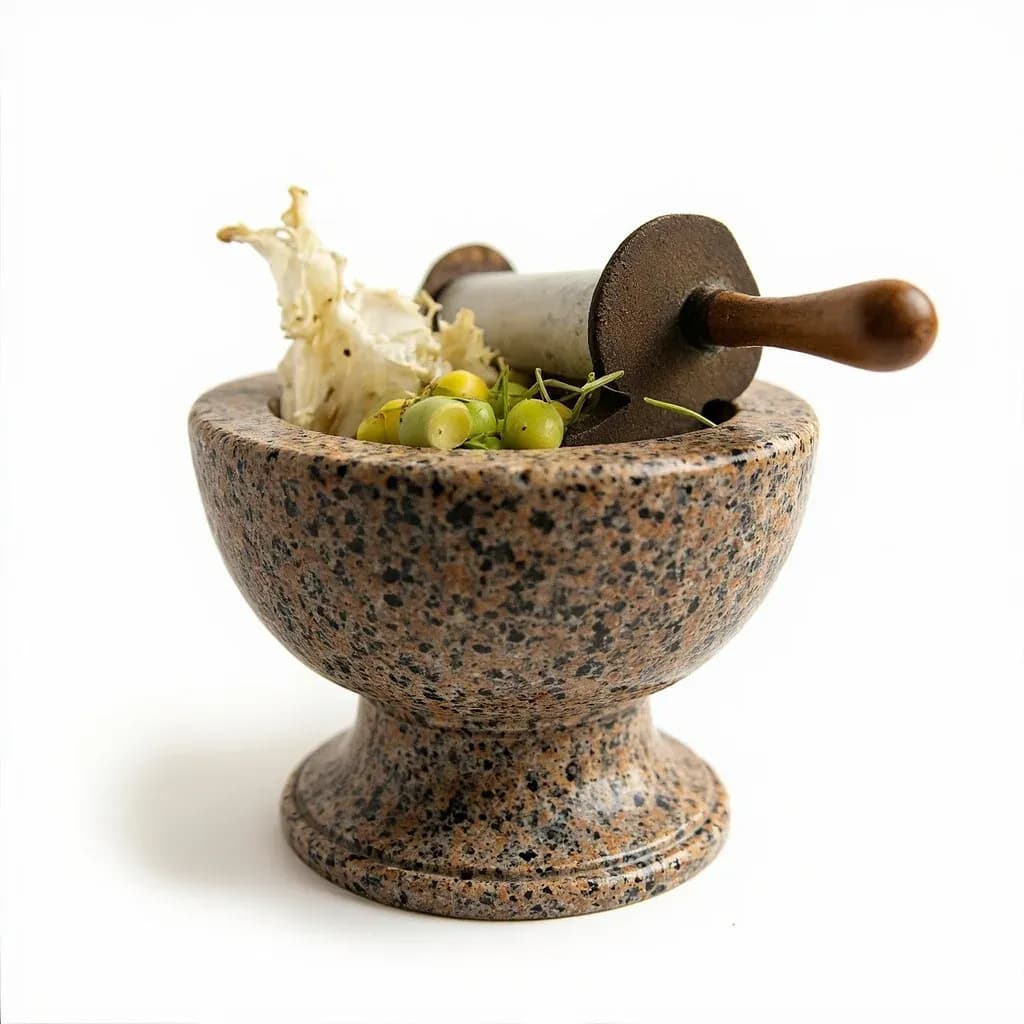
An olive mill grinds whole olives, pits included, into a paste using granite millstones, hammer crushers, or steel discs, then the paste is malaxed and pressed or centrifuged to separate the oil. Traditional Italian frantoio operations roll heavy stone wheels in a basin, while modern mills use stainless crushers for speed and hygiene. Cold extraction at low temperatures protects the oil's aroma, flavor, and polyphenols.
A frantoio is the entire system a grove or estate uses to convert harvested olives into bottled oil, not just a single machine. In its traditional form it is a stone wheel (the molazza), a kneading trough, a hydraulic press, and a settling tank; in a modern continuous line it is a defoliator-washer, a hammer or disc crusher, a bank of malaxing tanks, a horizontal decanter, a vertical separator, and a filter. For a cook, the mill matters because the decisions made inside it — when the fruit is crushed, how long the paste is kneaded, and at what temperature the oil is separated — determine whether the oil on your table tastes like fresh grass, peppery arugula, sweet almond, or stale wax. Every premium bottle of extra-virgin olive oil you have ever opened is a record of choices made at a frantoio.
The 'cold-pressed' and 'first cold press' designations on a label are not marketing flourishes; they refer to specific operational rules at the mill. Cold extraction means the paste never exceeds roughly 27 °C from crusher to separator, which preserves volatile aromatics and the polyphenols responsible for the throat-catching pepper of a fresh oil. 'First' originally distinguished the best fraction from oil recovered by re-warming and re-pressing the pomace — in a centrifugal system the equivalent is the oil that flows before any hot water or paste rework is added.
A good frantoio operator is part farmer, part brewer, part chemist. Time from tree to crusher is the single biggest variable: olives picked at dawn and milled by evening produce markedly fresher, more phenolic oil than the same fruit left in a bin overnight, when native enzymes and microbes begin to ferment the paste and free fatty acidity climbs. The mill's job is to be ready, clean, and running before the fruit arrives — and to keep detailed records of cultivar, lot, temperature, and time, because the personality of the oil is set inside it.
Alternatives
Types & varieties
Traditional granite or basalt wheel that grinds olives into a coarse paste; prized for gentle crushing and the classic 'first cold press' character.
High-speed rotating hammers that break pits and flesh; fast, modern, and the most common in mid- to large-scale mills.
Toothed metal discs that shear the olives; used in many continuous systems and easier to clean than hammer mills.
Traditional batch press where the paste is layered onto fiber mats (fiscoli) and squeezed; survives in premium and boutique mills.
Perforated steel plates that draw oil out by surface tension; produces very clean oil and is often paired with a final centrifuge.
Modern continuous separator that spins paste at high speed to fling out oil, water, and pomace; the workhorse of contemporary mills.
Newer design that outputs only oil and a single wet pomace, saving water and reducing wastewater; tends to retain more polyphenols than a three-phase system.
Pieralisi, Mori-Tem, and Alfa Laval are the dominant manufacturers of continuous olive-mill lines used across the Mediterranean.
Stages of a modern continuous frantoio
The line runs as a single chain from intake to filter, with each step tuned to protect the oil from heat, oxygen, and rough handling.
- Defoliation and washing — olives are stripped of leaves and twigs, then washed in potable water; leaves and unripe fruit add bitter, grassy notes if left in.
- Crushing — stone wheel, hammer mill, or disc crusher breaks pits and flesh into a coarse paste. The goal is rupture, not pulverization: shattered pits release amygdalin, a bitter compound.
- Malaxation (gramolatura) — the paste is slowly kneaded in a closed, jacketed tank, usually 20–45 minutes at ≤27 °C, so tiny oil droplets coalesce into streams the decanter can lift out.
- Extraction — in a traditional press, paste is spread on fiscoli mats and squeezed; in a modern line, a horizontal decanter spins the paste at high speed, separating oil, water, and solids by density.
- Vertical separation — oil from the decanter still contains trace vegetation water, which a second centrifuge removes.
- Filtration and storage — the oil is filtered (or left unfiltered) and stored in stainless-steel tanks blanketed with inert nitrogen at 14–18 °C until bottling.
What the bottle label can — and cannot — tell you
Olive-oil labels carry a layer of legal shorthand that is worth decoding before you buy, because it reflects what happened at the frantoio.
- Harvest date (or 'harvested October 2024') is more useful than a best-before date; freshness fades measurably within a year of milling.
- Single-estate or monocultivar oils name the grove and the variety (Frantoio, Coratina, Picual, Koroneiki), so you can chase a flavor profile you like.
- 'Cold pressed' or 'cold extracted' means the paste stayed under 27 °C through malaxation and separation; in centrifugal mills it is sometimes phrased 'cold extracted' to be honest about the technology.
- 'First cold pressed' historically meant the first, best fraction from a press; in centrifugal lines it means oil taken before any hot water or paste rework is added.
- Acidity (% oleic acid) and peroxide value on a technical sheet indicate fruit health and storage, but a low-acid oil is not automatically a tasty one — flavor still rules.
Common uses
Tips & pitfalls
- Mill olives as soon as possible after harvest — every hour of warm storage raises free fatty acidity and degrades the polyphenols that give fresh oil its peppery bite.
- For aromatic cultivars such as Frantoio, Coratina, and Picual, keep malaxation short (20–30 minutes) and the paste cool to preserve their signature green, peppery phenols.
- Do not pulverize the pits; the stone should be broken, not shattered. Over-crushed pits leach amygdalin and turn a delicate oil bitter and astringent.
- For a genuine 'cold-pressed' label, keep the whole chain — crusher, malaxer, decanter, separator — below 27 °C and never add hot water to the paste.
- If you run a small hydraulic press, build the stack of fiscoli mats evenly and high enough to form a clean cake; lopsided layers blow out and force cloudy, vegetation-water-laden oil.
- Filter or centrifuge the oil within one to two weeks of milling; unfiltered oil tastes vivid for a few weeks, but the sediment ferments and can turn the bottle rancid.
- Wash and sort olives before they enter the crusher — leaves, twigs, and unripe fruit push the oil toward harsh, grassy bitterness that no amount of post-milling care can fix.
- Track mill temperature, malaxation time, and lot code for every batch; those three numbers, more than any other, define the personality of the resulting oil.
Good to know
- Italian name
- Frantoio (also the name of a famous Tuscan olive cultivar)
- Key stages
- Cleaning → crushing → malaxation → extraction (pressing or centrifugation) → separation → filtration
- Malaxation temperature
- Cold extraction keeps the paste below 27 °C (some EU regulations allow up to 30 °C); the Italian term for malaxation is gramolatura
- Malaxation time
- Typically 20–45 minutes; longer raises yield but risks oxidation and loss of fresh flavors
- Typical yield
- Roughly 15–25% of olive weight as oil; gourmet cultivars often need 4–6 kg of olives per 1 L of oil
- Capacity range
- Artisan lines handle 50–500 kg/hour; industrial continuous lines process 2–10 tonnes/hour
- Time from harvest to crush
- Premium oil is milled within 8–24 hours of picking; delays cause fermentation and rising free fatty acidity
- Construction
- Food-grade stainless steel for all product-contact parts; granite or basalt for traditional millstones
Also called
Hammer Mill Crusher · Disc Crusher · Granite Stone Grinding Mill (Molazze) · Stone Burr Mill · Granite Millstone · Steel Burr Mill · Stone Mill (Soybean Grinder) · Wet Corn Mill (Molino de Nixtamal) · Frantoio
Related

Stovetop
The everyday burners where most cooking actually happens

Oven
Enclosed dry heat for roasting, baking, and braising

Grill
Live-fire or gas grates for char, smoke, and high heat

Smoker
Low, slow heat and wood smoke for barbecue and brisket

Air Fryer
Countertop convection that crisps with little or no oil

Slow Cooker
Set-and-forget low heat for stews, beans, and braises

Pressure Cooker
Sealed steam pressure that cooks tough food in a fraction of the time

Rice Cooker
Foolproof, perfectly steamed rice every single time