Appliances & Heat
High-BTU Propane Outdoor Burner
A powerful standalone propane burner for outdoor frying, boiling, and large-batch cooking.
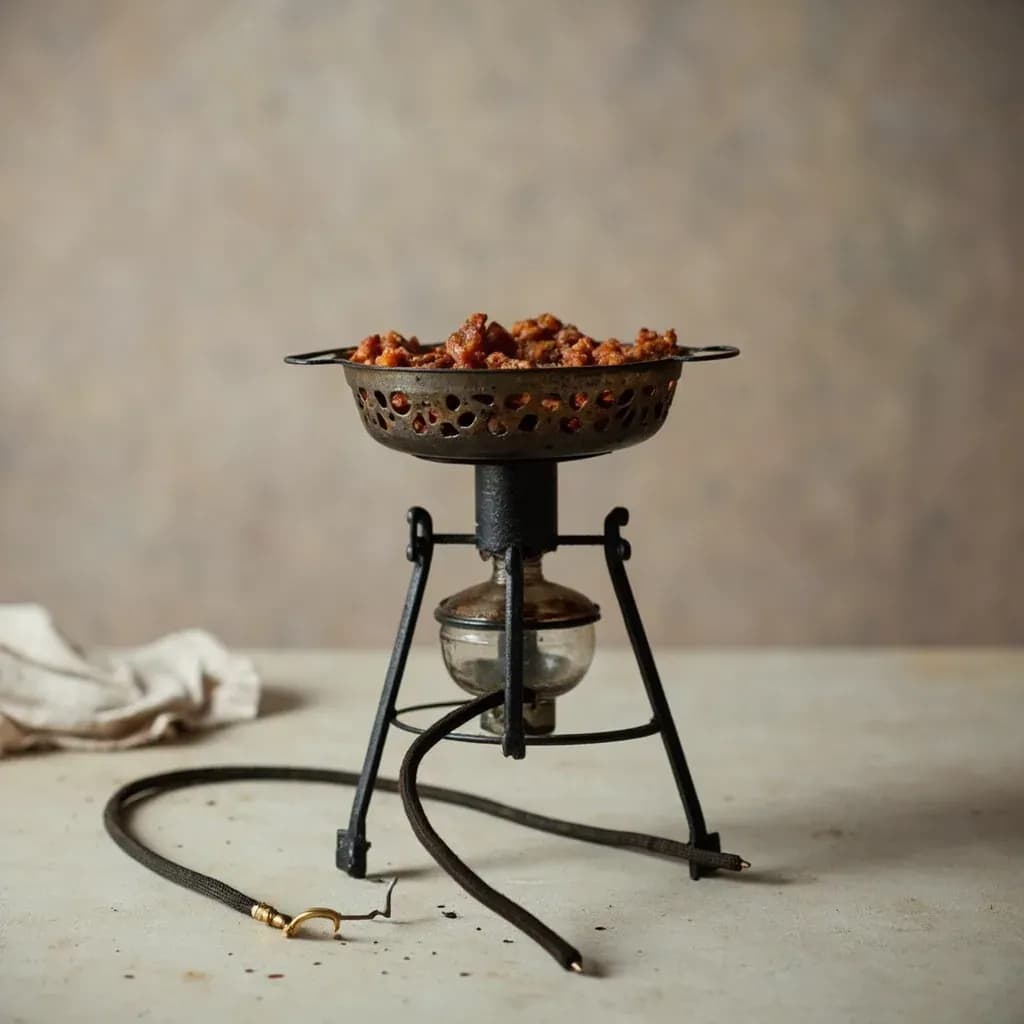
A high-BTU propane burner is a freestanding stand-mounted ring fed by a propane tank, putting out far more heat than a kitchen stove. Cooks use it outdoors for jobs that overwhelm an indoor range: frying turkeys, boiling crawfish or stockpots, and stir-frying in large woks. Portable two-burner camp versions of the same idea power outdoor and field kitchens.
A high-BTU propane outdoor burner is a standalone single- or double-burner cooking station, designed to run on liquid propane from a standard grill tank, that delivers heat output an indoor stove can only dream of — typically 50,000 to 200,000+ BTU/hr, sometimes more on commercial units. The defining trait is the high-pressure regulator (a 0–20 PSI adjustable or 10 PSI fixed unit) paired with a cast iron or stamped steel burner head that produces a focused ring of flame. That combination is what makes the category useful: a kitchen range tops out around 15,000–20,000 BTU per burner, which simply cannot bring a 60-quart pot to a rolling boil in reasonable time or recover oil temperature after a turkey goes in. With the right regulator and a cast head sized to the pot, an outdoor burner does in minutes what an indoor stove does poorly or not at all.
In practice the burner behaves like a small piece of restaurant equipment on legs. The cast head throws flame up the sides of the pot, the flame ring concentrates heat where it is needed, and the steel frame holds the pot stable at a comfortable working height. Output is governed largely by the regulator, not by the propane tank itself, which is why a burner connected to a 1 PSI BBQ regulator will run cool, yellow, and sooty even though the tank is full. The right regulator and a clean fuel line unlock the burner's rated output and a clean blue flame.
The category grew out of two traditions: the high-pressure wok burners used in Chinese restaurant kitchens, and the heavy cast jet burners that became standard in Louisiana crawfish and crab rigs from the 1970s–80s on. Today the same basic hardware shows up under crawfish pots, turkey fryers, homebrew kettles, and canning setups, with stands, heads, and pot supports tailored to each task.
Alternatives
Types & varieties
Most common type; one large cast burner head under a pot stand, 50,000–100,000 BTU; the workhorse for crawfish pots, turkey fryers, and canning
Multi-port cast head producing a focused ring of flame at 150,000–200,000+ BTU; built for homebrew boils and large stock pots
High-pressure burner with a 360° flame ring that engulfs a round-bottomed wok; outputs 100,000+ BTU and brings restaurant-style heat to outdoor stir-frying
Two-burner cabinet or stand unit; used for canning, fish fries, and any setup needing two pots at once
Compact burner paired with a 30 qt aluminum pot, basket, and lid, 50,000–60,000 BTU; the entry-level holiday setup
High-output jet or single-ring burner mounted to a stand sized for 60–80 qt round pots with strainer baskets
Jet burner on a tall stand, designed to slide under a 10–15 gallon boil kettle at proper working height
Matching BTU to pot size
The most common shopping mistake is buying a burner with far more — or far less — heat than the pot can use. A 60 qt crawfish pot under a 50,000 BTU burner will struggle to maintain a hard boil once it is loaded with cold shellfish and ice. A 30 qt turkey pot on a 200,000 BTU jet burner can scorch the oil, and the small pot exposes far more flame than is needed, which is wasteful and harsh on the burner head. A workable rule: target roughly 1,000–1,500 BTU per quart of pot capacity for boils, and somewhat less for frying, where the oil itself buffers temperature swings.
- 30 qt turkey or fish-fry pot: 50,000–60,000 BTU is plenty
- 40–60 qt crawfish or crab pot: 100,000+ BTU to maintain a hard boil
- 80–100+ qt stock pot or full crawfish rig: 150,000–200,000+ BTU jet burner
- For frying, more BTU is not always better — too much heat scorches oil and makes temperature control harder
The regulator: the most overlooked component
A propane burner is only as good as the regulator feeding it. A standard BBQ regulator delivers about 1 PSI, which is meant for low-pressure appliances like grill burners and is not enough to drive a high-BTU cast head. The result on a high-output burner is a lazy, yellow, sooty flame that smells of unburned propane and never reaches rated BTU. Most homebrew and crawfish burners ship with — or require — a 0–20 PSI adjustable or 10 PSI fixed high-pressure regulator, often with a separate high-pressure hose. Always check the listing: if it does not specify a high-pressure regulator, that is the first thing to add.
- High-pressure regulators: 0–20 PSI adjustable (preferred for control) or 10 PSI fixed
- Standard BBQ regulators (~1 PSI) will choke high-BTU burners
- Use a dedicated high-pressure hose rated for the regulator's output
- Check connections with soapy water for bubbles before each lighting
Safety geometry: oil, pot, and surface
The most common outdoor frying accident is a pot of oil that boils over, tips, or catches fire. Three rules prevent nearly all of them. First, the pot is never more than half full of oil — a 30 qt pot at half full holds about 3.5–4 gallons of oil (since 30 qt is 7.5 gallons total), enough to submerge a 12–14 lb turkey. Second, the burner stands on level, non-combustible ground (concrete, brick, bare soil) with at least 10 feet of clearance from structures; a wood deck is unacceptable. Third, the food goes in slowly. Cold or wet food, especially a not-fully-thawed turkey, causes the violent oil eruptions that lead to flash fires.
- Half-fill the pot with oil, no more
- Level, non-combustible surface only — never a wood deck
- Thaw turkey 24–48 hours in the fridge and pat dry before frying
- Lower the bird in 2–3 inch increments, not all at once
- Keep a metal lid and a Class K or ABC dry-chemical extinguisher within reach
Common uses
Tips & pitfalls
- Use only outdoors in open air — these burners produce large volumes of CO and unburned gas; never run in a garage, shed, or under a canopy without ventilation.
- Always pair the burner with a high-pressure (0–20 PSI adjustable or 10 PSI fixed) regulator; a standard 1 PSI BBQ regulator chokes output and causes incomplete combustion with a yellow, sooty flame.
- Set the burner on a flat, non-combustible surface — concrete, brick, or bare soil — and never on a wood deck; a tipped pot of 350°F oil is the most common cause of outdoor frying fires.
- Thaw and dry a turkey completely (24–48 hours refrigerated, patted dry) before frying; ice or water inside the cavity causes explosive oil eruptions.
- Lower food into hot oil slowly and in small increments; for turkey, dunk in stages of 2–3 inches to avoid boilover and overflow fires.
- Check all connections with a soapy-water spray before lighting; rising bubbles mean a propane leak — fix it before igniting.
- Use a clip-on deep-fry or infrared thermometer on the pot; oil temperature drops sharply when cold food goes in, and a high-BTU burner is what lets you recover quickly.
- For 100+ qt boils, run on a 100 lb propane tank instead of a 20 lb tank to avoid running out or freezing the regulator mid-boil.
Good to know
- Typical BTU range
- 50,000–200,000+ BTU/hr; homebrewing burners sit near 50,000–100,000, while jet and commercial outdoor units reach 150,000–200,000+
- Fuel
- Liquid propane (LP) from a standard 20 lb BBQ tank; 100 lb tanks are preferred for long boils and 100+ qt pots
- Regulator pressure
- Requires a high-pressure regulator (0–20 PSI adjustable or 10 PSI fixed); a standard 1 PSI BBQ regulator chokes output and produces a yellow, sooty flame
- Pot capacity
- Comfortably supports 30–80 qt pots; jet burners handle 100+ qt stock pots and full 80 qt crawfish rigs
- Runtime on 20 lb tank
- Roughly 2–3 hours at 100,000 BTU/hr, depending on heat setting and ambient temperature
- Ignition
- Manual match-light or piezo igniter; no electrical hookup required
- Clearance
- NFPA recommends at least 10 ft from structures, on level non-combustible ground; never on a wood deck
- Cost range
- Roughly $50–$200 for typical single burners; jet, wok, and commercial-grade units run $200–$600+
Also called
Two-Burner Propane Camp Stove · Outdoor Propane Burner · Fogon · Outdoor Burner · Turkey Fryer Burner
Related

Stovetop
The everyday burners where most cooking actually happens

Oven
Enclosed dry heat for roasting, baking, and braising

Grill
Live-fire or gas grates for char, smoke, and high heat

Smoker
Low, slow heat and wood smoke for barbecue and brisket

Air Fryer
Countertop convection that crisps with little or no oil

Slow Cooker
Set-and-forget low heat for stews, beans, and braises

Pressure Cooker
Sealed steam pressure that cooks tough food in a fraction of the time

Rice Cooker
Foolproof, perfectly steamed rice every single time