Appliances & Heat
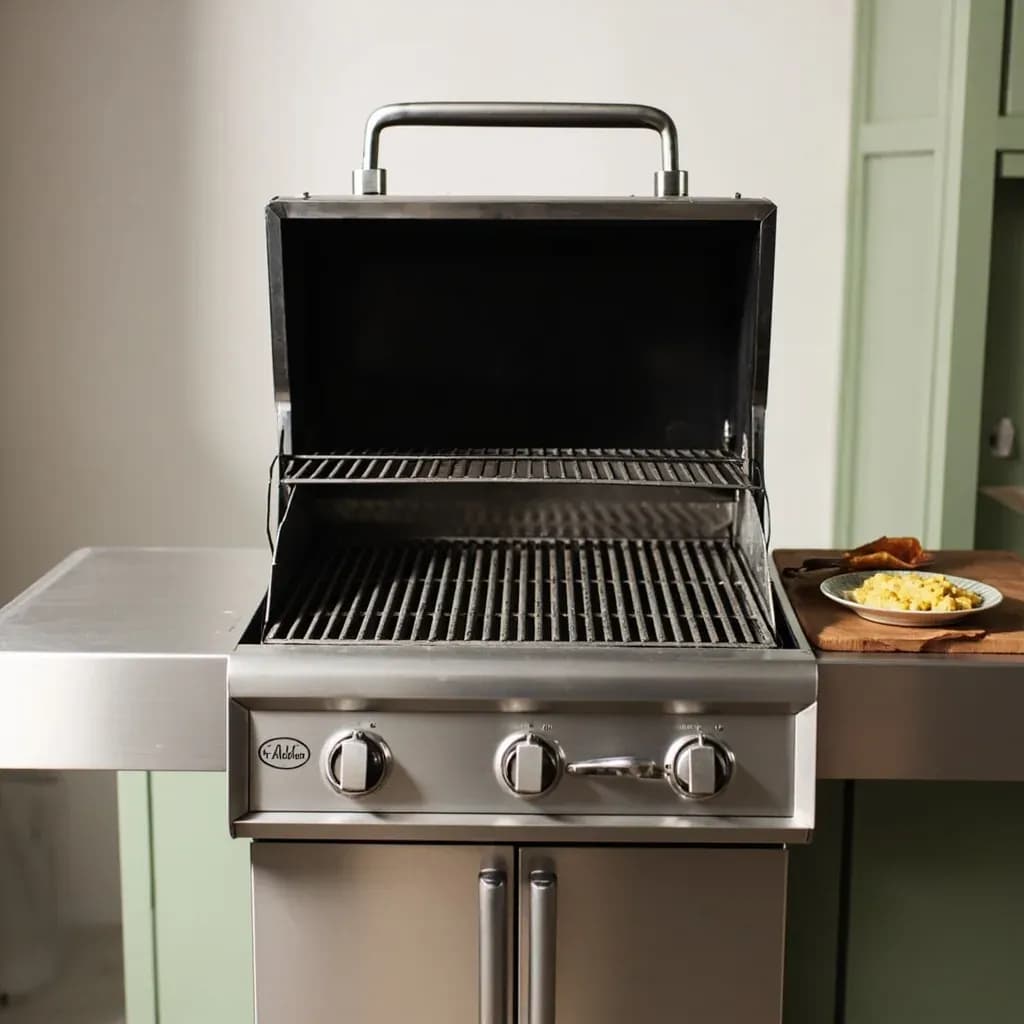
Propane Gas Grill
An outdoor grill fueled by a propane tank for fast, dial-controlled barbecuing.
A propane gas grill burns bottled LPG through tubular burners under cooking grates and flavor bars, lighting instantly and reaching grilling heat in minutes. Cooks dial each burner for direct searing or two-zone indirect cooking, making it the convenient backyard standard. It trades some of the smoky depth of charcoal for speed and easy temperature control.
A propane gas grill is an outdoor cooker that draws vaporized liquefied petroleum gas from a pressurized steel tank, drops it through a regulator to a steady ~11 inches of water column, and feeds it through control valves to a row of tube, ribbon, cast, or infrared burners beneath the cooking grates. Turning a knob opens the gas valve; the propane pulls air through a venturi, mixes, and ignites at the burner port via a piezo spark, battery electronic igniter, or standing pilot. Heat tents (also called flavorizer bars or vaporizer plates) sit above the burners to spread heat, shield the burners from drippings, and vaporize falling fat into a thin smoke that seasons the food. A hood with adjustable vents turns the unit into a small convection oven, which is what makes a gas grill far more than a hot grate over an open flame.
Gas grills became a domestic fixture in the United States from the 1960s onward, after Don McGlaughlin of Chicago built the first portable patio grill in 1954. By the 2000s, infrared burners, sear stations, rotisserie kits, side burners, and integrated smoker boxes had become standard options. A typical home grill totals 20,000–60,000 BTU across two to five main burners, runs on a 20 lb (≈4.7 gal) refillable tank good for roughly 18–20 hours of cooking, and can hold 500–700 °F at the grates after a proper preheat. Flat-top and hybrid models blur the line with griddles and charcoal cookers.
The appeal is dial-controlled, repeatable heat and clean operation: no ash, no lighter fluid, and fast startup compared with charcoal. The trade-off is a thinner smoke profile than charcoal or wood; a smoker box of dry wood chips and a two-zone indirect setup close most of that gap. Routine care — brushing hot grates, emptying the grease tray, covering the hood, and inspecting the hose and regulator — keeps a quality unit running for 10+ years. Safety hinges on leak-free connections, an upright tank stored outdoors, and never operating the grill in an enclosed or partially enclosed space.
Alternatives
Types & varieties
Single- or twin-burner units running on 1 lb camping cylinders; favored for tailgating, RVs, and small patios
Two to six main burners on a wheeled cart with side shelves and a hood; the most common residential format
Insulated heads designed for masonry or modular outdoor-kitchen islands
Burner fires a ceramic or metal emitter plate that radiates intense radiant heat (surface temperatures up to ~1,000 °F) for very fast searing
Gas burners alongside a charcoal tray or wood drawer so the cook can mix live-fire flavor with dial control
Solid steel or cast-iron plate instead of grates; aimed at breakfast, smash burgers, and fajitas
Park-style or pub-style single-burner heads on a post, often with a hinged grate
Core components
- Propane tank: 20 lb residential or 1 lb portable, upright and properly secured
- Regulator: drops tank pressure to a steady ~11" water column
- Manifold and control valves: one knob per burner, plus optional side burner
- Burners: stainless or aluminized tubes, cast iron, or infrared emitter plates
- Heat tents / flavorizer bars: diffuse flame, protect burners, and vaporize drippings for smoke flavor
- Cooking grates: cast iron, porcelain-enameled cast iron or steel, or stainless steel rods
- Hood with vent(s): enables convection cooking and indirect roasting
- Ignition: piezo spark, battery electronic, or continuous pilot
- Drip pan and grease tray: slide beneath the firebox to catch ash and fat
- Warming rack: upper level for toasting buns or holding cooked food
Setting up two heat zones
The single most useful gas-grill technique. On a three- or four-burner grill, ignite the outer burners only and leave the center off; on a two-burner, ignite one side. Food sears over the lit burners, then finishes, roasts, or smokes over the dead zone. This setup prevents flare-ups on fatty cuts and gives the grill a built-in oven for whole birds, ribs, or a pan of vegetables.
- High direct zone: 500–700 °F for steaks, chops, and smash burgers
- Medium direct zone: 350–450 °F for chicken pieces, sausages, and vegetables
- Indirect zone (burners off): 250–350 °F for whole chickens, pork shoulders, and low-and-slow smoking
Fuel and BTU basics
BTU ratings describe gas input, not cooking performance. A grill with modest total BTU but well-designed burners, good heat retention, and a tight lid will outperform a high-BTU grill that bleeds heat through thin steel. As a rough rule, home grills under 25,000 BTU cook adequately for a family; 35,000–50,000 BTU handles larger gatherings. An infrared side burner or sear station adds usable high heat without overwhelming the main grates, and a 20 lb tank (≈17 lb empty tare weight) with only a few pounds of fuel left will still run a three-burner grill on medium for a long afternoon.
- Per-burner output of 8,000–12,000 BTU covers most direct-grilling jobs
- Thin steel hoods lose heat fast; double-walled lids hold 500 °F+ with the burners on medium
- Wind cuts effective output dramatically; orient the hood to block prevailing wind
Cleaning and care rhythm
- After every cook: brush grates while still hot and empty the grease tray
- Monthly: remove grates and heat tents, brush the firebox, and clear burner ports with a stiff wire
- Twice a year: deep-clean burners, inspect the hose and regulator for cracks, and test igniter batteries
- Replace flavorizer bars when they corrode through and grates when porcelain chips badly
- Cover the grill once it is cool and dry; crack a vent to prevent trapped moisture
Troubleshooting quick reference
- Burner won't light: confirm the tank valve is open, listen for hiss at the burner, and check igniter spark and gap
- Yellow or lazy flame: clogged burner ports — shut off gas, let cool, and clean the ports with a wire
- Flame at the control panel or regulator: shut off the tank immediately, do not use, and replace the regulator and hose
- Popping or regulator frosting: reduce demand by running fewer burners on high, and let the regulator warm
- Hot spots on the grates: rotate food or replace heat tents that have warped or rusted out
Common uses
Tips & pitfalls
- Always preheat with the lid closed for a full 10–15 minutes so the grates and hood store heat; food sears instead of steaming on a cold grate
- Oil the food rather than the grates, and never spray aerosol oil near an open flame; if you oil the grates, use a folded paper towel gripped with long tongs
- Brush the grates with a wire brush right after preheat and again at the end of the cook, while the grill is still hot, to lift carbonized residue
- Keep the lid closed as much as possible; the grill works as a small convection oven and runs hotter and more evenly than with the lid up
- Use an instant-read or leave-in probe thermometer — grill times swing wildly with wind, ambient temperature, and fuel level, and visual cues on a gas grill are less reliable than on charcoal
- Avoid the classic burger mistakes: do not press with the spatula (it squeezes out fat and causes flare-ups), do not flip more than once, and let patties rest 3–5 minutes
- Turn the tank valve off first, then the burner knobs, so residual gas in the line burns out; this preserves the regulator and prevents leaks on the next start
- Check the tank level by weight on a bathroom scale after taring the tank; a standard 20 lb tank weighs about 17 lb empty, so the difference is fuel remaining
- Never store a spare propane tank indoors or in a closed vehicle, and keep tanks upright and out of direct summer sun
- If the regulator ices up in cold weather, close the tank, wait for it to thaw, and reduce burner demand — it is a symptom of gas cooling as it expands, not low fuel
- Replace the LP hose every 5–7 years, or sooner if you see cracking, and run a soap-bubble leak test on every fitting once a year
- Never use a propane grill under an overhang, in a garage, or in any enclosed space — carbon monoxide builds fast and fire risk is real
Good to know
- Fuel
- Liquefied petroleum gas (LPG), primarily propane, stored under pressure in a refillable tank
- Standard residential tank
- 20 lb (≈4.7 gal / ≈17.8 L) DOT-approved steel cylinder, used upright
- BTU range
- ≈20,000–60,000+ total for home models; individual tube burners typically 8,000–12,000 BTU
- Operating pressure
- ~11 inches water column (≈0.4 psi) after the regulator
- Cook time per 20 lb tank
- Roughly 18–20 hours of actual burn time, depending on burner setting and weather
- Pre-heat time
- 10–15 minutes with the lid closed to bring grates to 500–700 °F
- Achievable cooking temperatures
- ~250 °F on indirect low up to ~700 °F+ on infrared-equipped models
- Origin
- Portable propane grill credited to Don McGlaughlin, Chicago, 1954; domestic boom from the 1960s
- Key safety standard
- UL 21 in the US / CSA 4.1 in Canada for LP-gas hose assemblies; tanks require an OPD (overfill protection device) since 1998
Also called
Outdoor Gas Grill · Gas BBQ · Propane Grill
Related

Stovetop
The everyday burners where most cooking actually happens

Oven
Enclosed dry heat for roasting, baking, and braising

Grill
Live-fire or gas grates for char, smoke, and high heat

Smoker
Low, slow heat and wood smoke for barbecue and brisket

Air Fryer
Countertop convection that crisps with little or no oil

Slow Cooker
Set-and-forget low heat for stews, beans, and braises

Pressure Cooker
Sealed steam pressure that cooks tough food in a fraction of the time

Rice Cooker
Foolproof, perfectly steamed rice every single time