Appliances & Heat
Sandwich Maker (Tosti-ijzer)
An electric press that toasts and seals filled sandwiches between hot plates.
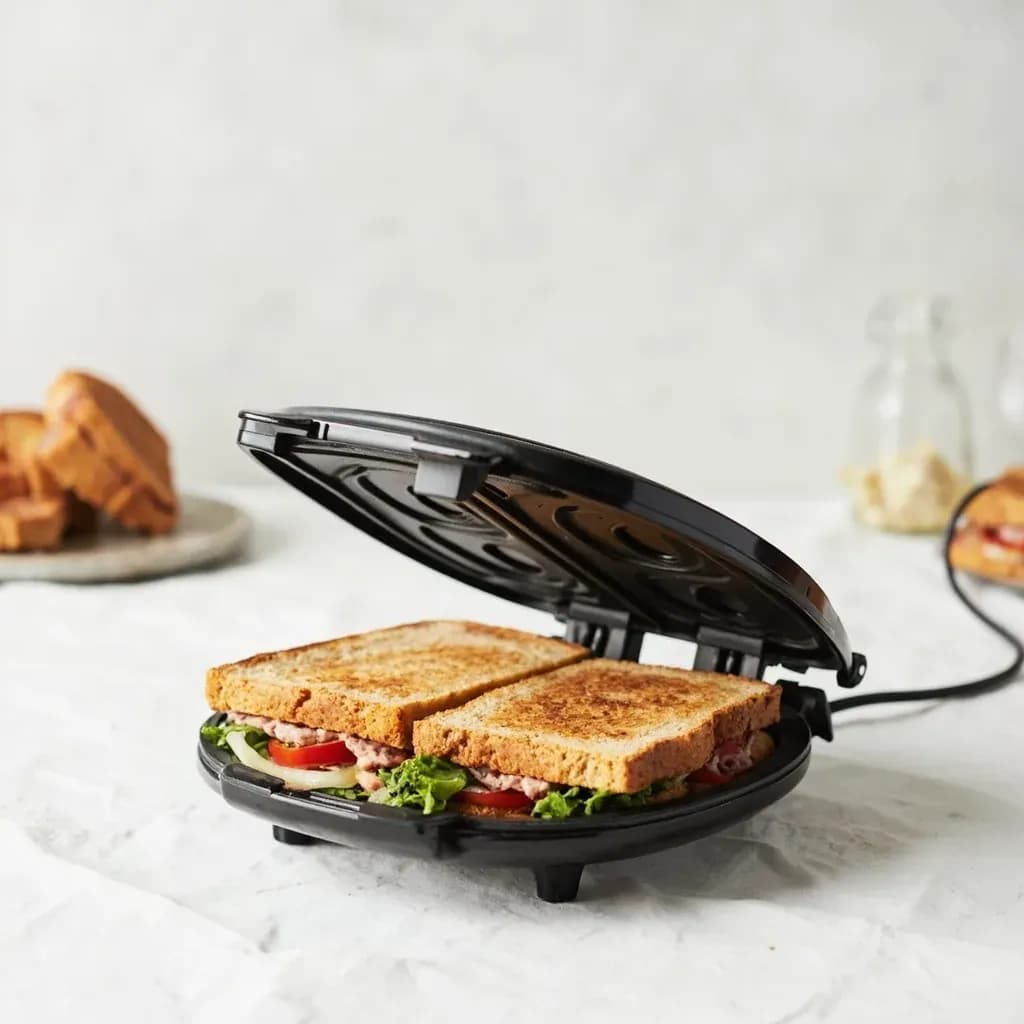
A sandwich maker is a countertop electric appliance with two hinged heated plates that toast and press a filled sandwich, melting the cheese and crisping the bread. The Dutch tosti-ijzer makes the classic ham-and-cheese tosti. Triangular or grooved plates seal the edges and create the familiar pressed pockets.
A sandwich maker is a small countertop electric appliance built around two heated, non-stick plates joined by a hinge. When the lid closes, the plates press and toast the outer surfaces of two slices of bread while the heat melts whatever sits between them, and a raised rim around the plates both seals the edge and cuts the finished sandwich into triangles or rectangles. The device is a single-purpose descendant of the waffle iron, engineered to do one job very well: produce a sealed, golden, evenly melted toasted sandwich in roughly four minutes, with no pan to tend and no flipping required.
The appliance takes its most evocative name from the Dutch tosti, the simple ham-and-cheese toasted sandwich that is a quick everyday lunch in the Netherlands and Belgium, and which gave the tosti-ijzer its identity. Electric versions spread into homes from the 1970s onward, and the basic 750–900 watt, two-triangle, fixed-plate model remains the format most cooks picture. The meaningful modern variations are deeper plates for thicker fillings, removable plates for easier cleaning, and ceramic coatings as an alternative to the original PTFE non-stick finish.
In practice, the sandwich maker behaves less like a griddle and more like a stamping tool: it browns, it seals, it cuts, and it largely takes the guesswork out of melted-cheese sandwiches. The trade-off is capacity and versatility; for anything that needs an open, ridged sear or a wider cooking surface, a panini press or contact grill is the better tool, and for campfire cooking the manual cast-iron pie iron fills the same niche by a different route.
Alternatives
Types & varieties
The classic two-triangle cut; the most common consumer format worldwide and the default 'tosti' shape.
Larger plates for thicker, more generously stuffed sandwiches; usually rectangular and the most versatile home format.
Produces a sealed pillow or pocket; useful for fruit pies, calzone-style fillings, and sweet toasties.
Cast-iron long-handled version for campfires and stovetops; not electric, and not interchangeable with the plug-in appliance.
Related appliance with ridged, open-faced plates; toasts and grills but does not seal or cut the sandwich.
Larger hinged electric grill that opens flat and doubles as a griddle; the roomier sibling of the basic sandwich maker.
Layered appliance with a central ring for a cooked egg and stacked toasting rings for English muffins, cheese, and meat.
Plates detach for hand-washing or dishwasher cleaning; usually a modest step up in price and well worth it for regular cooks.
PTFE-free non-stick surface marketed as a healthier alternative; performance is similar to PTFE but the coating is more vulnerable to mechanical damage.
Choosing the Right Model
For most home cooks, the first decision is capacity and cut. A standard 2-triangle machine is cheap, compact, and perfect for a single serving, but it forces modest fillings and produces small finished sandwiches. A 4-slice deep-fill or rectangular model costs only a little more, accepts thicker bread and generous fillings, and is the better choice for families or for anyone who treats the appliance as a regular lunch tool. Above that sits the contact grill, which is a true multi-tasker: it makes a fine toastie, but also handles chicken breasts, vegetables, and open-faced melts, at the cost of a larger footprint and a higher price.
- Fixed plates are lighter and cheaper; removable plates make cleaning faster and extend the life of the non-stick coating.
- Ceramic coatings perform like PTFE but scratch more easily and are not meaningfully 'healthier' in normal home use.
- A clip-lock lid is convenient for upright storage but can over-press delicate fillings; many cooks disable the clip or press lightly.
- Cord exit on the side (not the back) lets the unit stand upright for storage, which is the standard way to keep it on a small counter or in a cupboard.
Care and Maintenance
The non-stick coating is the part that fails first, and it fails predictably: high heat, metal utensils, the dishwasher, and abrasive sponges will all shorten its life. Most fixed-plate machines can be kept going for years by wiping the warm plates with a damp paper towel, drying them, and storing the unit upright so the coating is not pressed against anything. Removable-plate models can be hand-washed in warm soapy water and, on those rated for it, run through the dishwasher on the top rack.
- Never submerge the main unit or let water reach the heating element; wipe the exterior with a barely damp cloth.
- Use only wooden, silicone, or plastic utensils on the plates.
- If the non-stick coating is worn, lay a slice of cheese against the bread or use a small piece of parchment paper as a barrier.
- Store only when fully cool, ideally upright with the lid closed, to protect the coating and save space.
Common uses
Tips & pitfalls
- Always preheat until the green 'ready' light comes on; a cold start yields pale, dry sandwiches and a poor seal.
- Butter or oil the outside of the bread, never the inside — the bread itself is the cooking surface, not the plate.
- Use day-old, sliced sandwich bread; very fresh bread compresses under the lid and squeezes the filling out the edges.
- Avoid high-moisture cheeses such as fresh mozzarella, feta, and buffalo mozzarella; low-moisture cheddar, Gouda, Emmental, or pre-sliced melting cheese seal more cleanly.
- Do not force the lid down over an overfilled sandwich — let the lid rest on top and let the steam do the work for the first 30 seconds, then close gently.
- Press lightly or disable the clip-lock: most sandwiches do not need the full weight of the lid to brown and seal properly.
- Keep fillings to roughly 2 tablespoons per triangle; a modest amount toasts more evenly and seals better than a generous mound.
- Add wet ingredients (pickles, tomato slices, chutney) between drier layers like cheese or meat to limit leakage onto the plates.
- Wipe plates with a damp paper towel while still warm; never submerge the unit or let water near the heating element.
Good to know
- Also known as
- Toastie maker (UK), jaffle maker (Australia), tosti-ijzer (Netherlands), sandwich toaster, sandwich press
- Typical power
- 700–1,400 W; most household models 750–900 W
- Plate temperature
- Approximately 200 °C / 390 °F, fixed on most basic models
- Preheat time
- 3–5 minutes from cold
- Cook time per sandwich
- 3–5 minutes
- Capacity
- Most commonly 2 sandwiches; 1-, 4-, and 6-slot deep-fill models also exist
- Cut shape
- Triangular (classic) or rectangular; some models accept both
- Origin
- Electric version descended from the waffle iron; mass-market home models spread from the 1970s onward
Also called
Tosti-ijzer · toastie maker · sandwich press
Related

Stovetop
The everyday burners where most cooking actually happens

Oven
Enclosed dry heat for roasting, baking, and braising

Grill
Live-fire or gas grates for char, smoke, and high heat

Smoker
Low, slow heat and wood smoke for barbecue and brisket

Air Fryer
Countertop convection that crisps with little or no oil

Slow Cooker
Set-and-forget low heat for stews, beans, and braises

Pressure Cooker
Sealed steam pressure that cooks tough food in a fraction of the time

Rice Cooker
Foolproof, perfectly steamed rice every single time