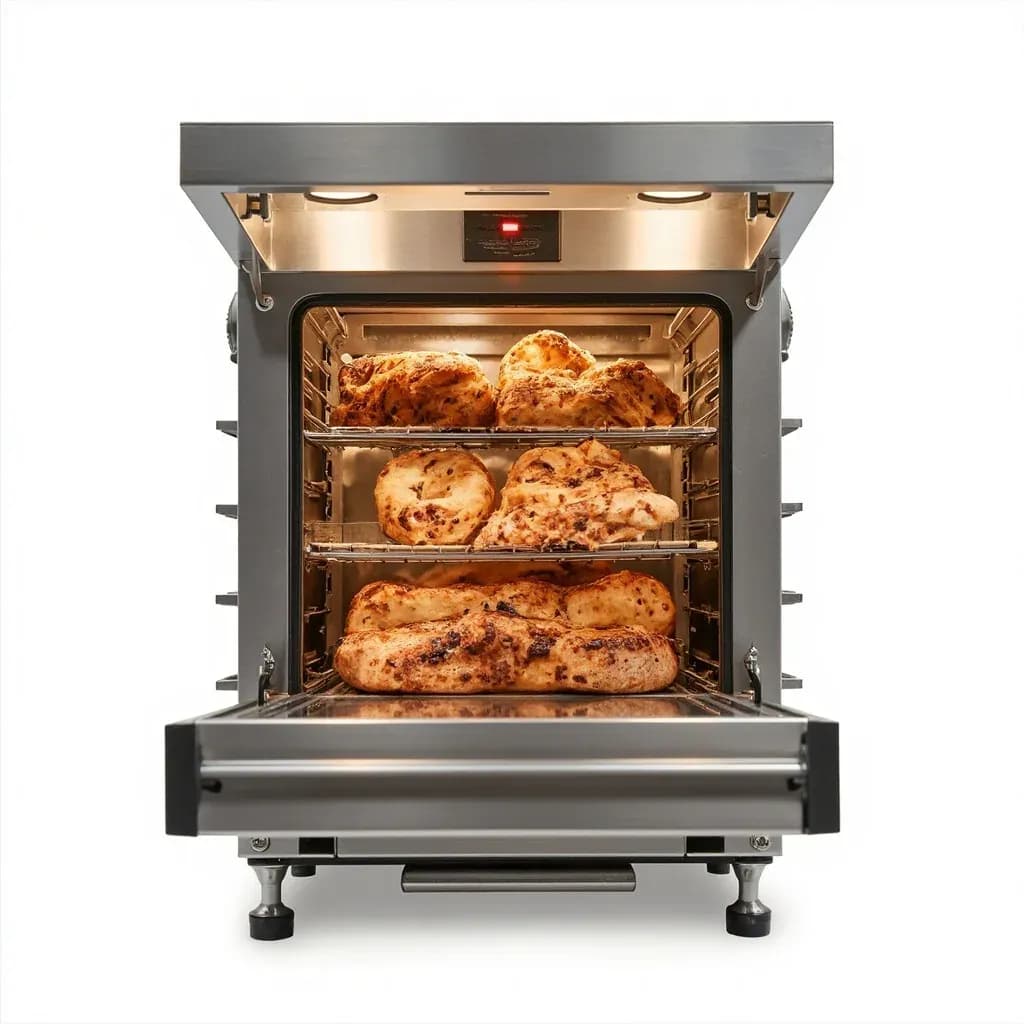
Appliances & Heat
Steam-Injection Oven
Oven that injects steam during baking for crackly bread crusts and moist results.
A steam-injection oven sprays controlled bursts of steam into the chamber during baking, keeping the dough surface moist so it expands fully before setting into a crisp, glossy crust. It's essential for artisan breads like baguettes and sourdough, and helps roasts and pastries stay tender. Professional and high-end home ovens build this in; bakers otherwise improvise with pans of water or ice.
A steam-injection oven is a heated cabinet fitted with a built-in water-supply system that releases steam into the cavity at programmed moments during cooking. The injection can be a timed burst at the start of a bake — as in most bakery deck and rack ovens — or a continuously variable humidity target from 0% to 100%, as in a combi-steamer. The defining parts are a sealed cabinet, a source of pressurized or flash-heated water, and a distribution system — perforated pipes, nozzles, or a fan-assisted humidifier — that fills the cavity with water vapor on demand.
The reason this matters is physics. Water vapor in a hot cavity keeps the surface of food wet and pliable long after the interior has begun to set. For bread, that means the dough can continue rising into the first 10–20 minutes of the bake — the window bakers call oven spring — instead of forming a dry skin that cracks open and arrests the rise. For meats, vegetables, and custards, it means surfaces stay moist rather than toughening under radiant heat. Once the steam is vented and the dry phase resumes, surface temperature climbs past the point where starches gelatinize and Maillard reactions can run, producing the glossy, crackling crust or the deep, even browning the oven is chosen for.
In practice, a steam-injection oven behaves like two tools in one cabinet: a dry convection oven and a steamer, with a continuous range of humidities between them. That range is what separates a true combi from a basic on/off steam-injection convection oven, and it shapes almost every cooking decision inside the cabinet — when to inject, when to vent, when to switch modes mid-cook.
Alternatives
Types & varieties
Switches between dry convection, pure steam, and combination modes with programmable humidity 0–100%; the most versatile format and the standard in pro kitchens today.
Traditional bakery deck oven with a perforated steam-header pipe across the front of the deck; the workhorse for baguettes, sourdough, and hearth breads.
Large rotary or stationary rack oven for high-volume wholesale bakeries; injects steam to bake full racks of bread or rolls in a single load.
Boiler models generate dense saturated steam in a separate chamber; boilerless models flash water onto a hot element — lighter steam, less scale, simpler maintenance, lower cost.
Small electric units (typically 3–7 pan) for restaurants, R&D kitchens, and pastry shops; widely used for sous-vide-style cooking and finishing.
Standard convection oven with on/off steam injection; cheaper than a true combi, no humidity targeting, common in smaller bakeries.
Two tool families, one cabinet
Steam-injection ovens are often discussed as a single category, but they really span two distinct product lines. Steam-assisted bakery ovens — the deck and rack formats — exist primarily to deliver a timed burst of humidity at the start of a bake; humidity control is essentially binary, on or off, and the rest of the cook runs in dry heat. Combi steamers and combi ovens are general-purpose cooking tools that can hold any humidity level from 0% to 100% across the entire cook and are used for everything from bread to custard to roast chicken.
The same physical principle drives both: water vapor in the cavity keeps food surfaces wet and pliable, delaying crust formation, preventing surface drying, and (for bread) enabling the final rise known as oven spring. The difference is precision. A deck oven asks when to inject and when to vent; a combi asks what humidity to hold at every minute of the recipe. When specifying or buying, the most consequential choices are boiler versus boilerless steam generation, true combi versus on/off steam injection, and water treatment — these drive both steam quality and lifetime maintenance cost far more than brand.
How steam behaves in the oven
A few principles govern what steam actually does once it is in the cabinet:
- Condensation is the engine. Saturated steam at 100°C carries roughly 2,260 kJ/kg of latent heat, and the moment steam touches a cooler food surface it releases that heat directly into the food — the same mechanism that makes a stovetop steamer work.
- Humidity, not just temperature, controls browning. When the dough or food surface stays wet, Maillard reactions and caramelization cannot run; that is why bakers vent steam partway through a bake and why combi cooks add a dry finishing phase for color.
- Boiler steam is denser. Boiler-generated saturated steam carries more moisture per cubic meter than the lighter flash-steam of boilerless units, which matters for crusty breads and is less critical for general cooking.
Boiler vs. boilerless
The choice between a true boiler and a direct-injection (boilerless) system shapes both cooking results and ownership cost.
- Boiler systems hold water in a heated reservoir and release steam on demand. The steam is denser, more saturated, and better for high-gluten hearth breads and traditional baguette work. They also accumulate scale faster and need regular descaling.
- Boilerless systems drip or spray water onto a hot plate inside the cavity, generating steam on the fly. Steam is lighter and slightly less saturated, but the units are cheaper, lighter, scale-resistant, and recover faster between loads. They dominate the countertop combi market.
- Water quality is the deciding factor in either case. Hard water shortens generator life, clogs injectors, and leaves mineral deposits on stainless interiors. A plumbed water softener or filtration system is essentially mandatory in a working kitchen.
Common uses
Tips & pitfalls
- Inject steam only during the first 10–20 minutes of a bread bake, then vent; leaving steam on too long yields a gummy, under-set crust that never dries and cracks properly.
- Do not open the door during the steam phase. Every opening vents the humid microclimate that drives oven spring and you will end up with a duller, thicker crust.
- Preheat the deck or stone fully before loading bread. Steam condenses on cold surfaces and drips back onto the dough, dulling the crust and slowing spring.
- For maximum crust crackle on hearth breads, give a hard steam burst at loading, then drop the injection as soon as the loaf has set its shape and the surface is matte.
- In pure-steam mode the oven will not brown. Plan a dry-heat finishing phase for roasts, vegetables, and any item where color matters.
- Disable the steam injection when baking dry items such as cookies, shortbread, or biscuits; otherwise the tops will stay soft and pale.
- Use filtered or softened water and follow the manufacturer's descaling schedule. Limescale is the single most common cause of injector and boiler failure.
- Clean door gaskets and drain lines regularly. Trapped condensation and food debris cause steam leaks, uneven humidity, and flavor carryover between cooks.
- A heavy covered Dutch oven at home replicates a small version of this effect — trapped dough moisture does the same job for a single loaf, which is why the technique works in a home kitchen.
Good to know
- Type
- Commercial/professional oven with an integrated steam generator and injection system
- Steam source
- Internal electric or gas-fired boiler, or boilerless direct-injection onto a heated plate
- Common configurations
- Combi (steam + convection), deck oven, rack oven, countertop combi steamer
- Temperature range
- Typically 80–300°C / 175–575°F depending on model
- Water supply
- Plumbed; manufacturers specify filtered or softened water to limit limescale
- Why steam works in bread
- Steam keeps the dough surface pliable during oven spring; once vented, surface starches gelatinize and Maillard reactions form a thin, glossy crust
- Capacity
- From 3–6 pan countertop units to 40+ rack roll-in bakery ovens
- Maintenance hotspot
- Limescale buildup in the steam generator and injector nozzles is the most common service issue
- Development
- Steam-injected deck and rack ovens have been used in European bakeries for decades; combi steamers were commercialized from the 1970s onward
Also called
Combi Steam Oven · Steam Oven
Related

Stovetop
The everyday burners where most cooking actually happens

Oven
Enclosed dry heat for roasting, baking, and braising

Grill
Live-fire or gas grates for char, smoke, and high heat

Smoker
Low, slow heat and wood smoke for barbecue and brisket

Air Fryer
Countertop convection that crisps with little or no oil

Slow Cooker
Set-and-forget low heat for stews, beans, and braises

Pressure Cooker
Sealed steam pressure that cooks tough food in a fraction of the time

Rice Cooker
Foolproof, perfectly steamed rice every single time