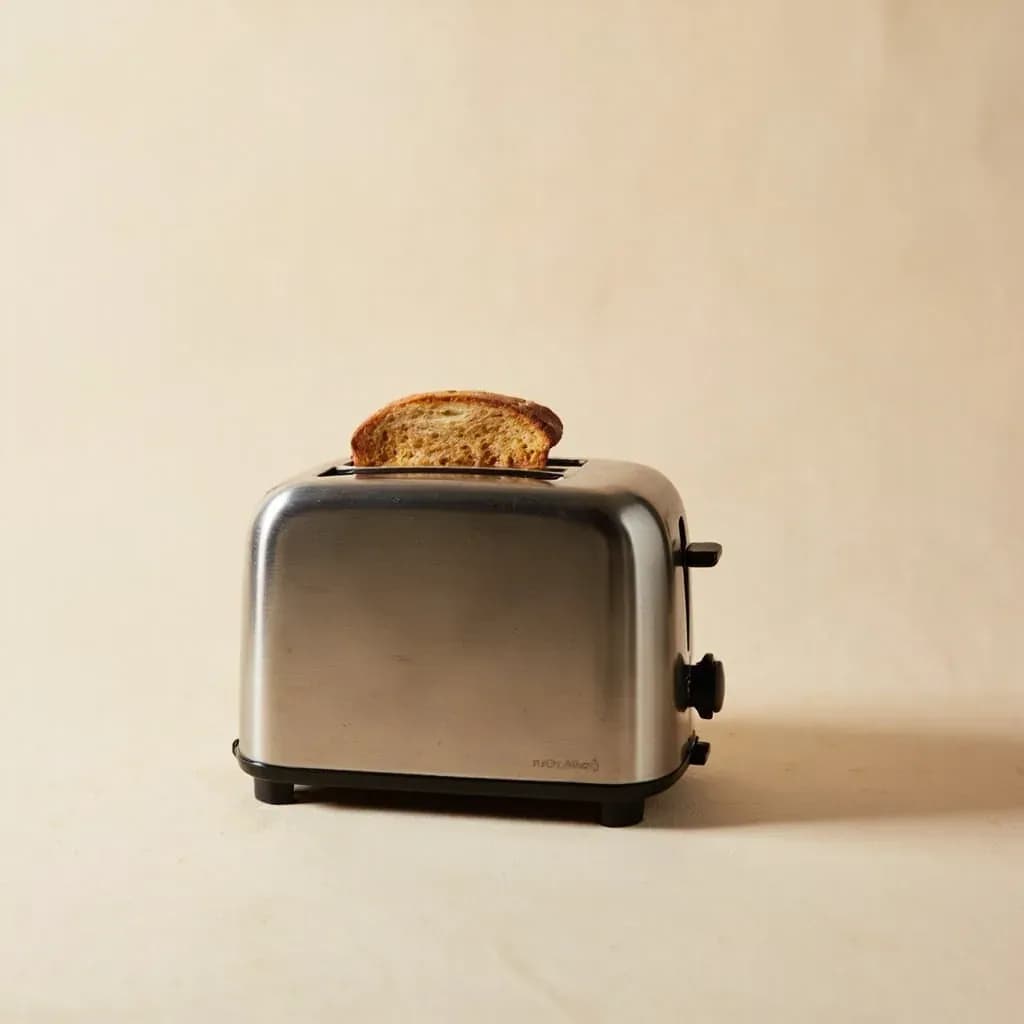
Appliances & Heat
Toaster
A countertop appliance that browns and crisps bread slices with radiant heat.
A toaster is a small electric appliance that toasts bread, bagels, and similar items by passing radiant heat from glowing elements over them in slotted bays. It is a staple breakfast tool with adjustable browning levels and often dedicated bagel or defrost settings. Toaster-oven variants add a small open chamber that can also bake, broil, and reheat beyond just toasting.
A toaster is a small electric appliance built around one job: delivering fast, even radiant heat to the surface of bread and similar flat foods so that they brown, crisp, and dry out in one to three minutes. Inside, thin loops of nichrome resistance wire glow at roughly 500–600 °F, mounted on mica cards that radiate heat sideways into the slot. A thermostat or electronic timer cycles the elements on and off to hit a target color, and a spring-loaded carriage ejects the slice when the cycle ends.
For a cook, the toaster is best understood as a dedicated surface-dehydration and Maillard tool, not a one-trick breakfast gadget. That framing explains why it excels on crumpets, split English muffins, and halved buns — foods that need a crisp, hot face while staying tender inside — and why a single long cycle on dense rye or frozen bread often disappoints: the outside scorches before the moisture inside has time to equalize.
The key distinction worth keeping in mind is between a pop-up toaster — fast, consistent, and limited to uniform slices — and a toaster oven, which trades speed for versatility (open-faced melts, small bakes, reheating). That design difference also explains most toaster-safety guidance: the same 500–600 °F elements that crisp bread will ignite crumbs and fats in seconds.
Alternatives
Types & varieties
The standard countertop appliance with vertical slots and a spring-loaded carriage; 2- or 4-slot domestic models
Small countertop oven with built-in toasting element; handles toast, bake, broil, and reheat; air-fryer toaster ovens now common
Commercial unit that moves bread on a belt through infrared or radiant elements; used in diners, hotels, and high-volume kitchens
Open-sided horizontal heating chamber (e.g., Breville Lift & Look); better for sourdough, crumpets, and irregular shapes
Single long slot per pair; fits artisan loaves, halved baguettes, and long English muffins
Free-standing open-side toaster such as the Dualit Classic; one- or two-sided heating for crumpets, buns, and muffins
Wire or metal rack held over a burner or flame; pre-electric and still used in camping and some traditional kitchens
Chrome-plated Popmaster, Sunbeam T-20, and similar; collectible, often restored for style rather than daily use
Matching toaster to task
The right toaster depends on what you actually toast most, because each format solves a different problem. The bagel, defrost, and reheat buttons are not gimmicks — each addresses a real thermal issue with how heat moves through bread.
- For uniform sandwich bread and bagels: a 2- or 4-slot pop-up is fastest and gives the most even color, since radiant heat strikes both faces at once.
- For artisan loaves, sourdough, crumpets, and anything over about 1.25 in thick: a flatbed or long-slot model lets you watch and adjust without jamming the carriage.
- For households that also want to melt cheese, reheat pizza, or bake a small tray: a toaster oven is the better buy, despite its slower preheat.
- For a commercial kitchen serving hundreds of slices an hour: only a conveyor model keeps pace — pop-up toasters simply cannot.
- Bagel mode routes power to one side only, so the cut face browns while the rounded crust warms without burning.
- Defrost mode runs a longer, gentler cycle so frozen slices thaw as they toast rather than scorching on the surface.
Common uses
Tips & pitfalls
- Always empty the crumb tray before it piles up; accumulated crumbs are the leading cause of toaster fires.
- Use the bagel setting for bagels and split English muffins: it heats only the cut side, leaving the crust warm but not burned.
- For frozen or thick-cut bread, use the defrost setting or run two short cycles on a lower setting — a single long cycle chars the surface before the interior dries.
- Never insert metal (forks, knives) to free stuck bread — unplug the unit, turn it upside down, and gently shake.
- Buttered bread will smoke, drip fat onto the elements, and can ignite; toast plain bread and add butter after.
- Resist the highest browning levels for everyday eating; medium-dark maximizes flavor while limiting acrylamide formation.
- Clean the outside with a damp cloth only when unplugged and cool; never immerse a pop-up toaster in water.
Good to know
- Invented
- Late 19th century; the first electric toaster, the Eclipse, was built by Alan MacMasters in Edinburgh around 1893
- First pop-up patent
- Charles Strite, 1921 (Waters Genter Company, Minneapolis)
- First household automatic
- Toastmaster 1A1, introduced 1926 by Waters Genter
- Heating element
- Nichrome resistance wire wound around mica cards; glows at roughly 500–600 °F
- Typical power
- 800–1800 W in US household models; 120 V in US/JP vs. 220–240 V in UK/EU
- Common settings
- Cancel, Reheat, Defrost, and Bagel (one-sided heat)
- Acrylamide note
- Maillard browning produces acrylamide; very dark toast develops measurably more
- Crumb tray
- Removable tray at the base; should be emptied regularly — accumulated crumbs are the leading cause of toaster fires
Also called
Torradora · Toaster Oven
Related

Stovetop
The everyday burners where most cooking actually happens

Oven
Enclosed dry heat for roasting, baking, and braising

Grill
Live-fire or gas grates for char, smoke, and high heat

Smoker
Low, slow heat and wood smoke for barbecue and brisket

Air Fryer
Countertop convection that crisps with little or no oil

Slow Cooker
Set-and-forget low heat for stews, beans, and braises

Pressure Cooker
Sealed steam pressure that cooks tough food in a fraction of the time

Rice Cooker
Foolproof, perfectly steamed rice every single time