Prep & Assembly
Aroma / Quality Grading
Judging an ingredient's quality and ripeness by smell, look, and feel before cooking.
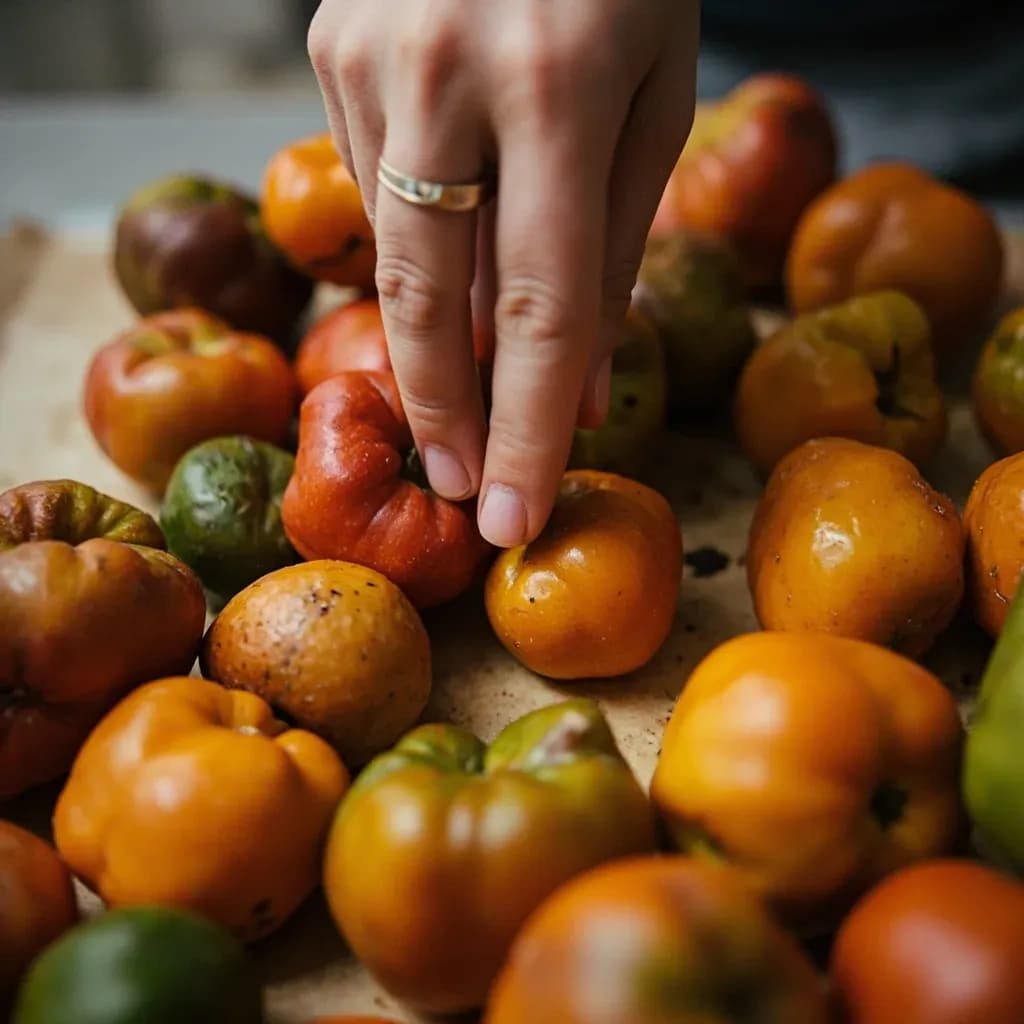
Aroma and quality grading is the sensory assessment a cook makes to sort ingredients by freshness, ripeness, or grade. Smelling for sweetness or off notes, checking color and firmness, and inspecting for blemishes all guide which item to use and how. It is a constant background skill in professional kitchens where ingredient quality drives the dish.
Aroma and quality grading is the deliberate, sensory triage a cook performs before any ingredient meets a knife, a pan, or a pot. It draws on smell, sight, touch, and occasionally sound to read ripeness, freshness, and suitability for purpose — and it is the single largest determinant of how a finished dish will taste, far more than any choice of technique or seasoning. Done well, it is fast: five to thirty seconds per item, repeated across a delivery, a market stall, or a prep table. Done poorly or skipped, it lets bad product into the kitchen, where no amount of skill can rescue it.
The practice goes by several names. In food science it is organoleptic evaluation; in coffee it is cupping; in wine it is the sommelier's nose; in Japanese cooking it sits inside the broader concept of shun, the pursuit of each ingredient at its seasonal peak. All of these traditions converge on the same principle: comparison reveals what isolation hides. A single mango in front of you is hard to grade; three mangoes side by side make the spectrum from best to worst obvious. The cook who grades in batches, in a fixed order (sight, weight, touch, aroma, sound), trains the eye and the nose the way a musician trains the ear.
A few rules govern how the senses behave in this work. Cold suppresses volatile aromatic compounds, so anything taken straight from a refrigerator or ice case needs a moment in cupped hands before a final sniff. Olfactory receptors fatigue in five to ten seconds on a single stimulus, which is why graders work in short bursts and rest the nose between categories. And a strong smell is not always a good smell — overripe, fermented, and rancid ingredients all produce powerful aromas, so grading requires a vocabulary of desirable as well as off notes.
- Difficulty
- Medium
Types & varieties
Judging ripeness and freshness primarily by smell — the most powerful single cue for fruit, fish, herbs, spices, oils, and dairy.
Reading color, sheen, blemish pattern, and stem or blossom-end condition; the first pass at market speed.
Firmness, weight-for-size, give under the thumb, skin tautness — decisive for produce, bread, and cheese.
Listening for the snap of fresh asparagus or green beans, the hollow knock of a ripe watermelon, the crackle of bread crust.
Sequential use of all senses in a fixed order — the professional standard in receiving and prep.
How to do it
- 1
Stage the comparison
Line up three to five specimens of the same ingredient side by side whenever possible. A single item in isolation is hard to grade; comparison reveals the spectrum from best to worst and trains the eye and nose faster than any textbook.
- 2
Inspect visually first
Scan for color uniformity, sheen, bruises, mold, insect damage, and stem or blossom-end condition. Turn each item over — many defects (the bottom of stone fruit, the underside of leafy greens, the seamed side of a melon) hide from the top view.
- 3
Weigh and handle
Lift the item. Note density relative to size; identical specimens of different weight signal different water content or maturity. Assess skin tautness and surface moisture at the same time.
- 4
Palpate gently
Use the pad of the thumb or whole fingers to test firmness. Record the give: rock-hard means underipe, slight give means ripe, mushy means overripe. For delicate items (berries, fish flesh), touch only once and minimally.
- 5
Release and assess aroma
Cup the item in both hands, gently roll or warm it for a few seconds to drive volatiles toward the nose, then take two or three short sniffs — not deep inhalations, which fatigue receptors. Note primary aromas, then any off-notes (sour, sulfurous, fermented, cardboard, crayon, musty).
- 6
Listen where relevant
Break a spear of asparagus or a green bean — a clean, sharp snap indicates fresh. Tap a watermelon for a deep, hollow ring. Crumble bread to gauge crust crackle. This cue is decisive but only valid for a few ingredient classes.
- 7
Sort and decide
Mark each item: use immediately, ripen on the counter for a few days, store cold for later use, or reject. A receiving log or a sticky tag makes the call re-checkable at prep and over the following days.
- 8
Rest the nose between batches
After grading several specimens, smell something neutral — your own forearm, a coffee bean, fresh air — for ten to fifteen seconds before moving to the next ingredient. This resets the olfactory receptors and prevents off-notes from carrying over from one item to the next.
The cold-temperature problem
Refrigeration preserves ingredients but suppresses the volatile compounds that carry aroma. A strawberry straight from the cooler can smell like almost nothing; the same berry at 60°F (16°C) smells of fruit. The professional fix is short: cup the item in both hands for ten to fifteen seconds, or let butter, cheese, and fish sit on the counter for a few minutes before the final call. Dairy and fish are most affected. The corollary is that cold storage cannot be fully evaluated on receipt — grade for packaging integrity and sell-by date, then re-grade at prep when items have warmed.
Olfactory fatigue and the coffee-bean convention
Receptor cells in the olfactory epithelium desensitize after repeated exposure to the same compounds, which is why a fishmonger can no longer smell their own shop after an hour. The fix is built into professional cupping: sniff two to three times, then rest the nose on something neutral — a coffee bean, the inside of one's own wrist, a breath of fresh air — for ten to fifteen seconds. The coffee-bean step is a working reset that cuppers rely on, even if its physiological mechanism is debated; the wrist-and-air reset is a reliable reset of the receptors. For home cooks, the same principle applies when sorting a market haul: grade three or four items, then walk away for a minute before starting the next category.
Ripe versus fresh
The two words are not synonyms, and confusing them is one of the most common grading errors. Fresh describes how recently something was harvested or processed; ripe describes the peak of its edible life. A freshly harvested avocado is typically unripe and needs days on the counter; a ripe avocado at the store is often a week or more past harvest. Fish, by definition, is never ripe — it is graded only for freshness. Stone fruit, tomatoes, and bananas are graded for ripeness within a window of freshness. Knowing which axis you are judging is the difference between buying avocados to use tomorrow and buying avocados to use next week.
Common uses
Tips & pitfalls
- Sniff the stem end of melons and pineapples — the blossom end is unreliable and can smell misleadingly sweet even when the fruit is underipe.
- Fresh fish should smell like clean seawater or cucumber, never 'fishy,' ammoniated, or sour; a strong fish smell at the counter means the fish is already turning.
- Press the pad of your thumb into stone fruit and avocados — a slight give without mush is the target; rock-hard means days from ready, mushy means past it.
- Heavier-for-size citrus, onions, and melons signal juicier, denser flesh; same size, lighter weight is a warning.
- Whole spices, freshly ground coffee, and saffron should smell layered and complex; flat or musty notes mean stale — for saffron, rub a few threads on damp paper and look for a saffron-yellow stain and a hay-honey aroma.
- Extra-virgin olive oil should smell grassy, peppery, artichoke-like, or of ripe tomato; waxy, crayon, or musty notes signal rancidity.
- Float-test eggs in cool water — fresh sinks and lies flat, old stands on end, bad floats. This works because the air cell grows with age.
- Smell fatigues in about five seconds on a single item; grade in short bursts, compare across specimens, and rest your nose with coffee beans or fresh air between categories.
Good to know
- Category
- Prep & Assembly
- Subtype
- Sensory evaluation (organoleptic assessment)
- Primary senses used
- Smell, sight, touch, and occasionally sound
- Time per item
- 5–30 seconds for most ingredients; longer for high-value goods
- Skill level
- Beginner to advanced; sharper with repetition and comparison
- Formal equivalents
- Cupping (coffee), sommelier evaluation (wine), tea grading, spice buying
- Cultural concept
- Japanese 'shun' (旬) — peak seasonality judged by aroma and feel
- Common pitfall
- Olfactory fatigue sets in within 5–10 seconds on a single item
Also called
Sensory Grading · Quality Assessment
Related

Whisk
Beat ingredients smooth and aerated with a looping wire motion

Sift
Pass dry ingredients through mesh to aerate and remove lumps

Strain
Pour through mesh to separate solids from liquid for a smooth result

Filter
Pass liquid through fine material to clarify out the smallest particles

Rice
Press cooked potatoes through small holes for fluffy, lump-free texture

Mash
Crush soft cooked food into a rustic, creamy purée

Grind
Crush food into a coarse to fine texture, from spices to meat

Grate
Shred food into fine bits against a sharp-toothed surface