Transform & Preserve
Aspic Clarification
Clearing a gelatin-rich stock with an egg-white raft to make a brilliant, set aspic.
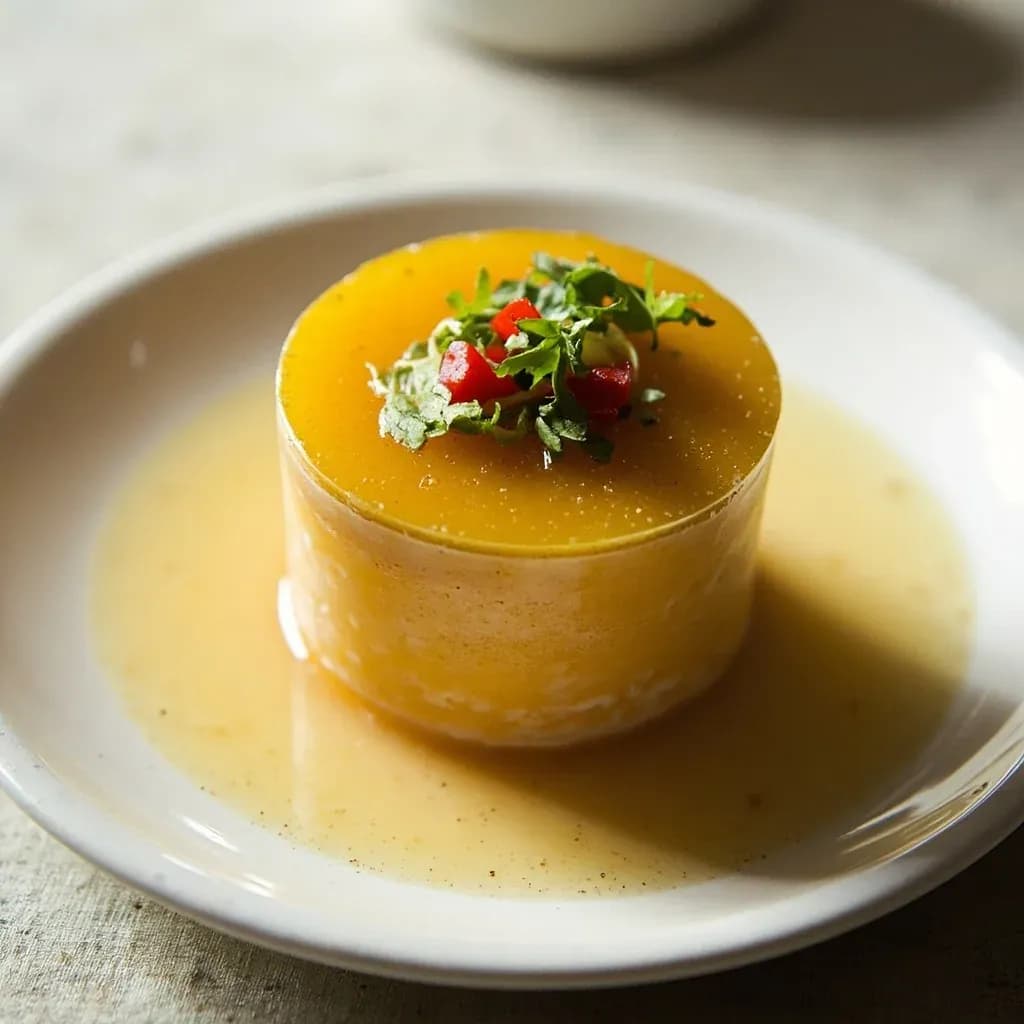
Aspic clarification simmers a gelatinous stock with a raft of egg whites and aromatics that traps cloudiness and fine particles as it rises. The clarified, gelatin-rich liquid is then strained and chilled to set into a glossy, transparent jelly used to coat or suspend foods. Gentle, undisturbed heat is essential so the raft forms and holds without breaking.
Aspic clarification is the marriage of two classical techniques: a protein raft used to render a stock brilliantly clear, and the natural gelatin in that stock to set it into a trembling, jewel-like jelly. The process is identical to making a perfect consommé, only carried further — the liquid is kept for its body rather than served as a soup, and is then poured around or over foods to glaze, bind, or encase them. A raft of whipped egg whites (often joined by ground meat and aromatic vegetables) is suspended in cold stock, then brought up to a bare simmer; as the whites coagulate they coalesce into a single floating mass that traps suspended fats, proteins, and sediment, leaving the liquid beneath it glass-clear.
The result is a medium of remarkable range: it can glaze a terrine to a mirror shine, hold together a layered cold buffet centrepiece, or be reduced into a glossy sauce base. It is also unforgiving. Heat that climbs even a few degrees too high shatters the raft; stock that carries residual fat will never clear; whites whipped to stiff peaks trap air and refuse to knit. A cook who learns to read the pot — watching for the first steam, the first curds, the moment the whites rise as one — has learned something that translates directly to a dozen other classical preparations, from a clear game consommé to a champagne jelly for fruit.
Modern cooks often treat aspic as a finished dish, but in the classical kitchen it is closer to a medium in the way that a sheet of pasta or a sheet of gelatin is a medium. The clarification step is what allows that medium to disappear visually and let the food inside it do the talking.
- Difficulty
- Hard
Types & varieties
Modern, lighter method using whipped egg whites alone; produces a clean, neutral flavour suited to pale poultry and fish aspics.
Traditional method pairing egg whites with lean ground beef or veal plus a brunoised mirepoix; adds body and savoury depth, preferred for robust game and beef.
Egg whites combined with finely chopped leek, onion, and herbs; chosen when the cook wants clarification without darkening the liquid for pale chicken or fish aspic.
Historical method for game and hunting-style aspic; uses fresh blood as part of the raft, contributing deep colour and a characteristically iron-rich flavour.
A slower, gentler variant where the egg-white mixture rests cold for several hours before being brought to a simmer, allowing finer particle removal and a more delicate result.
How to do it
- 1
Prepare the stock
Make or gather a gelatin-rich stock from veal, chicken, beef, or game bones. Refrigerate it overnight and lift off every trace of solidified fat. The stock must be cold before you begin — warm stock will cook the whites on contact and the raft will not form properly.
- 2
Build the raft mixture
For each litre (quart) of stock, whisk 4 egg whites to loose, frothy peaks — do not whip to stiff. Combine with the cold stock in a wide heavy pot. For a traditional meat raft, fold in 200 g (7 oz) lean ground beef or veal per litre, a finely brunoised mirepoix of carrot, onion, and celery, and a sachet of parsley stems, thyme, and bay.
- 3
Bring up slowly
Place over low heat and warm very gradually, stirring only at the very start so the meat and vegetables are evenly suspended. Within 15–25 minutes small curds will appear, then the whites will rise as a single mass to the surface and seal into a raft. Watch the pot — the moment you see steam rather than a boil, you are on track.
- 4
Pierce and simmer
When the raft is solid, use the back of a ladle to punch a small 4–5 cm hole in the centre, just large enough for the liquid to bubble through. Maintain a bare, lazy simmer — never more than a slow plume of steam — for 45–75 minutes. Do not stir, and do not let the raft break apart.
- 5
Strain
Line a chinois or fine-mesh strainer with a double layer of well-dampened cheesecloth or muslin. Ladle the clear aspic through gently, without pressing the raft. For absolute clarity, pass it a second time through fresh cloth.
- 6
Adjust and reinforce if needed
Taste and season lightly with salt and a few drops of sherry, Madeira, or lemon juice, depending on the dish. If the aspic will not set firmly when chilled, soften 5–10 g of bloomed leaf gelatin per litre in cold stock and whisk it into the hot clarified liquid off the heat. Use immediately while still warm and liquid, or chill rapidly over an ice bath.
- 7
Pour or coat
Pour into oiled ring moulds, individual timbales, or shallow trays; or use just-warm aspic (around 30–35 °C) to glaze pre-chilled items — terrines, ballotines, poached fish — in successive thin layers, chilling between coats for a mirror finish.
- 8
Chill to set
Refrigerate for at least 4 hours, ideally overnight, until the aspic gives a clean, soft tremble when the mould is shaken. Unmould by dipping the outside of the mould briefly in warm water and inverting onto a chilled plate.
Reading the raft
The most useful skill in clarification is patience at the moment the whites begin to set. In the first ten minutes the liquid will look milky and speckled with small curds. As the temperature climbs, those curds migrate upward and start to coalesce. The raft is forming when the surface suddenly looks like a single, lightly wrinkled skin. From that moment you are clarifying — the liquid beneath should be visibly clearing with each passing minute. Punch the central hole, drop the heat, and leave the pot alone.
- Steam rather than boil is the visual cue you are on track.
- The raft should be solid enough to resist a light touch from the ladle, not fragile or foamy.
- If the raft breaks into islands, the heat climbed too fast; the aspic can still be rescued by straining and re-clarifying with a fresh half-raft.
When to reinforce with gelatin
Clarification mutes flavour and slightly thins the perceived body of a stock, because some soluble proteins are lost to the raft. A stock that sets firmly on its own before clarification will almost always set firmly after; a stock that wobbles when chilled needs help. Test a small ladleful in a saucer in the fridge for 20 minutes before deciding.
- Bloom 5–10 g of leaf gelatin per litre in cold stock, then whisk into the hot clarified aspic off the heat.
- Never add gelatin to a boiling liquid — it loses strength and can turn cloudy.
- For a slicing aspic, aim for the higher end of the gelatin range; for a glaze that should flow, stay at the lower end.
Aspic versus consommé
The clarification step is identical; only the final gelatin strength differs. A consommé is served as a clear soup and is often reduced slightly for intensity. An aspic is left at its full natural setting strength (or reinforced) so it can hold a shape. Think of them as the same clarified liquid at two different concentrations of body.
Common uses
Tips & pitfalls
- Always start with stock that is cold and completely defatted — fat prevents the raft from sealing properly and clouds the result.
- Whip the egg whites only to loose foam, not stiff peaks; over-whipped whites trap air and the raft will not knit tightly.
- Bring the pot up to a simmer very slowly over 20–30 minutes — rushing causes the whites to scramble before they coalesce.
- Once the raft has formed, make a small hole in the centre with the back of a ladle so the liquid can bubble through; this bubbling is what actually drives clarification.
- Never stir after the raft has set; disturbing it re-introduces the very particles you are trying to remove.
- Dampen the cheesecloth or filter with cold water first so it clings to the strainer and does not absorb excessive aspic.
- Taste before seasoning — clarification mutes salt and aromatics, so a final adjustment is essential.
- For an aspic that slices cleanly, the stock should set at or just below body temperature; if it does not, bloom a little extra gelatin in cold stock and whisk it into the hot clarified liquid.
- A perfectly clear aspic will reveal a coin or your fingers through a 5 mm layer in a glass — anything cloudier should be re-clarified with a fresh half-raft.
Good to know
- Technique type
- Protein clarification (egg-white raft) combined with a natural gelatin set
- Origin
- Classical French cuisine, codified in the 19th century by Antonin Carême and standardised by Auguste Escoffier
- Also known as
- Consommé clarification; raft clarification
- Clarifier ratio
- Roughly 4 egg whites per litre (≈4 per quart) of stock; ground lean meat added in roughly equal volume to whites for a traditional meat raft
- Target temperature
- Bare simmer at 80–90 °C / 175–195 °F; never a true boil
- Timing
- 15–20 minutes to assemble; 45–75 minutes to clarify once the raft sets
- Yield loss
- Approximately 20–30% of the starting volume is absorbed by the raft and sediment
- Setting test
- A correctly set aspic gives a soft, even tremble when a chilled mould is shaken — never rubbery
- Equipment
- Wide heavy pot, ladle, chinois or fine-mesh strainer, double layer of damp cheesecloth or muslin
- Storage
- 4–5 days refrigerated; 2–3 months frozen; glaze items only after both aspic and food are well chilled
Also called
Consommé Clarification · Raft Clarification
Related

Confit
Cook slowly submerged in fat for silky tenderness and keeping

Cure
Draw out moisture with salt and time to preserve and concentrate

Pickle
Steep in acidic brine for bright, tangy, crunchy preservation

Ferment
Let friendly microbes transform food into tangy, complex flavor

Marinate
Soak in a seasoned mix to flavor and tenderize before cooking

Brine
Soak in salt water so meat stays juicy and seasoned throughout

Dehydrate
Slowly dry out moisture to concentrate flavor and extend shelf life

Cold-Smoke
Perfume cured food with smoke without cooking it through