Water & Steam
Banana-Leaf Parcel Steaming
Steaming food wrapped in banana leaves for moisture and herbal aroma.
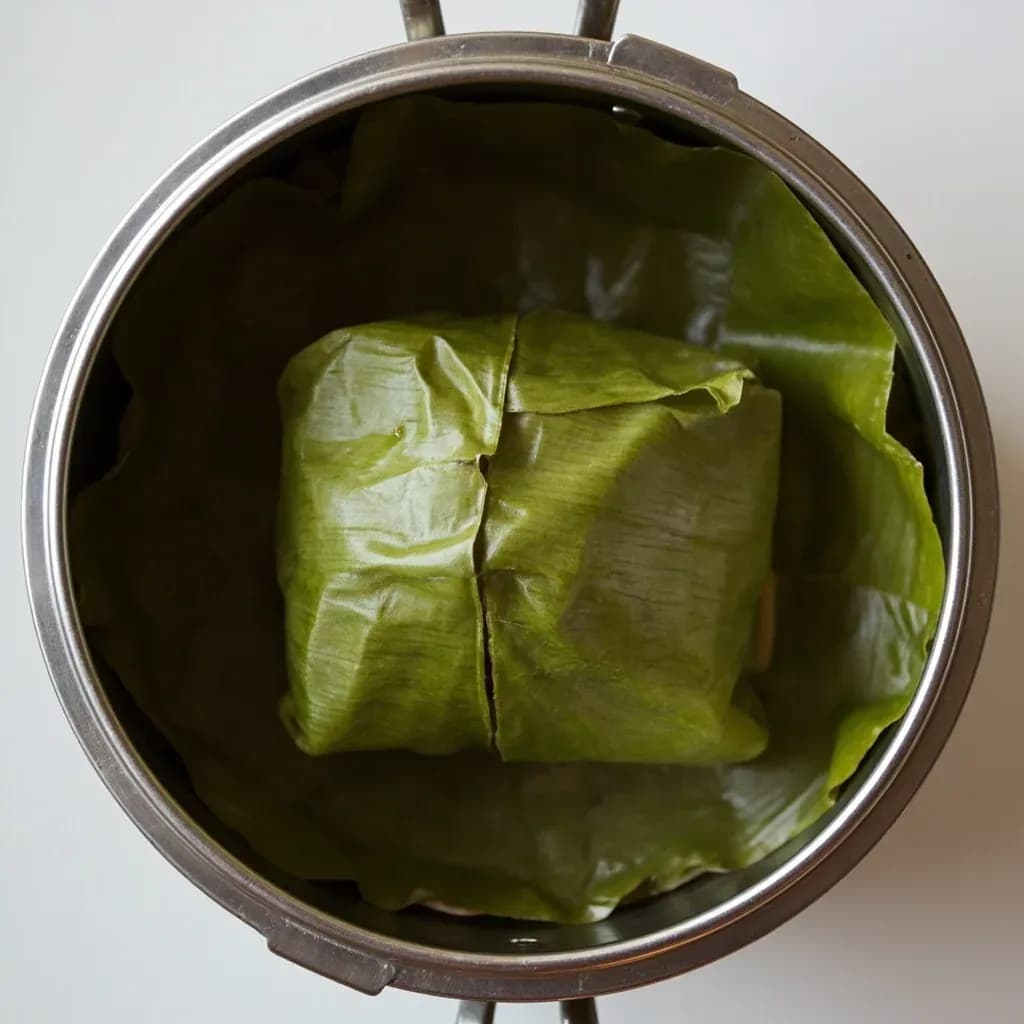
Banana-leaf parcel steaming wraps seasoned fish, rice, or batter in pliable banana leaves and steams the bundles until cooked. The leaf seals in moisture, imparts a subtle grassy aroma, and makes a natural serving wrapper, as in Bengali paturi and Southeast Asian otak-otak. Briefly warming the leaf over a flame makes it supple enough to fold without tearing.
Banana-leaf parcel steaming is a moisture-and-aroma technique in which food is enclosed in wilted banana leaf and cooked over boiling water. The leaf is not a heat source; it is a wrapper that traps steam against the food, prevents drip-drying, and contributes a faint grassy, green-tea note from chlorophyll and polyphenols released as the leaf heats. The technique appeared independently across the tropics wherever Musa species grow — South and Southeast Asia, the Pacific, the Caribbean, Latin America, and tropical Africa — and survives today in dishes as varied as Balinese pepasan, Puerto Rican pasteles, and Bengali hilsa paturi.
The skill is low but the details matter. Wilting the leaf makes it pliable, trimming the thick central rib lets it fold flat, and tying with soaked leaf strips or cotton twine keeps the parcel from opening under steam pressure. A properly wrapped parcel cooks evenly, stays moist, and finishes with a subtle vegetal fragrance; a sloppily tied one loses moisture and may unravel mid-steam. The leaf is never eaten — it is the wrapper and aroma vehicle, then composted or discarded.
For cooks outside the tropics, frozen banana leaves (sold in Asian and Latin markets) are functionally identical to fresh once thawed and wilted. The technique is forgiving: a torn parcel still cooks, it just loses more aroma, which is why the wrapper matters more for delicate fish and custards than for long-cooked rice dishes that would survive a loose wrap.
- Difficulty
- Medium
Types & varieties
Fish, chicken, or pork with basa gede spice paste, wrapped and steamed until the leaf blackens
Tightly folded parcels of chicken, fish, or tofu with chili, galangal, and coconut milk, steamed in stacks
Fish, often hilsa, with mustard, coconut, and chiles wrapped in banana leaf and steamed
Tamarind and gram-flour paste spread on colocasia leaves, rolled inside a banana leaf, steamed, sliced, and tempered with mustard seed
Steamed rice-flour dumplings filled with jaggery-coconut, the classic Ganesh Chaturthi offering
Steamed rice-flour parcels filled with sweetened coconut, folded in banana leaf like an envelope
Salted-egg and coconut fish custard set in a banana-leaf cup and steamed
Glutinous rice cooked in coconut milk, sometimes with chocolate or mango, wrapped and steamed
Hanging rice woven tightly in palm or banana leaf and steamed; the rice takes on a faint green tint
Glutinous rice and coconut milk in a banana-leaf-lined bamboo tube, roasted over an open fire, sometimes finished by steaming
Savory masa-and-meat pies wrapped in banana leaf and boiled or steamed, traditionally a Christmas dish
Sweet cornmeal and coconut pudding steamed in banana-leaf cups
Glutinous rice dumplings, often with mung bean and pork or shrimp, wrapped in banana leaf; bánh ít cooks in 30–45 minutes, bánh tét for several hours
Steamed bean pudding set in banana-leaf cups, the leaf used as a liner inside the ramekin
Compressed rice loaf cooked inside a banana-leaf cylinder, then sliced and served with soups and satay
How to do it
- 1
Prepare the leaves
If using fresh leaves, separate them at the natural seams. Wipe both sides with a damp cloth rather than rinsing under running water — the waxy cuticle traps droplets and dilutes flavor. Pass each leaf briefly over a gas flame or a dry, hot skillet for 2–4 seconds per side until the color turns a deeper, glossier green and the leaf flexes without cracking. Stack the wilted leaves and cut off the thick central rib with scissors or a sharp knife; the midrib will not fold flat and leaves a hard edge against the food.
- 2
Cut to size
Cut the leaves into rectangles of roughly 20–30 cm (8–12 in) on the longer side, or large enough to wrap the portion with at least 4–5 cm (about 2 in) of overlap on every edge. Reserve any long, thin offcuts for tying and soak them in water for 5 minutes to make them pliable.
- 3
Portion the filling
Place the seasoned filling in the center of each leaf piece, shiny (upper) side up for the cleanest appearance when opened. Keep portions moderate — a 1–2 cm (about ½–¾ in) layer steams more evenly than a thick mound. For rice pastes, shape into a flat log or pad; for fish, lay it flat; for custards, set the leaf directly in a small ramekin or cup to hold the liquid.
- 4
Fold the parcel
Bring the two long sides up over the filling and overlap them by 3–4 cm. Fold the short ends over the long seam, one at a time, pressing flat so the parcel holds its shape. Think of wrapping a present with butcher paper: neat, firm folds matter more than multiple layers. Leave a small air gap inside so steam can circulate; over-tight wrapping yields uneven cooking and a doughy center in rice dishes.
- 5
Tie securely
Wrap a soaked leaf strip or cotton twine lengthwise around the parcel, then crosswise, knotting firmly. The parcel should feel snug but not crushed — steam must move around the food, not compress it. A properly tied parcel will not open when lifted by its ties. Avoid nylon or elastic, which can melt against the hot steamer walls.
- 6
Set up the steamer
Fill a wok or pot with 2–3 cm of water, set a trivet or bamboo steamer in place, and bring the water to a rolling boil over high heat. The water must stay below the rack; direct contact will soak and tear the leaves. Optionally line the rack with a loose piece of wilted leaf or parchment to prevent sticking.
- 7
Steam the parcels
Lay the parcels seam-side up on the rack, leaving 2–3 cm between them so steam reaches every surface. Cover with a tight lid and reduce heat to a steady, vigorous boil. Steam thin fish parcels 15–20 minutes, sticky rice dumplings 30–45 minutes, and dense filled cakes (modak, lemang-style) 1–2 hours. Do not lift the lid during the first two-thirds of the cook — each peek drops the temperature noticeably.
- 8
Check and rest
Unwrap one parcel as a test: the filling should be set or tender, and the leaf should have darkened considerably with charred-looking edges. For rice-based fillings, a toothpick should slide through with no raw core. If underdone, rewrap and steam another 5–10 minutes. Let finished parcels rest 3–5 minutes before opening — steam trapped inside continues to cook the food and carries the leaf aroma outward.
- 9
Serve
Present the parcel whole on a plate and let each diner tear it open, or slice in half lengthwise to show the cross-section. Open at the table for the full aroma release: the leaf acts as a steamer lid the moment it is cut, so the grassy scent is strongest in the first 30 seconds. The leaf is not eaten; it is the wrapper and aroma vehicle, then composted or discarded.
Why the wrapper matters
A banana-leaf parcel behaves like a tight, breathable steamer lid pressed directly against the food. Steam from the pot surrounds the parcel, and the moisture that condenses on the wrapper runs back over the filling, so the food self-bastes without ever drying out. The leaf also acts as a flavor reservoir: chlorophyll and polyphenol compounds break down at steaming temperatures and migrate a short distance into the food's surface, producing the green tint and grassy note characteristic of well-made suman, puso, and pepasan. A torn or loose parcel loses this effect because steam escapes before condensing on the food, and aroma compounds volatilize into the pot rather than into the filling.
- The leaf is a wrapper, not a heat source; it cannot sear or brown.
- A snug (not crushing) parcel traps steam against the food and keeps custard surfaces smooth.
- Pale fillings turn faintly sage-green with long contact — this is correct, not spoilage.
Choosing and storing leaves
Fresh banana leaves should look glossy and undamaged; avoid any that are split, yellowed, or dried at the edges. In tropical markets they are sold in bundles of layered strips and keep about a week wrapped in damp paper towels inside a refrigerator. In temperate markets, frozen leaves are the standard: they keep six months or longer and behave identically to fresh once thawed and patted dry. Outer wilted leaves from a previous cook can be wiped and reused two or three times for steaming savory dishes, but never reuse a leaf that touched raw protein for a sweet filling.
- Fresh leaves: about 1 week refrigerated, wrapped in damp paper towels.
- Frozen leaves: 6+ months; thaw and pat off condensation before wilting.
- Reuse outer wilted leaves 2–3 times for steaming; discard leaves that touched raw meat before using for sweets.
Scaling and equipment
Almost any steamer works: a bamboo tier, a metal insert, or a deep pot with a trivet and tight lid. The water must sit below the rack, because direct contact soaks and tears the leaf. For large batches — modak for a festival, suman for a gathering — parcels stack on multiple tiers as long as steam can reach every surface; leave 2–3 cm between parcels and avoid peeking during the first two-thirds of the cook, since each lid lift drops the temperature noticeably.
- Bamboo, metal, or improvised pot-and-trivet all work; the lid must fit tightly.
- Keep water 2–3 cm below the rack; contact with boiling water tears the leaf.
- Stack tiers but leave space between parcels for steam circulation.
Common uses
Tips & pitfalls
- Wilt the leaf before wrapping: pass it over a gas flame or hold it over a hot skillet for 2–4 seconds per side until it turns bright green and flexible; this prevents cracking during folding.
- Trim the stiff central rib before cutting pieces; the midrib is too thick to fold neatly and leaves a hard edge against the food.
- Lay food on the shiny (upper) side of the leaf for the cleanest appearance when the parcel is opened; the matte underside stains more.
- Do not rinse banana leaves under running water — trapped droplets dilute flavor and cause soggy spots. Wipe with a damp cloth instead.
- Tie parcels with thin strips cut from the leaf itself, soaked briefly to make pliable, or use cotton kitchen twine; avoid nylon or elastic that can melt.
- Leave a small air gap inside the parcel so steam can circulate; over-tight wrapping yields uneven cooking and a doughy center in rice.
- Stack parcels in the steamer with 2–3 cm between them so steam reaches every surface.
- A faint green tinge on rice, fish, or custard is chlorophyll from the leaf and a sign of correct contact, not spoilage.
- Season the filling before wrapping — the leaf is a steamer, not a flavor extractor, and will not rescue a bland filling.
- If fresh leaves are unavailable, thawed frozen leaves work identically; just pat off ice crystals and condensation before wilting.
Good to know
- Origin
- Pan-tropical; pre-colonial practice found across South and Southeast Asia, the Pacific, the Caribbean, Latin America, and tropical Africa where Musa species grow
- Primary function
- Wrapping food before steaming to retain moisture, prevent drying, and impart a subtle grassy, tea-like aroma from leaf polyphenols and chlorophyll breakdown
- Leaf size at use
- Pieces of roughly 20–40 cm (8–16 in) per parcel; full unfurled leaves run 30–60 cm wide and 1–2 m long
- Aroma compounds
- Heat releases chlorophyll-derived compounds and tannins; yields a faint vegetal, nutty, green-tea note without dominating the filling
- Color transfer
- Prolonged contact tints pale foods (rice, fish, custards) a soft sage green; considered desirable in many cuisines, not a defect
- Typical steam times
- 15–25 min for thin fish parcels; 25–40 min for sticky rice dumplings; 45 min–2 h for dense pastes (modak, lemang)
- Internal temperature targets
- 63 °C / 145 °F for fish; 74 °C / 165 °F for poultry and pork; 95 °C / 203 °F for rice to fully gelatinize starch
- Reusability
- Outer wilted wrapping leaves can be wiped and reused 2–3 times for steaming; leaves that touched raw protein should not be reused for sweets
Also called
paturi · banana-leaf-steaming · otak-otak
Related

Boil
Cook in vigorously bubbling liquid at full rolling heat

Simmer
Hold liquid at a gentle shimmer for tender, unhurried cooking

Poach
Cook gently in barely-trembling liquid for silky, tender results

Steam
Cook in rising vapor to keep color, nutrients, and shape intact

Blanch
Plunge briefly in boiling water, then shock cold to lock color

Braise
Sear, then cook slow in a little liquid until fall-apart tender

Stew
Simmer bite-sized pieces fully submerged into a rich, unified pot

Sous-Vide
Seal and cook in precise warm water for edge-to-edge doneness