Prep & Assembly
Blooming Saffron
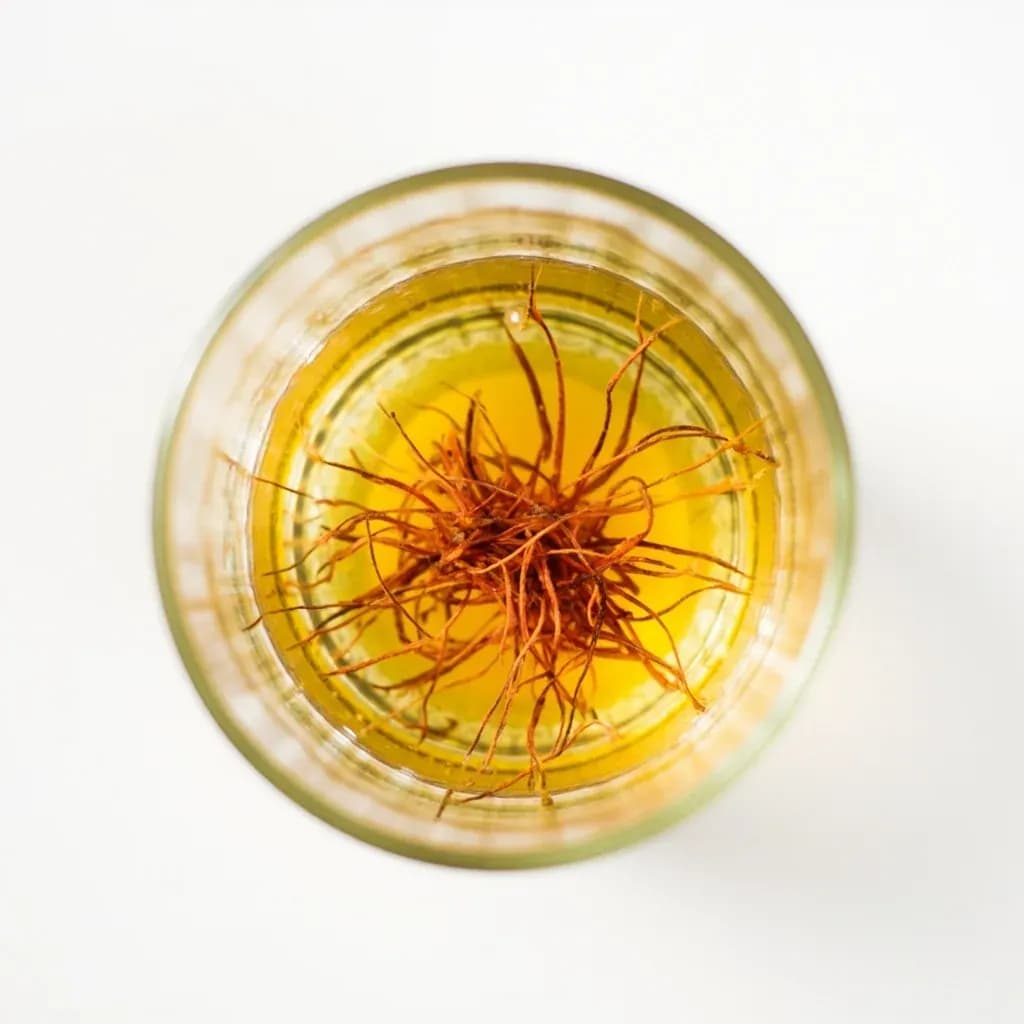
Steeping saffron threads in warm liquid to release their color, aroma, and flavor.
Blooming saffron means soaking the threads in a small amount of warm water, milk, or broth to draw out their golden color and floral aroma before adding them to a dish. Steeping disperses saffron's flavor far more evenly than adding the dry threads directly. Grinding the threads first and using gently warm rather than boiling liquid extracts the most from this costly spice.
Blooming saffron is the simple but transformative step of steeping saffron threads in a small amount of warm liquid before they meet the rest of the dish. Threads dropped whole into a pot of rice or stock give up only a fraction of what they hold; crushed and bloomed, the same pinch can color and perfume an entire pan. It is the difference between treating saffron as a garnish and treating it as a working ingredient.
The technique works because saffron's three signature compounds — crocin for color, picrocrocin for flavor, and safranal for aroma — release much more readily from broken threads than intact ones, and crocin in particular is water-soluble. A few minutes in warm liquid pulls them out into a glowing, almost luminous infusion that can be measured, timed, and folded into a recipe with the same control as any other liquid seasoning.
Blooming also lets a cook tune the saffron to the dish: milk carries the aromatics gently for sweets and rice, broth keeps the bloom savory for risotto and paella, and wine or rosewater push it in more specific regional directions. It is the single most useful thing to know about cooking with saffron, and one of the cheapest upgrades in the kitchen.
- Difficulty
- Easy
Types & varieties
The default method; a small ladle of hot (not boiling) water drawn from the cooking pot. Works in nearly any savory or sweet application.
Standard in Mughlai and North Indian cooking for biryani, kheer, and sheer khurma; milk carries fat-soluble notes differently and softens the aromatics.
Used for risotto alla Milanese and paella; a small ladle of the dish's own hot cooking liquid is taken out, bloomed, and stirred back in.
Dry white wine warmed and steeped with the threads; shows up in some Italian and Mediterranean preparations where wine is already in the pan.
Traditional in Persian and Middle Eastern sweets such as bastani and sholeh zard, where the floral water and saffron are matched in the final dish.
Steeps threads in room-temperature or ice water for 30–60 minutes to preserve the more delicate, volatile aromatics that heat would drive off.
How to do it
- 1
Measure the saffron
Weigh or count the threads. A typical pinch — about 15 to 20 threads, roughly 0.1 g — is enough for four servings of most rice or stew dishes. Set aside a little extra if saffron is the visual centerpiece of the plate, as in chelo with tahdig.
- 2
Crush the threads
Place the threads in a small mortar and pestle and press gently, or rub them between your fingertips over a small bowl. The goal is to break them into shorter pieces with a little powder, not to pulverize them into dust. Crushing multiplies the surface area in contact with the liquid and is the single biggest factor in how much color and aroma you get.
- 3
Warm the blooming liquid
Heat 2 to 4 tablespoons of water, milk, stock, or wine until it is hot to the touch but not simmering — roughly 70 to 80°C / 160 to 175°F. If possible, draw this liquid directly from the pot you are cooking in so the bloom matches the dish's flavor base.
- 4
Steep
Pour the warm liquid over the crushed saffron and stir once. Cover and leave for 10 to 20 minutes. The liquid should turn a deep, almost glowing orange-red. For a stronger bloom, leave it up to 30 minutes; for a more aromatic result, use cooler liquid and a longer steep.
- 5
Add to the dish
Stir the bloomed saffron — threads and all, unless straining — into the recipe toward the end of cooking so the color and aroma are not lost to prolonged heat. For Persian-style rice, drizzle the bloom over the rice and the oiled base of the pot to create the golden tahdig crust.
Why crushing matters more than the liquid
The most common misconception about blooming is that it is about the liquid. In practice, the liquid is just a carrier; the crushing is what unlocks the saffron. Whole threads are tightly rolled, and their outer surfaces release only a thin halo of color. Break them into shorter pieces and a little powder, and the crocin, picrocrocin, and safranal all come out in proportionally greater amounts. A mortar and pestle is the cleanest tool, but rubbing the threads between thumb and forefinger over a small bowl works nearly as well. The target is broken threads with some powder, not a fine dust — too fine and the bloom turns cloudy.
- Crushing multiplies surface area in contact with the liquid
- Whole threads release noticeably less color and aroma than crushed ones in the same steep time
- A small mortar is the ideal tool; fingertips are a reliable backup
- Do not skip this step even when you are in a hurry — it is the cheapest flavor gain in the recipe
Matching the bloom to the dish
The liquid you bloom in is a chance to point the saffron in a particular direction. Pulling a small ladle from the cooking pot keeps the bloom in the same flavor register as the rest of the dish. Milk rounds out the aromatics and is the right call for sweets, rice puddings, and biryani. Wine sharpens and lifts, suiting Mediterranean fish stews and certain risottos. Rosewater and orange-blossom water are not background flavors in Persian sweets — they are co-stars, and the saffron is bloomed in them for that reason. The cold bloom is worth knowing about for delicate applications where you want the full safranal perfume without cooking it off.
- Water is the neutral, all-purpose choice
- Milk for sweets, rice puddings, and Mughlai rice dishes
- Stock or broth for savory rice and stews
- Wine for Mediterranean and Italian preparations
- Rosewater or orange-blossom water for Persian and Middle Eastern sweets
- Cold or cool liquid for the most aromatic, least cooked result
Common uses
Tips & pitfalls
- Always crush or crumble the threads first; whole threads release only a fraction of the color and aroma of broken ones
- Use warm, not boiling, liquid — high heat drives off the volatile safranal and dulls the aroma
- Pull a small ladle of liquid from the dish itself so the bloom sits in the same flavor register as the recipe
- Bloom well in advance when you can: even 30 minutes of steeping gives a noticeably richer infusion
- Do not discard the bloomed threads; stir them back in for visual flecks and a second, milder release of flavor
- Strain if the recipe calls for a clear color, but leave the threads in for rustic dishes like paella
- Avoid reactive metal bowls (copper, unlined brass); ceramic, glass, or stainless steel is safest
- Do not try to bloom saffron in oil or pure fat — crocin is water-soluble and will not extract properly into fat alone
Good to know
- Also called
- Steeping saffron, saffron infusion, saffron bloom
- Typical ratio
- A pinch (about 15–20 threads, ~0.1 g) to 2–4 tablespoons warm liquid
- Liquid temperature
- Warm, 70–80°C (160–175°F); never boiling
- Steeping time
- 10–20 minutes typical; up to 30 minutes for a deeper extraction
- Key compounds released
- Crocin (color, water-soluble), picrocrocin (flavor), safranal (aroma, heat-sensitive)
- Time required
- About 5 minutes hands-on plus 10–20 minutes steeping
- Storage of bloomed saffron
- Covered and refrigerated, up to 24–48 hours; flavor continues to develop
Also called
Steeping Saffron · Saffron Infusing · Blooming Saffron (Dam Kardan-e Zaferan)
Dishes that rely on it
Related

Whisk
Beat ingredients smooth and aerated with a looping wire motion

Sift
Pass dry ingredients through mesh to aerate and remove lumps

Strain
Pour through mesh to separate solids from liquid for a smooth result

Filter
Pass liquid through fine material to clarify out the smallest particles

Rice
Press cooked potatoes through small holes for fluffy, lump-free texture

Mash
Crush soft cooked food into a rustic, creamy purée

Grind
Crush food into a coarse to fine texture, from spices to meat

Grate
Shred food into fine bits against a sharp-toothed surface