Water & Steam
Butter-Poaching (Beurre Monté)
Gently cooking delicate proteins submerged in an emulsified butter sauce held just below the simmer, yielding silky, evenly cooked results.
Beurre monté is a stabilized emulsion of butter and a clear liquid — water, dry white wine, or a light court bouillon — held at a bare quiver between 180 and 190°F (82–88°C). Codified in the classical French repertoire and refined in late-twentieth-century fine dining, the technique turns cold cubed butter into a foamy, pourable bath that can poach, hold, and finish a protein in a single step. It is the rare method in which the cooking medium is also the sauce.
What makes beurre monté distinctive is how the fat behaves once the butter melts into the simmering liquid. The butterfat disperses as tiny droplets through the water phase, with the milk solids helping to keep those droplets suspended, so the bath remains a stable, opaque foam. That thin layer of emulsified fat wraps the food, slows heat transfer, prevents the surface of delicate flesh from seizing, and shields pale proteins like sole, halibut, and lobster from oxidation. The payoff is uniformly opaque, velvety texture and a glossy, buttery finish no water-based poach can deliver.
Because the bath doubles as a finished sauce, beurre monté collapses what would otherwise be three separate steps — pre-poach, finish in butter, build a sauce — into one low-effort process. The cook seasons the mount, slips in the protein, and emerges a few minutes later with both the cooked item and the sauce it should be served with, with little risk of overshoot or drying out.
- Difficulty
- Moderate
Types & varieties
Plain water base; the purest, most neutral version, used when the butter and the protein should speak for themselves.
Built on dry white wine (sometimes with a splash of white wine vinegar); brighter, more acidic profile, classic for fish and shellfish.
Made over a vegetable- or fish-based court bouillon for a deeper savory background.
Steeped with thyme, bay leaf, parsley stems, or tarragon during the mount; strained before the protein goes in.
Finished with lemon juice and zest; the classic choice for sole and other flatfish.
How to do it
- 1
Choose and prepare your liquid
Pour about ½ cup (120 ml) of water, dry white wine, or a light court bouillon into a wide heavy-bottomed saucepan. Add aromatics if using — a slice of lemon, a thyme sprig, a bay leaf, a few peppercorns. Bring to a bare simmer.
- 2
Build the beurre monté
Reduce the heat so the liquid just trembles. Whisk in 1 tablespoon of cold cubed unsalted butter at a time, whisking constantly and making sure each addition is fully incorporated before adding the next. Continue until you have a stable, foamy emulsion of 2–3 parts butter to 1 part liquid (about 8–12 oz / 225–340 g butter total).
- 3
Season the bath
Season the finished mount with fine salt, a few grinds of white pepper, and a small squeeze of lemon if desired. Skim any surface foam with a slotted spoon or fine mesh skimmer for a cleaner look. Hold at 180–190°F (82–88°C).
- 4
Prepare the protein
Pat fish, shellfish, or vegetables completely dry. For fish fillets, portion into even pieces. For lobster, blanch briefly in lightly salted water (about 1 minute) to set the shape. For in-shell eggs, bring to room temperature first.
- 5
Poach gently
Lower the protein into the beurre monté so it is fully submerged or at least half-covered. Maintain the gentle quiver — do not boil. Cook fish 3–5 minutes depending on thickness, lobster 6–8 minutes, in-shell eggs 6–9 minutes for a soft, spoonable yolk.
- 6
Check doneness
Fish is ready when it turns just opaque and resists flaking; a paring knife inserted into the thickest part should feel warm. Lobster meat should be firm and curl into a loose C. Eggs should feel set around the edges with a barely jiggly center.
- 7
Rest and serve
Lift the protein with a slotted spatula and rest briefly on a warm plate, spooning a little of the mount over the top to glaze. Serve immediately with a generous spoonful of the butter and an optional garnish of chopped herbs, flaky salt, or a final squeeze of lemon.
- 8
Maintain the bath for service
If holding briefly, keep the mount at low heat and whisk occasionally; if it tightens, whisk in 1–2 tablespoons of hot water to loosen. Use within 1–2 hours and do not reuse for a second service.
Beurre Monté vs. Beurre Blanc
The two sauces share a name, a language, and a reliance on an emulsified butter, but they do different jobs and are not interchangeable. Beurre blanc is a finished sauce built on a reduction of shallots, white wine, and vinegar, with cold butter whisked in off the heat to form a glossy, slightly tangy spooning sauce that plates beside the protein. Beurre monté is a neutral cooking medium made by emulsifying butter into water or stock before the food goes in, and it serves simultaneously as the cooking liquid and the sauce served with the dish. The acid in a beurre blanc would curdle in a long, hot bath; the absence of acid in a beurre monté is what allows it to hold steady at poaching temperature for an hour or more without breaking.
Pan, Tools, and Holding
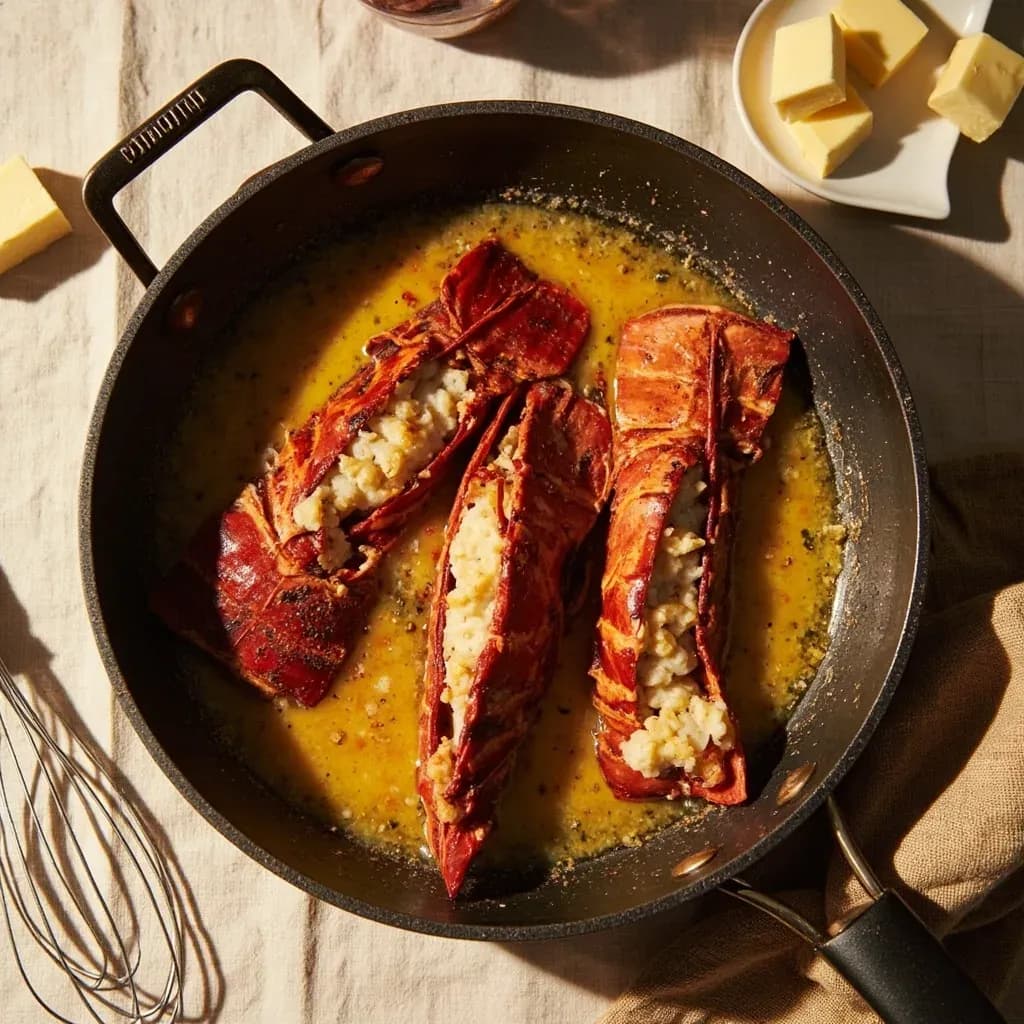
A wide, low-sided heavy pan — a rondeau or a 10- to 12-inch straight-sided skillet — is the right vessel. The shallow depth means the mount forms a thin, even layer that recovers temperature quickly after cold food is added, and the wide surface makes skimming easy. A flat whisk is more useful than a balloon whisk; it cuts the butter in fast without beating excess air into the sauce. Clip a thermometer to the side and watch for the surface to tremble, not break. The mount can be held for an hour or two on the lowest possible heat, with an occasional whisk and a splash of hot water to loosen it if it tightens. Once it has held proteins, do not pour it back into a fresh batch — flavor a new mount instead.
Common uses
Tips & pitfalls
- Use cold, cubed unsalted butter — cold cubes melt slowly, giving you time to emulsify each one fully before the next goes in. Soft or melted butter is already separated and will not mount cleanly into the simmering liquid.
- Whisk the first cubes vigorously into the simmering liquid until fully emulsified before adding the next handful; this is the single biggest factor in keeping the sauce stable.
- Never let the mount boil. A bare tremble on the surface is the target; rolling heat will cause the butterfat to separate and the emulsion to break. A broken mount looks thin and streaky rather than foamy and opaque.
- If the sauce breaks, whisk in 1–2 tablespoons of hot water off the heat and return to a gentle simmer to re-emulsify. Repeat as needed rather than starting over.
- Season the mount itself (salt, white pepper, a squeeze of lemon) before adding the protein so flavor penetrates the flesh as it cooks, not just the surface.
- Pat proteins very dry before submerging. Excess surface water thins the emulsion, dulls the buttery flavor, and dilutes the glossy glaze.
- Cook fish only until the flesh is just opaque and flakes with gentle pressure — carryover heat finishes the job. Overcooking is the most common mistake and the hardest to reverse.
- For lobster, blanch briefly in lightly salted water first to set the shape, then finish in the beurre monté for tenderness and shine; skip this and the meat contracts into a tight ball.
- Don't reuse the mount after it has held proteins for any length of time. The liquid is full of exuded juices and will not emulsify cleanly a second time — build a fresh bath for the next round.
Good to know
- Origin
- Classical French technique, refined in the late-20th-century fine-dining kitchens of chefs such as Thomas Keller and Eric Ripert.
- Core ratio
- Roughly 2–3 parts cold unsalted butter to 1 part liquid (water, light stock, or dry white wine) for a stable emulsion.
- Holding temperature
- 180–190°F (82–88°C) — a bare quiver, just below a true simmer.
- Yield
- About 1 cup of beurre monté per 6 oz (170 g) butter plus 2–3 Tbsp liquid.
- Active time
- 5 minutes to build the emulsion; 3–5 min for fish, 6–8 min for lobster, 6–9 min for in-shell eggs.
- Difficulty
- Easy to medium; the emulsion is forgiving but breaks if overheated or starved of liquid.
- Storage
- Best used immediately; can be held on the stove for 1–2 hours, but should not be refrigerated and remounted.
- Flavor profile
- Clean, rich butter flavor that takes on aromatics (lemon, thyme, bay, white pepper) without masking the protein.
Also called
beurre monte · butter-poached · monte au beurre poaching
