Transform & Preserve
Citrus Curing
"Cooking" raw fish in citrus juice whose acid firms and opaquens the flesh, as in ceviche.
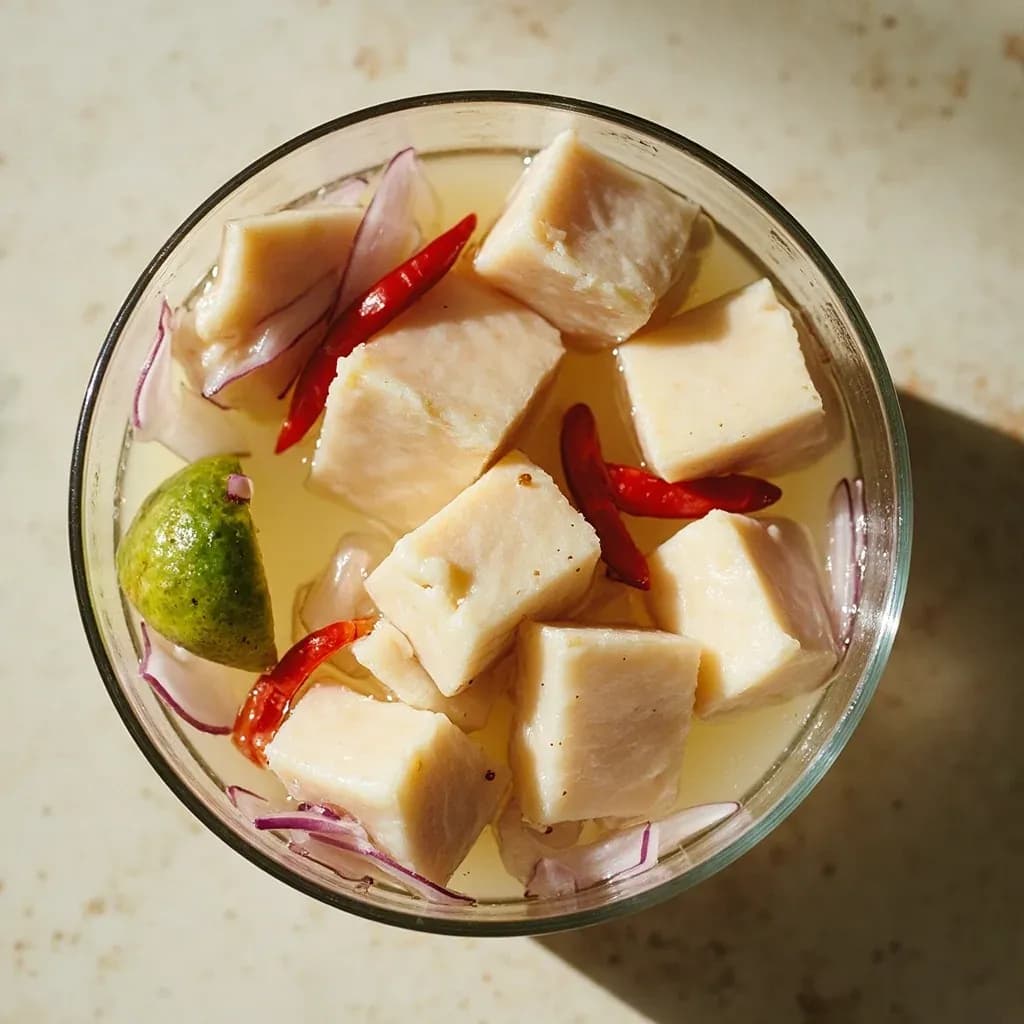
Citrus curing bathes raw fish or seafood in lime or lemon juice, whose acid denatures the proteins much like heat, turning the flesh firm and opaque without any cooking. It is the heart of ceviche, kinilaw, poisson cru, and souse, usually with onion, chili, and herbs added for brightness. Because the acid does not kill all pathogens, very fresh, sashimi-grade fish is essential for safety.
Citrus curing is the practice of "cooking" raw seafood in the acid of fresh citrus juice — most often lime, sometimes lemon, bitter orange, or calamansi. The citric and ascorbic acid in the juice denature the proteins on the surface of the fish in much the same way heat does, turning translucent flesh opaque and giving it a firm, just-set texture without ever raising the temperature. Because the action works only from the outside in, the cook controls doneness with a stopwatch rather than a thermometer: minutes for a silky center, longer for a fully opaque cure, and beyond a certain point a softening into mush.
The technique is the backbone of an entire family of raw-fish dishes — ceviche across Latin America, kinilaw in the Philippines, oka and 'ota 'ika across the Pacific — and it shows up in lighter doses in dishes like Thai yam pla, scallop crudo dressed with lemon, and contemporary citrus-cured salmon. It is a method that rewards timing, knife work, and the freshest possible fish far more than any special equipment: a bowl, a sharp knife, and a refrigerator are all you really need to pull off something that, done well, feels like a small miracle of kitchen chemistry.
One caution belongs at the top of any citrus-curing discussion: citrus acid is excellent at changing texture but unreliable as a disinfectant. Parasites and many bacteria are not reliably killed by juice at refrigerator temperatures, which is why the safest cures begin with sushi- or sashimi-grade fish that has been frozen to a parasite-killing temperature first, and why finished dishes should be eaten within minutes of assembly, not hours.
- Difficulty
- Medium
Types & varieties
Diced white fish cured in key lime with sliced red onion, ají limo or rocoto, and cilantro; served with cancha, sweet potato, and choclo. The released marinade is called leche de tigre.
Peruvian-style ceviche that folds shrimp, squid, mussels, or scallops into the fish for a seafood medley.
Tomato- and clamato-based version with onion, jalapeño, cucumber, and avocado; the fish is usually lime-cured briefly, then dressed in the sauce.
Cured in lime and tumbled with tomato sauce, served with plantain chips (chifles) and popcorn.
Typically built on reineta, corvina, or salmon, cured with lemon or pica, and finished with onion, cilantro, and merken or ají.
Diced raw fish cured in cane vinegar plus calamansi, ginger, onions, chilies, and often coconut milk — a vinegar-and-citrus hybrid with a Southeast Asian accent.
Pacific Islander raw-fish preparations: cubes of fish in coconut cream with citrus, onion, and chili, served cool.
Lightly lime-dressed white fish salad with lemongrass, mint, chili, and fish sauce — a brief cure, not a long marinade.
Thin slices or strips of salmon briefly tossed in lemon or yuzu juice with salt, sugar, and dill, in the spirit of gravlax.
Cubed ahi tossed with limu, soy, sesame, and a splash of citrus — the acid here seasons more than it cures.
How to do it
- 1
Select and pre-chill the fish
Choose sushi- or sashimi-grade, very fresh, skinless, boneless white fish. Trim away bloodlines and any dark muscle, then wrap in plastic and chill until firm — about 20 minutes in the freezer makes for cleaner cuts. If parasite safety is a concern, freeze the fish to −20°C / −4°F for 7 days (or −35°C for 15 hours) before curing.
- 2
Cut uniformly
With a very sharp knife, cut across the grain into even 1–1.5 cm (about ½ in) cubes for a classic ceviche, or into 5 mm (¼ in) slices for a more sashimi-like texture. Uniform size is what lets every piece finish curing at the same moment.
- 3
Season with salt
Toss the cut fish with fine sea salt at about 1% of the fish weight and let it stand 1–2 minutes. The salt begins to break down structure and draws out a little liquid, which carries seasoning into the flesh so the acid has less work to do.
- 4
Cover with fresh citrus
Add freshly squeezed juice — key lime or Persian lime for Peruvian-style ceviche, lemon for Chilean, calamansi for kinilaw, or a thoughtful blend. The juice should just cover the fish, or you can toss to coat and add more as the fish releases liquid. A working ratio is ½ to ¾ cup juice per 450 g (1 lb) fish.
- 5
Cure briefly in the refrigerator
Cover and return the bowl to the fridge. For 1 cm cubes, begin checking at 3 minutes; the goal is full opacity at the surface with a still-moist, just-set center, usually reached in 5–10 minutes. Thin slices can finish in 60–90 seconds.
- 6
Add aromatics
Stir in thinly sliced red onion (rinsed under cold water to soften its bite), minced ají or jalapeño, and garlic, then taste and adjust salt. Add cilantro, mint, or chives at the very end so their color and aroma stay bright.
- 7
Finish and serve immediately
Drain the fish for a cleaner plate, or serve spooned with its marinade for the classic Peruvian style. Plate over lettuce, with sweet potato and toasted corn, on tostadas, or in avocado halves, and eat right away — citrus-cured fish does not wait well.
The chemistry, in plain terms
Citric acid is a small molecule that readily gives up protons, and those protons slip into the surface layer of the fish and disrupt the hydrogen bonds that hold muscle proteins in their folded, translucent state. As the proteins lose their shape they tangle with one another and trap water, just as they do when heated, which is why the flesh whitens and firms up. Two practical consequences fall out of this:
• The reaction works from the outside in. A cube the size of a thumbnail cures faster than a steak-cut slab, because the acid has less distance to travel before reaching the center. • The reaction does not stop on its own. Once proteins have denatured and water has been expelled, continued exposure softens the network further and the flesh turns mushy. Draining or plating stops the cure.
- A cube's surface area to volume ratio is what dictates cure time, not the volume of juice used.
- Salt applied before the juice seasons the fish all the way through and speeds protein unraveling, so the acid works faster and more evenly.
- Cold fish and cold juice slow the reaction and buy the cook a little more control; warm citrus accelerates everything and pushes the fish toward mush.
Leche de tigre and the byproduct economy
As the fish cures it releases liquid — its own moisture plus the juice — loaded with dissolved protein, salt, and fish flavor. Peruvian cooks call this marinade leche de tigre, "tiger's milk," and treat it as a precious thing rather than a byproduct. Blitzed with a small extra piece of fish, garlic, celery, and salt, then strained, it becomes a pearly, intensely savory shooter served as an aperitivo or poured over fried calamari. It is also the cleanest proof that citrus curing is a real transformation: nothing in the marinade existed before the fish met the juice.
- Reserve the marinade as soon as the fish is plated if you want a clean, dry presentation; keep it on the fish if you want the classic Peruvian wet-style ceviche.
- For a balanced leche de tigre, blend about 1 part reserved marinade with ¼ part fresh fish, a small clove of garlic, a slice of celery, and salt to taste, then strain.
- A splash of leche de tigre lifts almost any seafood — drizzle it over grilled octopus, fried squid, or a simple bowl of white rice and shrimp.
Common uses
Tips & pitfalls
- Source sushi- or sashimi-grade fish from a trusted counter; the technique cannot disguise the flavor of fish that isn't very fresh, and acid does not kill parasites the way heat does.
- Cut the fish uniformly — usually 1 to 1.5 cm / about ½ inch cubes — so the cure finishes across the batch at the same moment.
- Salt the cut fish a minute or two before adding citrus; the salt seasons all the way through and helps the acid penetrate.
- Always use freshly squeezed juice. Bottled juice has lost volatile aromatics and often contains preservatives that slow denaturation and mute flavor.
- Keep everything cold: chill the bowl, the fish, and the juice, and cure in the refrigerator, not on the counter. Warm citrus accelerates the cure and pushes the fish straight to mush.
- Do not over-cure. The fish should turn opaque on the outside while remaining slightly translucent and silky at the center — minutes, not hours. Drain or plate to stop the reaction.
- Add alliums, chiles, and tender herbs at the end of curing, not the beginning; their color and fresh flavor collapse in acid.
- Skip oily species such as mackerel, sardines, and bluefish for a first attempt; their strong flavor and soft texture turn muddy under acid and their fat masks the cure.
- For thin sashimi-style slices, a 1–2 minute dip in citrus is enough; serve immediately on a cold plate so residual heat from the room does not push the cure past its window.
Good to know
- Also known as
- Acid curing; the iconic dish forms are ceviche (Spanish-language name), kinilaw (Filipino), and oka or 'ota 'ika (Samoan/Tongan)
- Origin
- Coastal Latin America, with Peru considered the modern home of lime-based ceviche; acid-curing of seafood by fermentation predates Spanish contact, but citrus as the acid is post-15th century
- Active agent
- Citric acid (with smaller contributions from ascorbic acid and other organics) in lime, lemon, bitter orange, or calamansi juice
- Typical juice pH
- About 2.0–2.4 for fresh Persian or key lime; lemon runs slightly higher, calamansi noticeably so
- Cure time for diced fish
- 3–10 minutes for a translucent-to-firm finish, 15–30 minutes for fully opaque, beyond 30–40 minutes the texture turns mushy
- Best fish style
- Very fresh, lean, white-fleshed fillets such as sea bass, corvina, halibut, sole, snapper, or fluke
- Food safety note
- Acid does not reliably kill parasites; standard safeguard is to freeze intended-for-raw fish to −20°C / −4°F for 7 days (or −35°C for 15 hours) before curing
- Storage
- Best served within 30 minutes of curing; dressed fish should not be held more than a few hours, even under refrigeration
- Difficulty
- Easy to execute, hard to master — timing and fish quality decide everything
Also called
Citrus Curing · Lime-Curing · Ceviche · Kinilaw · Citrus Marinating
Dishes that rely on it

Related

Confit
Cook slowly submerged in fat for silky tenderness and keeping

Cure
Draw out moisture with salt and time to preserve and concentrate

Pickle
Steep in acidic brine for bright, tangy, crunchy preservation

Ferment
Let friendly microbes transform food into tangy, complex flavor

Marinate
Soak in a seasoned mix to flavor and tenderize before cooking

Brine
Soak in salt water so meat stays juicy and seasoned throughout

Dehydrate
Slowly dry out moisture to concentrate flavor and extend shelf life

Cold-Smoke
Perfume cured food with smoke without cooking it through