Prep & Assembly
Citrus Meat Cleaning
Washing meat with lime, sour orange, or vinegar to clean the surface before cooking.
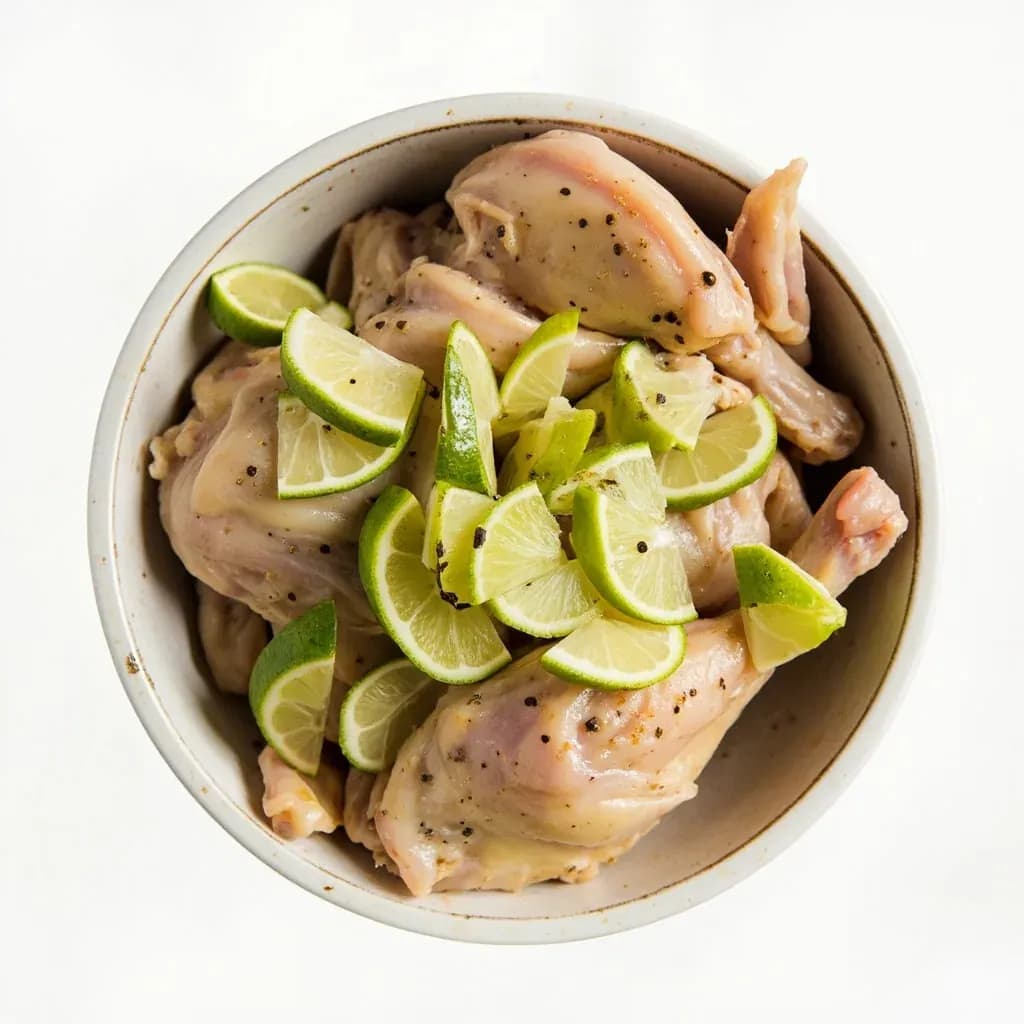
Citrus meat cleaning rubs and rinses raw meat or seafood with lime, sour orange, or vinegar to remove residue, slime, and odors before cooking. The acidic wash, known as netwaye vyann in Haitian kitchens, also lightly seasons the surface and is a deeply rooted preparatory ritual across the Caribbean. The meat is patted dry afterward so it browns properly.
Citrus meat cleaning — also called a lime wash, sour-orange wash, or acid rinse — is a pre-cooking bath in citrus juice, sour orange, or vinegar (almost always with coarse salt) used to scour the surface of raw meat and offal before it moves on to seasoning or marination. The practice predates refrigeration and remains standard in Puerto Rican, Dominican, Cuban, Mexican, Peruvian, West African, Filipino, and South Indian kitchens, where it is applied to everything from tripe and kidneys to whole chicken, rabbit, and guinea pig.
The bath does three things at once. The acid (typically pH 2.0–3.0) denatures surface proteins, lifting blood, membrane, and bone fragments; the salt acts as a gentle abrasive and draws off water through osmosis; together they neutralize the strong, gamey, or barnyard odors that cling to offal, older animals, and wild game. A brief soak also carries a mild antimicrobial effect, since a pH well below 4.6 inhibits most surface bacteria — though it is emphatically not a substitute for thorough cooking.
Used with restraint, the technique improves flavor, texture, and presentation; used carelessly, it turns delicate offal chalky and waterlogged, can bleach color and give lean muscle a denatured surface, and leaves residual moisture that prevents proper browning. The craft lies in choosing the right acid, the right contact time, and the right follow-through rinse.
- Difficulty
- Easy
Types & varieties
Caribbean and Mexican standard; fresh Persian or Key lime juice, often diluted 1:1 with water and sometimes combined with crushed garlic and oregano
Cuban, Puerto Rican, and Dominican preference; naranja agria, frequently bottled in Latin markets, prized for a rounder, more aromatic acid profile than lime
West African, Filipino, and South Indian standard; white distilled, apple cider, or cane vinegar, sometimes the sole acid in mutton tripe and goat offal preparations
Mughlai and Pakistani preparation; coarse salt rubbed into the meat with lemon juice, especially for kidneys and paya (trotters)
Peruvian anticuchos prep; the classic 30-minute soak for beef heart before skewering, which both cleans and tenderizes the dense muscle
How to do it
- 1
Inspect and trim
Lay the meat on a clean board. Peel off silverskin, loose membrane, blood clots, and any bone fragments. For kidneys, slice lengthwise and snip out the white core with shears. For tripe, scrape the dark lining with the back of a knife. Trim first, wash second — a clean cut sheds debris far more easily than a ragged one.
- 2
Prepare the acid bath
In a non-reactive bowl (glass, stainless steel, or food-grade plastic — never copper or aluminum), combine the juice of 2 to 4 limes, or about 1/2 cup sour orange, or 1/2 cup white vinegar, with 1/2 cup cold water and 1 tablespoon coarse kosher or sea salt. Stir until the salt dissolves. Optional aromatics: 2 lightly crushed garlic cloves, a teaspoon of whole peppercorns, or a sprig of oregano for game and older animals.
- 3
Submerge and scrub
Place the meat in the bath. For whole cuts such as chicken, rabbit, or cuy, rub the liquid over every surface with your hands for 1 to 2 minutes. For offal, submerge fully and gently agitate for 5 to 15 minutes. The acid will coagulate surface proteins and loosen debris, which the suspended salt then scrubs away. Do not exceed 15 to 20 minutes on kidneys, tripe, or liver — the proteins turn spongy and pale.
- 4
Rinse under cold running water
Transfer the meat to a colander and rinse thoroughly under cold tap water for 30 to 60 seconds, rubbing gently. The rinse water should run clear and the meat should feel clean and no longer slick, not 'cleaned to death.'
- 5
Drain and pat dry
Shake off excess water and blot aggressively with paper towels. Surface dryness is critical for proper Maillard browning in the next step. For an even better sear, air-dry the meat on a rack in the refrigerator for 20 to 30 minutes after blotting.
- 6
Proceed to seasoning or marination
In Puerto Rican and Dominican cooking this is the opening of the adobo — follow immediately with garlic, oregano, pepper, and salt. In Peruvian anticuchos, move directly into the cumin and ají panca marinade. The cleaned, dry surface is now ready to receive spices and high heat.
The food-safety gray zone
The technique occupies an awkward middle ground between pre-modern practice and modern food-safety guidance. The acid bath does have measurable bactericidal effect — pH below 4.6 denatures surface proteins and kills most vegetative bacteria within minutes — but health agencies in the U.S. and EU advise against any form of raw-meat washing because droplets and aerosols can contaminate surrounding surfaces, utensils, and produce.
The technique persists across Latin American, Caribbean, West African, and South Asian home and restaurant kitchens for three reasons: it demonstrably improves the flavor and texture of offal and game; it predates municipal sanitation; and the alternative — meticulous knife work and running water — is impractical for tripe, intestines, or kidneys. The reference position is to endorse the practice, document the time limits, and emphasize the discard-and-rinse steps that contain contamination risk. It is not, and never has been, a substitute for cooking.
- Discard the wash liquid immediately — it is contaminated and must not be reused, poured near produce, or splashed around the kitchen
- Rinse the cleaned meat under cold running water to halt acid action and wash away loosened debris
- Never apply the wash to fish intended for raw preparations like ceviche thinking it 'cleans' — it does not eliminate parasites or anisakids
- Modern guidance: pour the spent wash down a sink far from produce prep; the aerosol and splatter can spread pathogens to other food
Why salt almost always joins the bath
Salt is not optional in this technique. It pulls double duty: as a fine abrasive, it physically dislodges membrane and blood residue that acid alone would only loosen; as an osmotic agent, it draws water (and the off-flavors dissolved in it) out of the meat's surface. The result is a cleaner, drier, better-browning piece of protein than acid alone can deliver.
Common uses
Tips & pitfalls
- Use cold liquid — warm acid accelerates mushiness on delicate offal like liver and brains
- Do not exceed 15–20 minutes on kidneys or tripe; proteins turn spongy, pale, and waterlogged beyond that point
- Always discard the wash liquid; it is contaminated and should never be reused or splashed near other food
- Rinse thoroughly under cold running water after the soak to halt acid action and remove loosened debris
- Pat the meat very dry before searing; residual acid and moisture inhibit browning and produce a steamed, gray crust
- Choose glass, stainless steel, or food-grade plastic bowls — reactive copper or aluminum will pick up off-flavors and discolor
- Fresh citrus has noticeably more aroma than bottled; bottled sour orange is convenient but loses some aromatic brightness once opened, so refrigerate and use it up quickly
- Never apply this wash to fish you intend to eat raw thinking it 'cleans' it — it does not eliminate parasites or anisakids
Good to know
- Also known as
- Lime wash, sour-orange wash, vinegar wash, acid rinse, adobo soak (when followed by seasoning)
- Primary acids used
- Fresh lime (Key or Persian), sour orange (naranja agria), white or apple cider vinegar, sometimes lemon
- Typical pH of the bath
- 2.0–3.0 — well below the 4.6 threshold that inhibits most vegetative bacteria
- Standard contact time
- 2–15 minutes for surface cleaning; up to 30 minutes when light tenderizing is also the goal
- Salt pairing
- Coarse kosher or sea salt, used both as an abrasive and to drive osmosis
- Yield impact
- Negligible weight loss for muscle meats; offal can firm up 5–10% from light protein coagulation
- Equipment needed
- Non-reactive bowl (glass, stainless, or food-grade plastic), cold water, colander
- Difficulty
- Beginner — the technique is forgiving provided time limits are respected
Also called
Citrus & Sour-Orange Meat Cleaning (Netwaye Vyann) · Washing Meat with Lime · Netwaye Vyann
Related

Whisk
Beat ingredients smooth and aerated with a looping wire motion

Sift
Pass dry ingredients through mesh to aerate and remove lumps

Strain
Pour through mesh to separate solids from liquid for a smooth result

Filter
Pass liquid through fine material to clarify out the smallest particles

Rice
Press cooked potatoes through small holes for fluffy, lump-free texture

Mash
Crush soft cooked food into a rustic, creamy purée

Grind
Crush food into a coarse to fine texture, from spices to meat

Grate
Shred food into fine bits against a sharp-toothed surface